Creativity, trust, and collaboration were the recurring themes at the World Out of Home Organisation’s (WOO) Annual Congress yesterday, as leaders across the industry advocated to change the narrative around the sector to drive growth.
The congress, which took place at the London Hilton on Park Lane, saw 807 delegates from 55 countries in attendance, with the central message encouraging leaders to shout more about the channel’s value.
Effectiveness has been a primary concern for the OOH industry in recent years, but as Orlando Wood, chief innovation officer at System1 Group, said during his session: “The more we’ve focused on effectiveness, the less effective it’s become.”
As a result, much of the day featured speakers who inspired attendees by sharing the public-good narrative that OOH offers, with almost 50% of OOH resources going back into public infrastructure, like bus shelters and defibrillators.
The trust consumers have in OOH advertising was also a central message, as was the opportunity to be creative, allowing OOH to hold people’s attention in the ‘real world’ when so many are facing digital fatigue.
To achieve this, collaboration across the industry is key. And while healthy competition within OOH was encouraged, ultimately the real competitor is digital platforms, like Meta and Google.
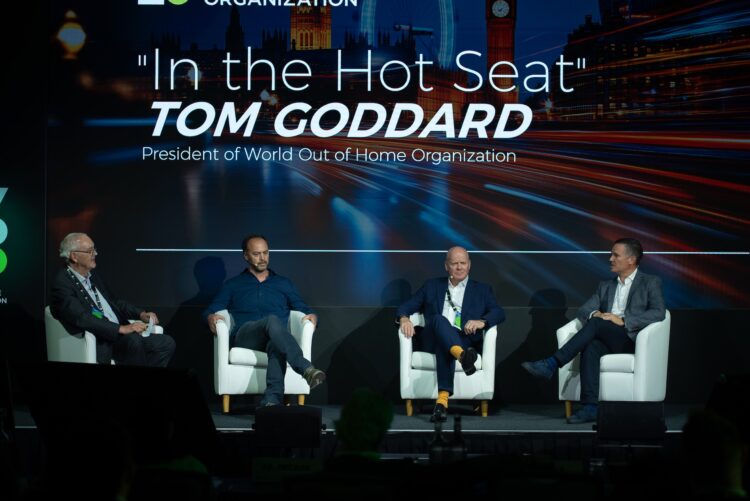
In the hot seat
This idea of collaboration was put to the test in a fireside chat with three of the UK’s biggest OOH leaders: Justin Cochrane, president and CEO of outdoor at Bauer Media, Mike Gordon, chief commercial officer at Global, and Dallas Wiles, co-CEO of JCDecaux UK.
The trio took to the stage against the backdrop of a video highlighting some of the three companies’ major OOH work in the UK, to the sound of Without You, by The Cure.
Tom Goddard, WOO president, moderated the session, titled ‘In the hot seat’, and gave a candid start: “Do you like each other?”
While attendees might have been expecting some hostility, Wiles responded by leaning into this theme of collaboration: “Why wouldn’t we? We’re not competitors.”
Instead, he argued, the real competitors are digital platforms, and ultimately: “We all go to play to the same drumbeat to make sure that we can grow our sector.”
Goddard turned his attention to the question of effectiveness, where Wiles outlined that “significant investment” has gone into this over the next five to 10 years and referenced the development of Playout data (Playout is designed and maintained by Adwanted, The Media Leader’s parent company) being integrated with Route, better enabling econometricians to see “the value of our channel”.
Cochrane, also chair of Outsmart, answered a question on unjustified regulation, as much of the industry body’s work goes towards tackling concerns such as rising business rates.
He echoed what Jean-François Decaux said in his keynote speech: that OOH is an easy target because it is so visible, and that “we don’t engage more publicly about what OOH gives back and I think we could push that a bit harder, a bit further.”
On the topic of programmatic, Wiles argued the adoption has been too slow: “I still believe if you can buy a campaign on social and search at 11 o’clock at night on a kitchen table, and you can’t do the same in OOH, they will go elsewhere.”
He noted that simplicity is key to make the process faster and easier to buy.
Goddard went on to identify the trend of OOH being acquired by other legacy media, and asked Gordon about the advantages of Global’s combined offering of outdoor and audio.
“Clients don’t buy channels, they buy audiences,” said Gordon.
Another advantage he shared was the unique first-party data that Global can feed into its sell-side platform, DAX, and Global:IQ, its data and effectiveness platform.
To conclude, Goddard took questions from the audience, with one attendee asking whether classic OOH remains relevant in an increasingly digital and programmatic world.
Referencing Global’s recent signing of another 10-year contract with Transport for London, Gordon argued that classic OOH isn’t going anywhere and remains something clients are still seeking.
Adwanted UK is the trusted delivery partner for three essential services which deliver accountability, standardisation, and audience data for the out-of-home industry.
Playout is Outsmart’s new system to centralise and standardise playout reporting data across all outdoor media owners in the UK.
SPACE is the industry’s comprehensive inventory database delivered through a collaboration between IPAO and Outsmart.
The RouteAPI is a SaaS solution which delivers the ooh industry’s audience data quickly and simply into clients’ systems.
Contact us for more information on SPACE, J-ET, Audiotrack or our data engines.