



‘This is not good enough’: The business case for online safety
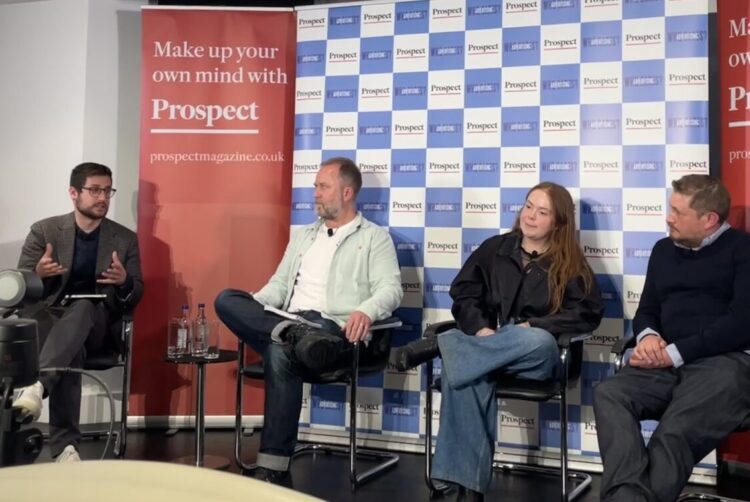
Advertisers have both a moral obligation and a commercial incentive to tackle online safety, according to a panel of editors, activists, and regulators speaking at an Advertising: Who Cares? event last Thursday.
The panel, titled ‘Who Cares About Safety’, was moderated by The Media Leader‘s Jack Benjamin, and featured Jake Dubbins, co-founder of the Counscious Advertising Network, Lexie Kirkconnel-Kawana, CEO of Impress, Andy Burrows, CEO of the Molly Rose Foundation, and Cosima Wiltshire, a policy researcher and rising public affairs leader.
The business case was raised by Kirkconnel-Kawana, who argued that the dominance of Google, Meta, and Amazon – which collectively accounted for two-thirds of UK adspend in 2025 – is a “massive monopoly problem”.
“Advertisers should collectively be getting together, going: ‘Hang on, this is not good enough that I only have one or two suppliers in the market that I can go to’,” she said.
She also suggested that advertisers should use competition frameworks to challenge the market power of these major platforms and “get better results for yourselves”, rather than treating these companies’ dominance as “inevitabilities”.
Regulations have historically worked well, she argued, suggesting it is possible to inflict this change; it just takes “political will and courage”.
When looking to the future, Kirkconnel-Kawana said a “plurality of providers” would empower advertisers to have more autonomy over their experiences with these platforms, but that would require “radical change in the market”.
Meanwhile, Burrows suggested there would be a risk premium for advertisers not taking online safety issues seriously because it’s “very clear” that parental and public views on online safety have “snapped,” and that this needs to translate into meaningful change.
Dubbins argued that advertisers should be concerned about the lack of clarity regarding where their ads are appearing on these platforms. To give an example, he read out several racist tweets he had seen that week, and next to the last one was a Google ad for the World Cup.
He asked the room: “Are these effective places to advertise? Is that brand safe? What would Google’s staff globally think of where those ads are popping up in that?”
As a result, Dubbins wants there to be a mandatory transparency of the supply chain because advertisers have “next to zero control of where their ads are popping up on these platforms.”
Regulation
Questions over whether UK online safety regulation is fit for purpose dominated the discussion, with panelists arguing that policymakers have failed to keep pace with the realities of modern media consumption.
Speaking on an earlier panel, ‘Who Cares About Content’, former UK Government minister Damian Collins OBE highlighted the mismatch between regulatory standards applied to public broadcasters and digital platforms such as YouTube, which he noted has become the UK’s biggest distributor of television.
“What does it mean to be a public broadcaster with a broadcasting license with various codes you have to abide by, if you’re reaching your customer through the same medium, where people don’t really have to do very many of those things?” he asked.
Later he added: “We’ve got a legacy of lots of different codes written for different media at different times and we’ve got to recognise that for the consumer at home, this is one box on the wall where everything is coming in.”
The debate continued on the online safety panel, where both Burrows and Kirkconnel-Kawana criticised the Online Safety Act, arguing that it is not fit for purpose.
Burrows said the legislation was not “commensurate to the size of some of the largest, most cash-rich companies in the world” and argued that it lacks incentives needed to drive meaningful cultural and business model change among platforms.
Burrows described the UK as being at an inflexion point on online safety, and the panel was united in its opposition to proposals for a social ban for under-16s.
Kirkconnel-Kawana argued that adults are also experiencing the harmful content on social media and Dubbins echoed this sentiment because “it’s not just children that can be in super vulnerable places”.
Drawing on conversations with young people at an open house event in April, Wiltshire identified that older teenagers often feel less in control of their relationship with social platforms than younger children, with many 14 to 17-year-olds described as feeling “out of control”, suggesting that age doesn’t necessarily correlate with someone’s ability to cope.
Dubbins went on to question whether age-based restrictions could ultimately benefit platforms by allowing them to avoid more fundamental reforms.
“Is it a win for the platforms to be forced to comply with a ban for a specific age group as opposed to having to redesign their platforms to be less addictive?” he asked.
Benjamin opened the floor for questions to seek an alternative perspective on the social media ban for under-16s. One audience member noted that 80% of parents agree with the ban, but Burrows argued this signalled more that parents are “crying out for this to be fixed” than a complete ban.
Safety by design
The panel were united in arguing for social media platforms to be safer by design, rather than banning young people from social media.
The panellists pointed to evidence from Australia’s under-16 social media ban, which came into force in December 2025, suggesting that many young people continue to access platforms despite the restrictions and raising questions about whether age-based bans can effectively address online harms.
Burrows argued that, instead of fixing the problem by insisting on safety-by-design, the social media ban is “putting barriers in the way of children disclosing harm”.
Kirkconnell-Kawana agreed, arguing that the ban treats social platforms like the tobacco or alcohol industry, but that they’re a “completely different product”, adding that the platforms are shaping people’s behaviour and how their brains function.
If safety by design is the solution, Benjamin asked the panel what safety design features they would like to see in the future.
Burrows proposed a conditional ban on personalised algorithms. That would include not serving harmful content at all, ensuring users are exposed to a diversity of content, and featuring high-quality content from trusted broadcasters.
Wiltshire called for an end to infinite scrolling and criticised the design choice of blocking the clock from view, making it harder for users to monitor how long they have spent online.
She also argued that social platforms should face the same expectations as other consumer products and services, requiring them to demonstrate safety before being released to the public.