



WPP Media upgrades growth forecast despite macro headwinds

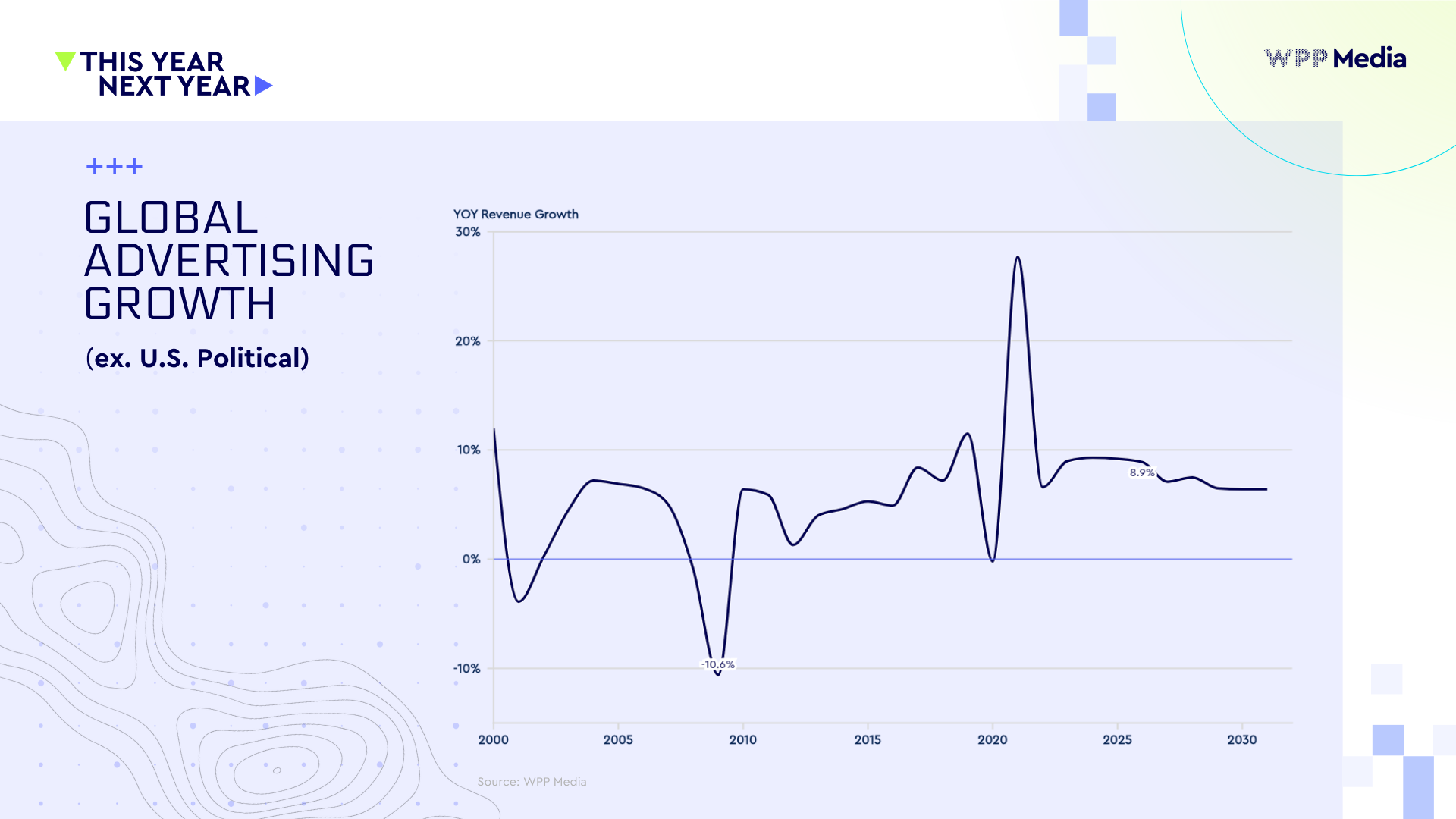
WPP Media has upgraded its global growth forecast +8.9% to $1.3tn in 2026, up from +7.1% growth previously forecast in December.
This is despite significant macroeconomic headwinds caused by active wars in the Gulf and Ukraine, with the former set to drive substantial spikes in energy inflation and potential shortages in key markets amid the closure of the Strait of Hormuz.
WPP Media’s global president of business intelligence Kate Scott-Dawkins described the state of the global ad market as “quite buoyant”, with the US market driving growth in particular.
WPP Media upgraded its US growth forecast 4.5 percentage points to +11.9% this year, excluding political ads. Including political ad expenditure during this year’s midterm elections, WPP media expects 13.9% ad expenditure growth in the world’s biggest ad market.
In contrast, the This Year Next Year 2026 Global Midyear Forecast, described Europe as facing “the most acute direct impact from the Iran conflict among large developed regions”, primarily due to its energy dependency, though the UK is “somewhat insulated” from this. WPP Media is therefore predicting more modest 6.9% adspend growth in the region this year.
Strait of Hormuz disruption threatens $94bn of global ad investment over next 18 months
Drivers of growth: AI, China, consolidation
Scott-Dawkins suggested there were three core engines driving global ad market growth: China’s trade surplus, which doubled from 2021 to 2025; high media concentration; and substantial AI investment driving greater efficiencies and new advertisers.
China’s export engine is notable, Scott-Dawkins said, because it is “driving a lot of advertising revenue” in ex-China markets, particularly for electric vehicle companies and other high-tech exports like LCD modules and integrated circuits.
Meanwhile, media concentration continues unabated, with China beginning to enter a dominant bipolar position alongside the US.
The top five ad sellers globally (Google, Meta, ByteDance, Amazon and Alibaba) now comprise 58% of the global ad market.
Of the top 10 sellers, for the first time there is “not a single traditional media company”, with six of the top 10 now Chinese. (The top 10 is rounded out by Temu, Microsoft, Tencent, JD and Kuaishou.)
“This is the first time we’ve seen this changing of the guard, and that bifurcating system of tech stacks and campaign orchestration is going to be increasingly important in this world,” Scott-Dawkins said.
AI search on trajectory to capture two-fifths of search market by 2031
The mid-year forecast is the first of its kind by WPP Media to offer an estimate of the AI search market that is distinct from the total search market.
The new channel encompasses ads served within Google’s AI Overviews and AI Mode, as well as paid placements within other large-lanugage model products like OpenAI’s ChatGPT, which has begun testing ads in the US, UK and other territories.
Traditional search and generative search are together expected to account for 21.8% of the global advertising market this year (equivalent to more than $270bn).
Within this, generative search is expected to represent just 1.9% of the category’s ad revenue this year and 0.4% of the total global ad market ($5.1bn).
However, WPP Media expects AI search to expand to $32bn in 2031 to capture 39.2% of the total search market, as Google and other competitors rapidly ramp up advertising opportunities across AI search and user behaviour continues to shift.
The media buying arm also expects generative search to become the fastest media channel to reach $100bn.
Downside risks abound as consumers tighten belts
While strong growth in the ad market might seem “rosy”, Scott-Dawkins noted that “if you’re sitting at home looking at increased gas bills or you’re a CPG [consumer packaged goods] brand looking at increased plastic costs, it doesn’t feel very rosy”.
In the US, labour share (calculated as the percentage of productivity that accrues to works as compensation) is now at its lowest level since 1947, suggesting mass wealth inequality as the fruits of labour are not transferred to most workers.
This comes as AI development risks placing more white collar roles, particularly entry-level roles, at risk.
Believe It or Not Ep. 1: Will AI replace most white collar jobs?
Scott-Dawkins thus acknowledged that there is a “disconnect between overall upside and certain markets that are feeling more of a strain”.
WPP Media’s base growth case notably “assumes no global recession and a resolution to the Iran conflict”. On Sunday, the Trump administration reached a ceasefire deal as part of a “framework” for an end to the US-Israel war with Iran, but peace has thus far remained elusive despite recurrent pronouncements by US President Donald Trump that the war is over and the Strait of Hormuz reopened.
Still, WPP Media’s downside forecast expects 7.8% growth this year before a slowdown in growth in 2027.