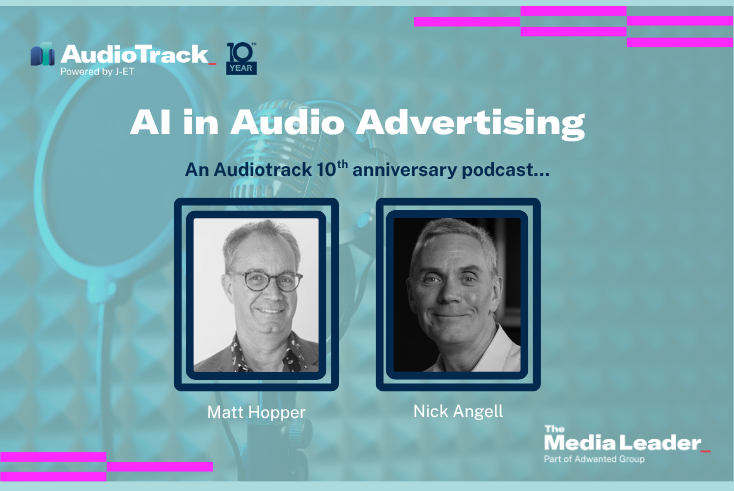
Artificial intelligence can generate a finished audio ad, complete with voice, music and sound effects, in under a minute. The question, according to two of the UK’s leading audio producers, is not whether it can do that but whether the result is any good.
LISTEN HERE
Speaking on The Media Leader podcast, Nick Angell, a freelance audio production director and former head of Angell Sound Studios, and Matt Hopper, founder and CEO of creative audio agency Trisonic, argue that AI’s most valuable contribution to audio advertising lies in augmentation rather than origination.
“AI is drawing information from all the audio campaigns ever created and then making its judgment based on that,” says Hopper. “Therefore, intrinsically, AI cannot be creative. It cannot give that human spark of inspiration.”
Both acknowledge the technology has transformed parts of the production workflow. Audio cleanup tools can now strip location noise from remotely recorded audio that would previously have been unusable, while dynamic creative tools can generate thousands of ad variations in hours rather than days. Hopper compares AI’s optimal role to Microsoft’s term “co-pilot”: useful at scale, but not a substitute for human direction.
Angell points to a client whose AI-generated audio he describes as “clunky” and “not engaging enough,” adding that using low-quality AI creative amounted to “conning the public.” Hopper’s response is a food-industry analogy: a chef-made burger and a fast-food equivalent are both meals, but only one is remembered.
The conversation also touches on the EU AI Act, which, from August, will require certain AI-generated content to be labelled.
Hopper is sceptical that mandatory audio disclaimers are the right approach for the UK, noting that the industry has spent years reducing the length of financial disclaimers to improve ad effectiveness. Invisible watermarking and responsible-use principles, he suggests, are more proportionate alternatives.
Synthetic voices raise concerns among both guests. Hopper says voice artists are having their voices cloned without permission, and that text-to-speech tools require the same directorial skill as a studio session to produce convincing results. “You have to perform that script in the way that you want it performed and then the voice will replicate it,” he says.
Angell’s conclusion is direct: “It’s a craft, and I definitely feel a responsibility to uphold this craft.”
The episode is part of a series produced in partnership with Audiotrack, the UK’s commercial audio delivery service and sister company of The Media Leader, which marks its tenth anniversary this year.