



Atria six months on: New formats, attention measurement, a ‘broad mix’ of clients and potential for expansion
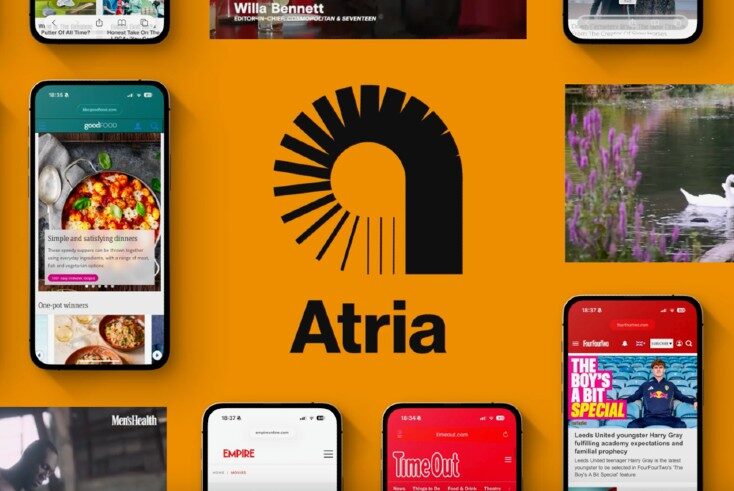
In January, six magazine publishers – Bauer, Future, Hearst UK, Hello!, Immediate and Time Out – launched Atria, a unified programmatic marketplace for advertisers to engage with the combined reach of those publishers’ brands, equivalent to about 33m UK consumers.
“It took a long time to get going, longer than it should have to get everyone aligned, but it’s been really successful,” Cath Waller, Immediate Media’s MD of advertising and board chair of PPA Magnetic tells The Media Leader six months after launch.
The initiative has already seen buy-in from a “broad mix” of clients, including brands across travel, cruises, gardening, fashion and energy, Waller says. Deals have thus far included “decent-sized” six-figure display campaigns.
Declining to share further details until early test campaigns are turned into formal case studies, she adds that early results have been “positive” in both engagement metrics and return on investment (ROI).
Atria is powered by publisher-owned first-party data and is hosted by the audience platform Permutive. The initial product was intended to be “very simple”, a way to go-to-market and test demand from advertisers.
“When we were launching, it was about making it easy to buy, and people are embracing that,” Waller continues.
After returning from Cannes Lions last month, the publisher collective launched “phase two” of Atria by appointing Adnami as its exclusive creative partner. Through the partnership, the adtech company, which specialises in attention-driven programmatic campaigns, has integrated its creative formats and attention measurement capabilities into the marketplace.
Matt Wilke, head of commercial partnerships at media agency Mediaplus, part of House of Communication UK, commented that Atria offers “exactly the kind of quality, brand-safe environment advertisers increasingly want to access at scale”, and called the Adnami tie-up a “positive step” by helping agencies “connect premium environments with more engaging creative formats and clearer evidence of attention.”
Said Wilke, “For advertisers looking to invest in quality, that combination is a valuable one.”
Fitting into everyone’s sales stack
Atria’s six founding members are employing different tactics to sell Atria as part of their wider brief. For Immediate’s part, the publisher has a “champion” for Atria within its sales team, and its entire agency team is selling it where appropriate.
In total, there are roughly 40 salespeople from the six magazine publishers currently out in market pitching Atria to clients.
“That’s why it’s really powerful,” says Waller. “Being able to sell it yourself, instead of setting up a separate business, means you’ve got more and more people hearing about it every day.”
It’s a distinct business strategy from the one news publishers set up by creating a distinct business in Ozone, a similar product that originally combined ad inventory from UK news brands News UK, Guardian Media Group, Telegraph Media Group and Reach. Since its founding in 2018, Ozone has expanded into international markets and added dozens more publishers to its ad platform.
Waller says Atria’s co-owned setup was not a “conscious strategic decision” but that it has been a “big benefit” to have the power of the publishers’ collective sales teams driving growth in the product.
“It kind of fits really neatly into everyone’s stack,” she says. Atria is a focused sell aimed at targeting premium programmatic buyers. “It’s not replacing the direct sell,” Waller adds. “For premium programmatic, scaled, targeted audiences, this is where it really comes into its own. And then we have our own strategies for other programmatic, too.”
Since advertisers purchase audience segments via Atria rather than individual publishers’ inventory, revenue from a given campaign is shared based on where different proportions of the audience are found.
“Whichever site it runs on, that publisher takes the revenue,” Waller explains.
A fashion campaign bought by Marks & Spencer, for example, might rely more upon Hearst, Bauer, or Condé Nast’s inventory than Immediate’s, due to the latter’s lack of fashion titles, whereas Immediate brands would likely benefit from campaigns from food or entertainment brands due to its ownership of the likes of Good Food and Radio Times.
This creates interesting incentives for different publishers to go after clientele they are more likely to benefit from personally. Waller sees this as a positive, “as long as everyone is pulling their weight.”
“In theory, we all know our core clients best,” she says. “So we would argue [Immediate] is really strong in food, in entertainment. If we all focus on where we have the strong relationships, actually everyone benefits from that.”
Waller believes that the relative lack of overlap between the specialist publishers’ brands also incentivises this behaviour.
“It’s a really grown-up scenario,” she continues. “I think we all understand the pressures the industry is under. And maybe because we did it a bit later, we’ve used a sensible approach which says we have to come together in this way to offer a solution, and everyone has to step up and get involved.”
As much as the buy side says it cares about trust, Waller adds, money has continued to flow away from premium publishers and toward global platforms rife with user-generated and AI-generated content.
“As we always say, our problem is not in this room. The challenge is out there,” she says, referring to the tech giants. “We have to provide at least an easy option [for the buy side].”
Sticking to principles
Waller believes Atria could become a “significant part” of each publisher’s programmatic business over the next few years.
That reality could attract more publishers to the collective, much like Ozone has for news brands and other premium websites.
Atria is in active talks with two additional “reasonably-sized publishers” that could join “in the short-term”, Waller says, declining to share further details.
Waller is wary of expanding Atria too far out, though, at least with regard to non-PPA members. She wants to ensure that Atria remains open only to magazine publishers with a high level of editorial quality, not those that run user-generated content.
“We have to stay true to what Atria means, which is inventory that follows the same principles: editorial, verified, accountable,” she says.
Another principle, so far, has been to offer advertisers a way to make a joyful connection with communities of passionate readers. Atria has therefore avoided adding current affairs magazines and can boast of being entirely brand safe.
“Where we’re seeing success is the fact that we don’t do bad news,” Waller says. “There isn’t a brand safety issue.”
For Waller, it’s important to protect what makes specialist magazine publishers “special and unique” in the wider media ecosystem.
“That’s what people want,” she says. “They want something they can’t find elsewhere.”