



Was Cannes Lions 2026 a tipping point? Trusted and quality are back on the agenda

Publishing week in focus: Opinion
In a bid to gauge the temperature around news investment at Cannes, World Media Group’s CEO swerved publisher sessions and went in search of other places where the value of news was being discussed.
The dust has settled from Cannes Lions, and as we all recover from sunburn, rosé and dehydration on an unprecedented scale, the key themes that have emerged seem pretty consistent. 2026 was the year of AI, of Creators, of Sports, and of finance bros talking M&A.
But, whisper it, there was another theme quietly coming up again and again in discussions with marketing leaders, agency executives, and those building the technologies that will power the future of the marketing landscape. The value of news reporting, and of high-quality, human-produced media in general, came up again and again.
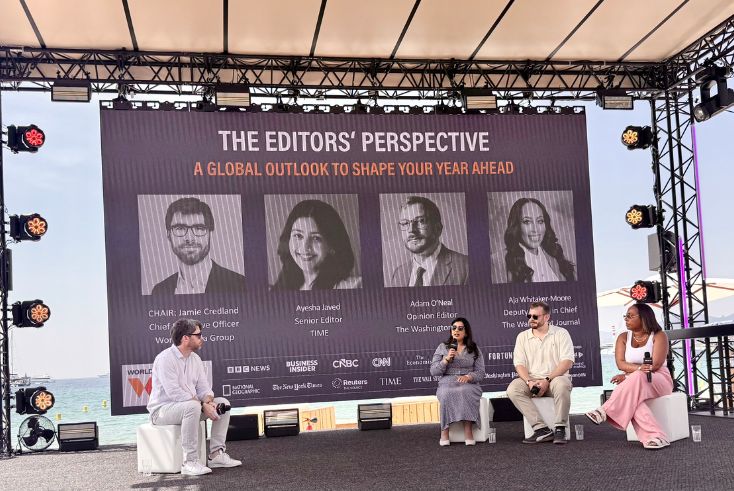
I’m not talking about the predictable places where you would expect people to be making the case for quality news journalism – our own WMG sessions had plenty of that.
The Press Gazette led the UK’s push for quality news by creating the first ever ‘Press Yacht’, and AdWeek had Kara Swisher, once again bringing together some of the biggest US advertisers and publishers to bang the drum for investment in news.
Plus, of course, there were plenty of news organisations running their own operations on the beach, whether that was Journal House, the Axios Yacht, or apartment activations from Washington Post, Fortune, CNN, Business Insider, BBC Studios, Time and others.
All of these initiatives are important, and gaining momentum every year. But they always run the risk of preaching to the converted. At Cannes, everyone is selling something: it is no surprise that news publishers think marketers should invest more in news.
So, in an effort to gauge the true temperature around news investment at Cannes (on the hottest days in French history, it turns out), I swerved some of these publisher sessions and went in search of other places where the value of news was being discussed.
Creators and risk
Creators were everywhere this year. One statistic estimated there were at least 500 of them on the beach, but with the challenges of defining what counts as a ‘creator’, I think it’s fair to say that was likely an understatement.
A significant shift here was that in the past, influencers went to Cannes to raise their profile, and perhaps generate some content. This year it was unapologetically a commercial mission, to secure sponsorships and client partnerships.
Creators are no longer individual operators, but fully fledged media operations and production companies. As such, the sophistication of the client conversation has increased significantly.
But the risk of working with creators remains real. Unlike established media companies, any organisation that is so reliant on an individual personality has an inherent risk.
We have already seen this play out in the UK with the likes of Russell Brand, Steven Bartlett, and Ruby Franke, and it’s a pretty safe bet there will be more of these controversies to come. Indeed, Semafor’s live podcast recording with ‘Call Her Daddy’ host and founder Alex Cooper noticeably avoided discussing the recent expose into her business practices published in Vanity Fair.
At a roundtable of communication directors hosted by Axios, I heard repeatedly that global marketers were concerned about this – particularly in spaces such as finance and health, where regulatory compliance is no joke.
Brands are taking a diversified approach to their influence as a result: “It cannot be anchored to a single individual.”, as Yasmin Hosseinzadeh, PayPal’s head of corporate affairs strategy, explained.
In that context, content partners with more established mastheads that are crucially independent of any individual contributor provide a safe haven.
The critical infrastructure for AEO/GEO
Unsurprisingly, the conversation around optimising content specifically for AI ingestion was everywhere.
Talk of having dual marketing strategies (for humans and for bots), speculation on the effectiveness or otherwise of OpenAI’s advertising offering, and practical talk on how to structure your content so that it actually gets surfaced by the bots came up repeatedly.
We are watching the whole industry learn a new skill, much as it had to learn SEO in the 90s. And while it’s a developing field, it is already clear that the credibility of trusted news publishers means they are comfortably the most-cited sources in AI tools.
Finding ways to leverage that trust will be key to marketers’ success. At the same time, most LLMs have already ingested everything published online (even if the legality of this is still very much up for debate).
In a very practical sense, the fact that news publishers are constantly creating new information, live data, reporting, and updates makes them inherently more valuable to both LLMs and marketers trying to position their brands within that environment.
We have already seen The Economist and TIME discuss their strategies for optimising content for AI bots, and the Wall Street Journal is likewise developing its position here in terms of the value it offers advertisers.
TIME COO Mark Howard spoke about this on the Press Yacht at Cannes:
People come to the website time.com as you can know it, and we all experience it. Bots go to a markdown page, where it’s a stripped-down version, the content metadata.”
Expect to see quality publishers much more in the driving seat here than some feared even six months ago.
The real cost of AI still isn’t clear
Several big global advertisers told me stories of rolling out AI across internal teams, only to be hit with a surprisingly large bill for tokens after a few short weeks.
In some cases, it would have been cheaper to hire junior-level staff to do the work than the agents the team had built. This was certainly the case at a leadership dinner hosted by Culture3, where at least two attendees I spoke to had this experience.
Will this continue to be the case, or will agentic work get cheaper over time? Will marketing teams become more efficient at utilising these tools and sticking within budget? And will marketers get better at deciding which tasks are truly more cost-efficient to have an agent handle, compared to those that continue to be best performed by a human?
Almost certainly, the answer is yes to all of the above. But in the meantime, using a content production studio from a world-leading publisher remains reassuringly measurable. Costs are easy to track, agreed up front, and are known to deliver results. For many marketers, selling-in a premium content partnership internally seems easier than explaining their Claude token bill to the CFO.
Platforms as a necessary evil, not a partner
As is now tradition, the presence of media owners, agency holding groups, and creative agencies (remember those?) in Cannes was dwarfed by the platforms. Meta, Google, YouTube, Amazon, TikTok and Snapchat were all there in a big way. As were Reddit, Pinterest and others.
Clearly, they are operating at a scale that dwarfs that of anyone else in the market, often funded by SME advertisers, who are under-represented on the Croisette.
Among larger, global advertisers though, discomfort with these platforms is growing.
There is widespread scepticism about their measurement tools, with several research companies trying to enter the space of measuring actual impact rather than the ‘views’ numbers these platforms give you.
There is a lack of confidence in how these platforms will adapt to the new consumer journey, with AI at its heart. And, critically, when it comes to sharing a glass of wine in Cannes, there is a lack of a feeling of partnership.
I heard from clients who preferred to work with media owners who answered the phone, responded to email, and could potentially meet in-person, rather than having to deal with faceless platform interfaces for help and advice. And I heard about high-level meetings with platforms going on during Cannes because ‘it’s the only time of the year I can actually get hold of anyone senior… the rest of the time they don’t engage with advertising’.
These concerns are all commercially-led, but against a backdrop of widespread concern about the damage these platforms are doing to society, children and democracy, it doesn’t help the investment case.
Sessions from the UN, the Molly Rose Foundation and others highlighted the ills of social media use and need for better regulation and advertising standards. This is a tough case to make at a conference that is unashamedly commercial (note the absolute lack of conversations around sustainability, diversity or ‘purpose’, which dominated just a few short years ago).
That said, I didn’t meet a single parent at Cannes Lions who was not concerned about their own child’s use of social media.
A future based on trusted partnerships
All of these trends were gradually, quietly, pointing the way to a different way of doing business. Trusted partners, measurable outcomes with named suppliers, content that is so powerful the LLMs cannot help but prioritise it, and journalists as individual creators, with a recognisable presence, but within an established media organisation’s editorial and legal framework.
The advertising industry is constantly moving forward, and we are never going back to some ‘golden age’ of advertising.
The opportunity is for marketers, and the industry, to seize this moment and set up new ways of working that prioritise the trusted channels we know deliver marketing outcomes.
WMG is championing this approach for our membership. In the UK, the News Alliance is raising awareness of these issues and building a growing coalition of voices. In the US, The Media Trust and others are championing the value that trusted journalism delivers advertisers.
Expect to see a lot more emphasis in the year ahead on the value of trusted connections with real human beings.
Of course, we might still need to blag our way into the Netflix party in order to sell this….
 Jamie Credland is World Media Group’s CEO