



Media owners, why are you giving away your best product for next to nothing?
Opinion
Why did no one think to replicate pre-clearance for online ad inventory, whether on the open web or on platforms? The result is a whole industry now tainted with trust issues, writes Omar Oakes.
The worst thing about heat waves? Sleeping.
Not just because you risk drowning in your own sweat overnight, but because it’s a genuine feat to drift off amid the incessant din of motorbikes, crying babies and drunk teens who loudly parade past our south-west London home every evening. Yes, I should move to a countryside bunker to avoid this din, but, like air conditioning, I just can’t afford it. I also need to be close to Chinese food at all times.
As for aircon, if only there was some cheaper, ‘just as good’ alternative. Surely too good to be true?
A £70 fan wrapped in cardboard
You may have seen this BBC News story from 10 July: “‘Cool in 90 seconds’ – the fake portable air conditioners sweeping the internet.” Classic watchdog journalism: the Beeb exposes fake “NASA-engineered” portable air conditioners, called AiraBreeze, as nothing more than £70 fans wrapped in cardboard.
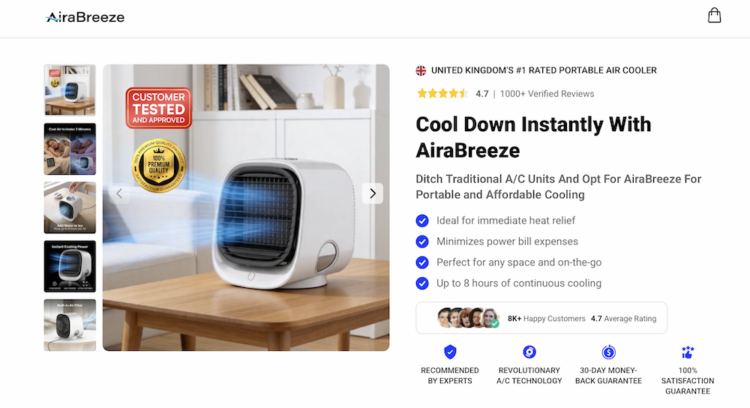
“The adverts have emerged on platforms including Facebook and YouTube, but the Advertising Standards Authority has now warned the products are often ‘too good to be true’.”
Disgusting. Taking advantage of people like that. Imagine profiteering from a scam like that?
Imagine my surprise, then, when Google’s YouTube served me the same AiraBreeze ads two days later. Same product. Same claims. Same “cool a room in 90 seconds” nonsense the BBC had just debunked, ASA quotes and all.
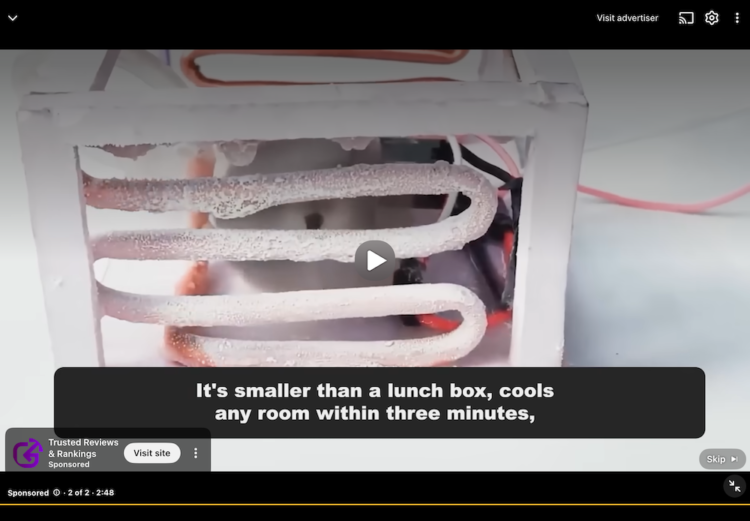
Being named by a national broadcaster changed nothing. The advertiser didn’t pull the campaign, and the platform didn’t stop serving it.
It gets better, so much worse
What was even stranger – because the BBC report failed to mention this – is that the ASA had already ruled against this exact brand, on YouTube, for running the exact same claims, back in November.
“The ad must not appear again in the form complained about,” the ASA’s ruling states: “We told UAB Rara Digital t/a Airabreeze not to mislead by exaggerating their product’s cooling abilities and cost effectiveness, and not to state or imply that their mini cooler product provided a viable and economical alternative to air conditioning.”
But it did. And it still does.
Not that this surprises anyone who spends time on these platforms. Unregulated user-generated content has produced its own house style of commercial bias, from the self-dealing infomercial format perfected by MrBeast, to the way influencers casually name-drop brands mid-podcast without ever actually declaring it’s an ad.
Which raises an awkward question for the “trust is self-correcting” theory our industry has told itself for decades: what happens when neither party has anything to lose?
The platform doesn’t care who bought the inventory. The advertiser (probably a dropshipping shell that will be gone by September) has no brand to protect and nothing that naming-and-shaming can touch.
Self-regulation assumes reputational damage is a cost someone eventually pays. On platforms selling to the anonymous and the disposable, nobody’s holding the bill.
The moat nobody’s pricing
That is precisely why the rest of the industry should be shouting that it built the opposite system a century ago, but has never really worked out what it’s worth.
The ASA regulates a £47bn UK advertising market on a budget of around £10m. Importantly, the ASA is not taxpayer-funded and is funded entirely through a voluntary 0.1% levy on display ad spend. The UK advertising industry spends roughly £4m a year on the ASA’s campaign to promote public awareness of that regulation – again funded entirely by donated, unsold inventory.
That is an extraordinary institutional moat: an entire industry submitting itself, voluntarily, to independent scrutiny, at a cost no platform could replicate even if it wanted to.
Because, if common sense isn’t enough, the data shows that trust produces results: a recent IPA analysis shows that for-profit ad campaigns that report very large increases in trust are 41% more likely to report at least one very large business effect, such as significant sales growth, profit, or market share.
Effectiveness guru Peter Field showed the explicit link between brand effectiveness and trust two years ago.
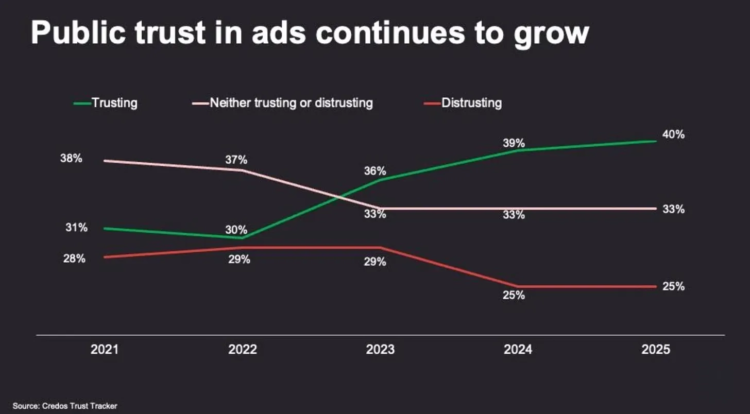
Trust has been on the industry agenda since then-AA President Keith Weed’s important speech in 2019 warning that we needed to address a long-term decline in trust in ads. Since then, the body’s think tank, Credos, has polled UK trust, and the results, frankly, aren’t great. One in four distrust advertising, less than half trust advertising, and a third are ambivalent.
It’s pretty obvious why trust was not such an issue in 2009. For decades, broadcast media owners, for example, have had trust safeguards baked in, with the likes of Clearcast or Radiocentre ensuring 99% of ads are compliant before the public sees them. The likes of AiraBreeze wouldn’t even bother with its grubby scheme.
Somehow, no one thought to replicate pre-clearance for online ad inventory, whether on the open web or on platforms.
And now the whole industry is tainted with trust issues.
Stop treating your best asset like an afterthought
So here’s my question: why is our industry only spending a piddly £4m telling the public about the best asset it has?
And when I say “our industry,” I mean the part of it that actually has a vested interest in vetting content before it’s published – not the part that talks tough about fighting fraud but, despite all its supposed technological brilliance, portrays itself as too inept to stop it (and certainly too greedy to give the money back).
This stuff is commercially valuable: pre-cleared, independently regulated, near-100% compliant environments, backed by hard data showing that advantage delivers measurably better commercial outcomes. Advertisers shouldn’t be browbeaten into spending with trusted media: they should be charged an explicit premium to invest in a product which actually works.
So the next time a media owner donates inventory to the ASA campaign, it should ask itself: if trust is so important, why are we funding this with scraps?
And why is “trusted media” – media owners that actually care about their reputations and their advertisers’ reputations – not an explicit thing to put on a rate card with its own price tag?
 Omar Oakes was the founding editor of The Media Leader and continues to write a column as a freelance journalist and communications consultant for advertising and media companies. He has reported on advertising and media for 10 years.