



Attention measurement is now an input into AI systems

The Media Leader Interview
Karen Nelson-Field discusses Amplified’s new product, AttentionAI, and why better attention data provision will lead to higher-quality creative and media decisioning.
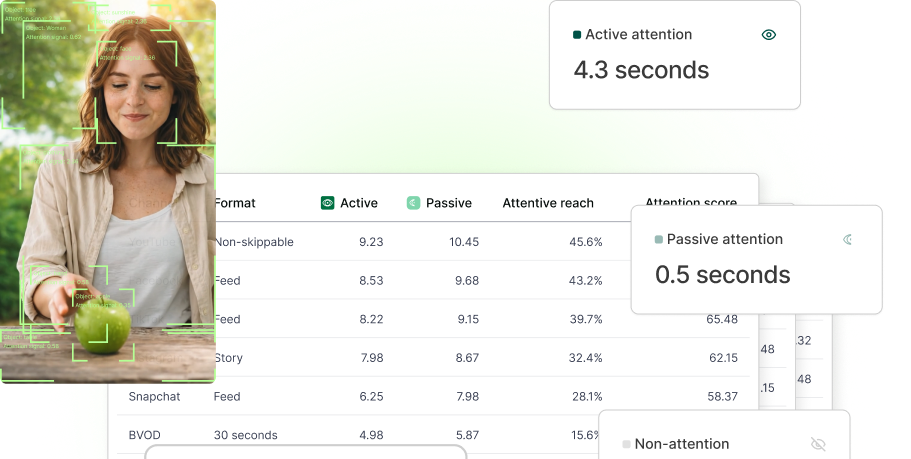
In May, attention measurement company Amplified launched AttentionAI, a product aimed at enabling brands and agencies to integrate attention metrics into their media and creative workflows via an API.
“I feel like this is my legacy left,” Dr Karen Nelson-Field, founder and CEO of Amplified, tells The Media Leader over a call from Toronto the week after launch. “What we’ve built is the world’s first generative model that takes in language from the codification of creative, the attention data we have, and builds an audience around that.”
AttentionAI, according to Nelson-Field, offers a significant shift in how attention data is provided to clients. She believes that after a decade of urging agencies and marketers to reconsider viewability and impression metrics in favour of attention data, the market is ready to integrate a tool such as this.
Use cases for AttentionAI are practically open-ended. Advertisers and agencies can use the tool for planning purposes, helping to advise on which media channels are optimal for a campaign. It can be plugged into mixed-media modelling (MMM) to improve model fit. It can be fed into large-language models (LLMs) and act as a constraint to agentic solutions.
“It could recommend what media [to invest in], straight up,” says Nelson-Field. “It could recommend where in the creative it falls short within that media”, assisting in creative versioning.
As she describes, advertisers can upload an ad and “within seconds” AttentionAI could produce a set of data predicting how your ad performs for attention relative to benchmark within a given media environment, based on the creative.
“Why I love what we’ve done is it essentially feeds into AI systems and sits in the background, rather than it being something people trade, or a unit of measurement that is bought against,” Nelson-Field says, noting she has never seen attention as a potential currency for media buying.
“Where I see the industry moving now is we all understand attention, we all understand it’s important, but it becomes a backseat as an input into AI systems, an input variable that is a constraint.”
Scale at a ‘fraction of the cost’
Amplified developed AttentionAI over the course of a little over a year, beginning as a creative testing model before developing into wider use cases as media agencies and advertisers began adopting enterprise AI tools like Anthropic’s Claude and Google’s Gemini into their workflows.
This presented the “perfect opportunity for us to be data provision at scale,” Nelson-Field explains. “The formation of the product was this underlying beautiful language-model-meets-attention-model.”
AttentionAI is sold as an API integration, with prices starting at $5,000 per month (in local market currency), with options increasing for fully-fledged enterprise usage. Customers can also pay in 10- and 50-ad packages for a dashboard experience as a short-term measure if they are keen to access the data on a short-term basis rather than a monthly commitment.
The product uses synthetic data based on a constantly-updating stream of human data collected by Amplified. Biometric data, such as eye-tracking studies, is expensive, requiring human subjects and safeguarding permissions. Amplified alone has spent “tens of millions of dollars” over the last decade conducting biometric data collection. Now, says Nelson-Field, “I can do it in seconds at a fraction of the cost.”
Nelson-Field is highly confident in the quality of synthetic data because she is “super fussy” about validating it against constantly-updating human datasets. “I’m very proud of it, and sleep well as a result,” she says.
AttentionAI launched with synthetic datasets for a host of media channels and formats. These include digital static imagery, cinema, outdoor, social and streaming, with linear TV set to be added.
Up for the cup: Which social ads won the Instagram attention battle
While declining to provide information on specific platforms, Nelson-Field notes that changes to platforms have reduced the amount of attentive time given by users to certain content, requiring datasets to be updated. Amplified does not use biometric data more than three years old, she tells The Media Leader.
For example, Meta recently acknowledged that 70% of the content viewed by users last year came from accounts they did not follow, compared to just 0% in 2020, as platforms move to favour algorithmic recommendation of content.
“The whole harvesting industry is a thing,” Nelson-Field says. “With harvesting comes frequency, and with frequency comes scrolling. So I’m not very happy with the formats that are going down that route. I get it, but what’s exciting is I think the future is going back to the future.”
‘Upstream’ movement
Nelson-Field believes the development of AI search is already beginning to fundamentally change marketing strategies, pushing advertisers to reconsider brand strategies in favour of short-termist media investment focused on sales conversion.
“There is a push toward upstream coming because it’s a double win for the brand,” she predicts. “You need to have noise in the market for humans to report on [your brand], rate it, discuss it, all of the indicators of AI search.”
Brands needing to improve “audience voice”, better influencing how they show up in online conversations captured by LLMs, need attention and, it follows, brand building through quality media and creative, says Nelson-Field.
“Instead of SEO, which is all behind the device, GEO is all about getting people to be noisy about brands again,” she continues. “At least, thank Christ, there’s some move toward quality advertising that gets people looking at it. That can’t be a bad thing.”
Looking ahead, Nelson-Field also believes tools like AttentionAI and other AI enterprise solutions will allow brands to take greater control back from agencies.
Nelson-Field herself built a tool in Claude “in five minutes” that uses Amplified’s data for the purpose of media planning, and she described her customers are broadly doing the same. “They’re vetting their own media plan,” she describes.
Over the next year, Nelson-Field is keen to develop further into letting brands get “back in control of their own stacks”, including through improving integrations into MMM.
“There are so many brands that are now doing their own Claude-to-Gemini end-to-ends,” she adds. “I wouldn’t say they’re necessarily taking it all back in-house, but they’re certainly validating. I see that from briefs to creative testing to early planning systems.”
The attention illusion: Why media’s obsession with ‘attention metrics’ risks missing the wider point