



Confident self-regulation is our industry’s most valuable asset
Opinion
The AA’s communications director calls for trusted relationships with tech platforms to set standards built directly into ad management tools and assist with enforcement against rogue actors.
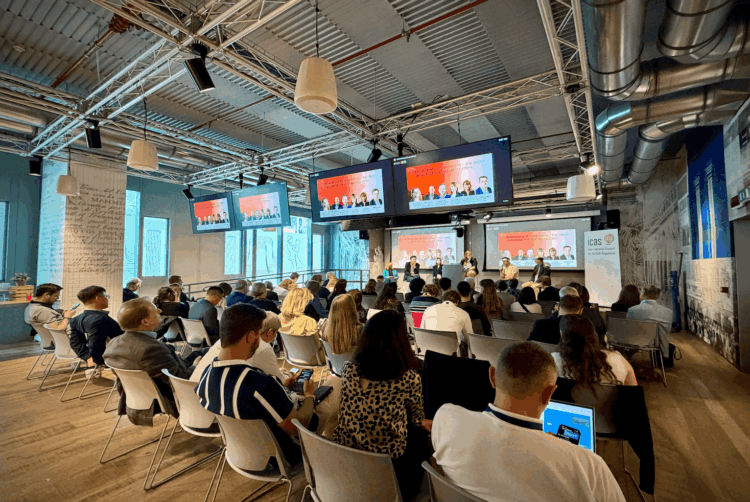
I had the privilege of addressing the Global Thinktank at the 10th Anniversary International Council of Advertising Self-Regulation (ICAS) conference in Milan last week (pictured). My message to the leaders in the self-regulatory system from around the world was simple: our industry’s future depends entirely on public confidence.
When James Best and I were researching our book, Trusted Advertising, we looked at the root of the word ‘trust’. It comes from the Proto-Indo-European dreu, meaning “solid” or “firm”.
But trust isn’t just about telling the truth; to be trustworthy requires competence, benevolence, and integrity. When it comes to advertising, all of this is vital; if the public doesn’t trust the messenger, they simply won’t trust the message.
Right now, trust is box office gold. You only have to look at the global success of the television show The Traitors, adapted in over 30 territories, to see how fascinated we are by the daily dilemma of who we can and cannot trust.
In the real world, however, the picture is not as entertaining. The Edelman Trust Barometer, drawing on more than 25 years of data, highlights a loss of belief in traditional leaders and an ongoing battle for truth. Notably, it finds that business is now the only institution the public views as both competent and ethical. People are looking to businesses to provide answers and stability.
For advertising, this is a profound opportunity, provided we get it right. New analysis from the IPA proves that trust is a hard commercial asset, showing that trust-building advertising campaigns are 41% more effective at driving major gains such as market share and profit.
Trust in advertising is growing, but it’s fragile
Our own Credos research in the UK paints a complex picture of the hurdles we face. While overall trust in advertising has risen to a five-year high, the public now navigates the online world in a state of “low-level vigilance”. People have adapted to a digital environment in which they feel they must constantly decode and question content to discern its true intent.
What’s driving this vigilance? Bombardment remains the number one driver of distrust. But dishonest and suspicious advertising – particularly scams – is the big mover. The sheer volume of ads from an ever-growing long tail of unfamiliar brands and companies, combined with the rapid rise of AI and the creator economy, is making it harder for the public to distinguish genuine brand messages from fraudulent ones.
Influencers represent a massive shift in how we communicate; Unilever recently noted its social media spend will move from 30% to 50% of its total budget. Yet, ASA research shows that 80% of people prefer influencers to clearly state when their content is advertising.
Then there is AI. It brings incredible opportunities for the industry – like O2’s AI-generated Granny, Daisy, which was developed to tackle scam callers – but it also brings the threat of deepfakes that erode our trust in everything we see and hear.
The cost of losing confidence
If we fail to maintain public trust, the consequences are severe. We are already seeing what might be described as the “Great Tightening” of regulation.
In the UK, we are experiencing increased restrictions on LHF products and the introduction of local bans on advertising legal products, with one Council threatening to ban advertising of meat and dairy on its own inventory. This is because some policymakers do not believe existing codes are sufficient to protect the public.
From press barons to the tech multiverse
This brings me back to the ICAS conference. A century ago in the UK, press barons joined with the advertisers and the agencies (now ISBA and the IPA) to form the Advertising Association, with the remit to protect and maintain advertising standards because they knew public confidence protected everyone’s revenue.
Today, we need the modern equivalent: the major tech platforms must work with us globally to set standards built directly into ad management tools and assist with enforcement against rogue actors. We are mutually dependent, sharing the same goals regarding trusted advertising and its effectiveness.
I confessed to the audience in Milan that, as a long-time film fan, I see them as our Guardians of the Advertising Galaxy. With the explosion of new tech, AI, and the creator economy, our advertising universe is rapidly expanding to multiverse levels. Navigating this change requires a joined-up approach.
Making the case for self-regulation worldwide
To protect our industry worldwide, we need confident, robust self-regulation, and I shared a five-point plan for the ICAS Global Thinktank to review.
I described the work that the SROs do around the world on behalf of the industry and the public as ‘a silent insurance policy’ but suggested it may be time to remove the ‘silent’ and be clearer about the value SROs deliver to people and to governments.
One thing’s for sure: tracking and responding to issues where trust in advertising is under increasing scrutiny is paramount to ensuring the industry’s work can continue to be trusted and, as importantly, that the industry is viewed as trustworthy.
The playwright Anton Chekhov wrote, “You must trust and believe in people, or life becomes impossible”. The same is true for our industry. Without trust, the relationship between brands and the public falls apart, and advertising cannot deliver the economic and social benefits we know it is capable of.
The future of trust in advertising is in our hands, and it is time for us to double down on support for SROs.
 Matt Bourn is the director of communications for the Advertising Association and co-author of Trusted Advertising and Sustainable Advertising.