



DCM upfront: Cinema, TV, sport and news carry majority of culturally resonant content, study claims
This industry is in rude health.”
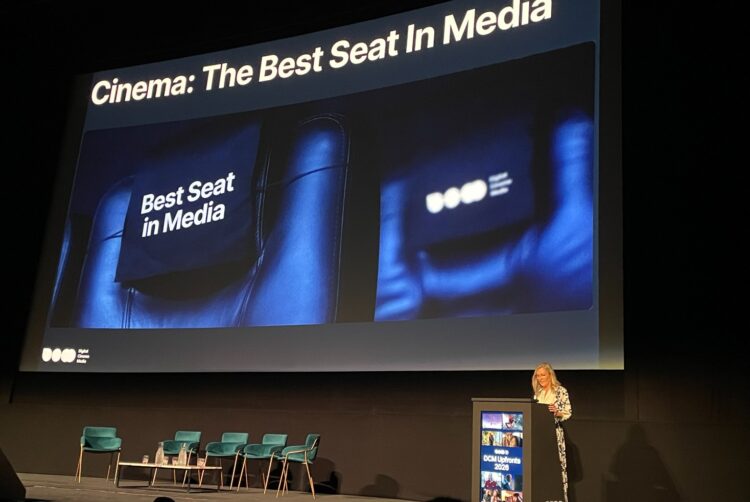
Karen Stacey, CEO of Digital Cinema Media (DCM), the UK’s largest cinema ad sales house, was in a chipper mood during the company’s upfront event at the Odeon Luxe Leicester Square in London this morning. And why wouldn’t she be? In the first half of the year, cinema admissions grew 9% year-on-year, DCM’s own revenue rose 15% year-on-year, and box office jumped 14% year-on-year to £604.9m.
Stacey said DCM, which represents 85% of the UK cinema market, is now working with more advertisers than ever before, including by developing 100 pieces of bespoke copy this year to be seen by the 2.5m weekly cinemagoers around the country.
“Often, continuity and focus is underrated as a superpower,” Stacey said. Decrying how ad bombardment on other media channels has harmed trust in advertising, she further committed, “hand on heart”, that DCM will never increase its ad load.
DCM’s growth, therefore, must come from proving the effectiveness of its product — not increasing supply.
Cultural relevance
That effort was on display at the upfront, as media consultancy MTM, in partnership with DCM, presented research aimed at uncovering which media channels contribute most to “cultural relevance”.
The research conducted a nationally representative survey of 1,500 Brits, asking them to spontaneously recall “cultural moments” from the past 12 months. “Cultural moments” were defined in the survey prompt as “events, trends or pieces of media (for example a film, TV show, an album) that grab lots of people’s attention and spark wider conversation, in-person and online.”
The report, Cultural Relevance, focused primarily on AV media rather than publishing or audio-only podcasts. It found that cultural moments were most commonly associated with traditional media channels and current events. Answers cited TV (23%), sport (21%) and news (20%) most common, followed by events (e.g., Christmas, Glastonbury, Eurovision) at 11% and cinema at 10%. In comparison, social media trends accounted for 5% of cultural moments spontaneously recalled by survey participants.
It should be noted that the research buckets cultural moments by media channel from which those moments are broadcast or otherwise originate; it does not attribute channel ownership to the conversation about those moments that may be occurring on social platforms.
When filtering out moments that were not “commercially available to broadcasters”, including the BBC and news (though news is commercially available to advertisers, albeit not on an event basis), the study concluded that spontaneously recalled cultural moments were dominated by three areas: TV entertainment (34%), cinema (28%), and sport (23%). In comparison, social media trends accounted for 12% of spontaneously recalled moments.
Cinema, TV and sport therefore combined deliver 85% of commercially available cultural moments people remember, as defined by MTM.
MTM CEO Caroline Wren explained that these cultural moments vary in scale, predictability and endurance. They may be mass or niche; spontaneous or planned; and fleeting or long-lasting.
Wren posited that TV, cinema and sport provide culturally memorable moments in part because they are relatively high-anticipation mediums that are associated with “talkability” compared with social trends, which tend to be more fleeting. Video-on-demand (VOD) and cinema, she argued, create “buzzworthy” moments that “define the zeitgeist”, whereas traditional UK broadcasters own the “heart of British culture” and social video platforms create “trendy, personalised and highly-relatable content.”
In the case of cinema, anticipation for films is often built up over weeks, months, and in the case of franchises, years. The same is true of regular major sporting events, such as this year’s World Cup, or new series of popular TV programmes.
The report also evidenced cinema’s unique quality advertising environment. It found cinema scored highest (relative to TV, streaming, social and online video) for advertising that doesn’t interrupt the audience experience, consumers’ openness to ads shown, and memorability of the ads. Survey respondents were also more likely to associate cinema advertisers with “high quality” (67%), “relevant to me” (65%), and “category leading” (61%) labels.
Echoing Stacey’s pledge to not increase ad load, Wren added that cinema advertising in particulary is enjoyed precisely becasue it is not disruptive to the entertainment experience. It is “one of the few places where ads are welcome, actually,” she said.
https://uk.themedialeader.com/the-cultural-moments-that-will-matter-to-media-in-2026
‘Data isn’t being optimised the right way’
Despite cinema’s strong growth this year and evidence that it plays a key role in global culture, the media channel remains undervalued in the ad market.
That is according to Bryony Lawler, senior director of growth at Ebiquity, who warned that current data and measurement standards are discounting the impact cinema makes on media plans.
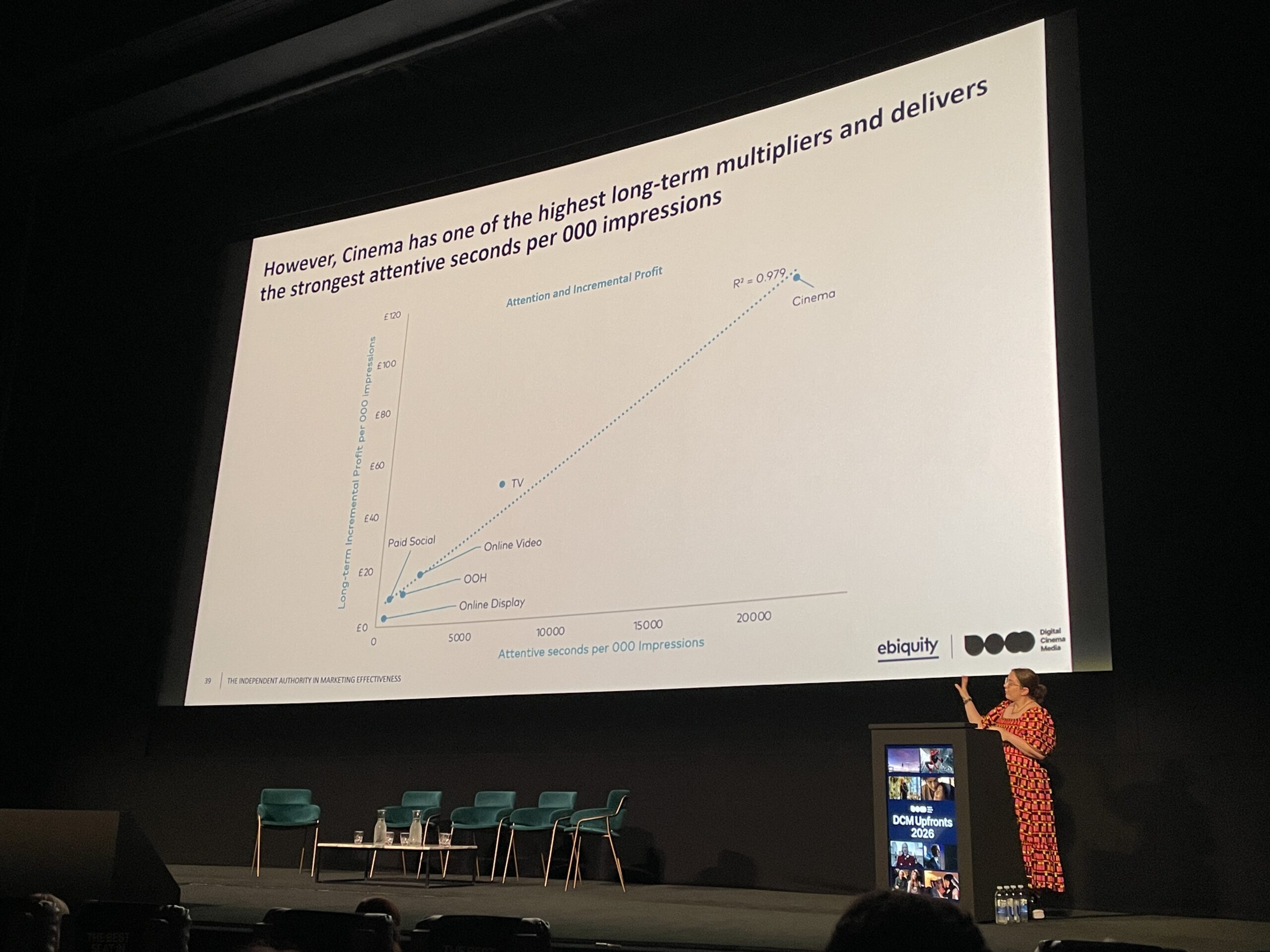
Cinema, she noted, sits at the “lower end” of return-on-investment (ROI) hierarchies. Marketers who emphasise cost efficiency rather than effectiveness may therefore prioritise cheaper or short-term media channels.
The value of cinema also generally fails to show up in econometrics, due in part to a lack of spend data and hard-to-break-down details on how different placements drive returns.
“Data isn’t being optimised in the right way,” she said, noting that DCM is working to better provide data to more econometric partners.
But cinema, Lawler emphasised, provides a high-attention medium and results in significant long-term incremental profit per thousand impressions.
To get the most out of the channel, Fleur Andrew, head of campaigns at Google Pixel UK, advised brands to “try and do a little bit more than the TV ad” by tailoring creative to the cinemagoing experience and considering foyer activations, pop-ups and other bespoke creative formats. She also likened the “turn your phone off” spot to a “platinum spot” beyond DCM’s gold, silver and bronze inventory.
Michael Bensley, DCM’s head of client, further advised that if brands want to benefit from cultural moments in cinema, they must plan in advance and consider moving beyond the tentpole titles to show up consistently in theatres.