



‘Engagement, habit, community’: Publishers advised to seek ‘defensible’ strategies in new search era

News brands and magazines, facing a collapse of referral traffic driven in part by the rise in popularity of AI search, are seeking new ways for their content investment to capture commercial value.
But this effort is challenged by an online ecosystem that divorces the commercial value of such content from its original source.
That is one of the main takeaways from a report by research service Enders Analysis, released weeks ahead of the annual Professional Publishers’ Association’s (PPA) Festival in London, which urges publishers to view habit-forming audience strategies, rather than mere engagement metrics, as the “north star” for growing publishing brands.
“High engagement does not automatically translate into loyalty,” the report reads.
Audiences are indeed fickle. According to Chartbeat data, referral traffic from Google fell by 34% last year on average, and the majority of web traffic to publisher sites is not sticky anyway. “Fly-by traffic” — or users arriving to publisher sites via search, social or other forms of aggregation, often with the aim of checking “the news” in a general sense — is touch-and-go compared to “deeper engagement”, which “tends to anchor around specific voices, formats and verticals”.
While “light” consumers of publishing still exist, the report finds “they no longer arrive at the front door”, instead seeking information upstream via AI summaries, notifications, social media platforms or aggregation services.
‘Structural assymetry’ a continued headwind
According to Enders Analysis, publishers are facing headwinds thanks to “structural assymetry” in how consumers interact with them vis-à-vis platforms.
Apart from a continued decline in referral traffic from search, apps that capture a high share of the attention economy (TikTok, Instagram, YouTube, Reddit, X, etc.) are “engineered for sustained engagement”, including through potentially addictive design decisions, such as algorithmic recommendation and infinite scroll. In contrast, publisher sites are “session-based by design.”
As Enders Analysis notes, this leads to a situation in which “publishers are producing journalism, but platforms are capturing the majority of time spent with it.”
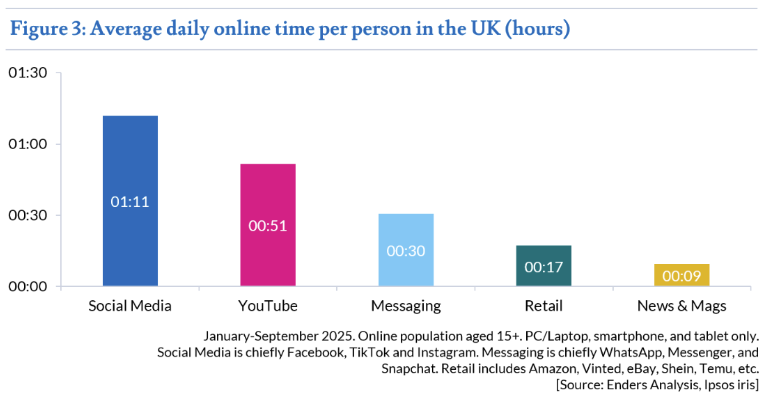
Indeed, according to the research firm’s analysis of Ipsos Iris data, online users spend an average of under 10 minutes a day with news and magazine websites, and 10x that amount of time on social media platforms, where they are more likely to first engage with a news item.
The same issue of off-platform engagement is true of podcasts and other types of multimedia formats, which publishers are increasingly turning to in order to reach new audiences themselves.
Podcasts, for example, can generate deep, habitual engagement, but that engagement is captured primarily by the likes of Spotify, YouTube and Apple Podcasts.
While publishers are working to monetise these productions via direct advertising opportunities, such as branded content and other long-term partnerships, the output is still “platform-led and structurally disconnected from the publisher’s app, subscription funnel and first-party data.”
The value of scoops is not what it used to be
Meanwhile, as Enders writes, credit and compensation for original content “are coming further adrift”, with newsrooms that break stories “capturing less and less of the commercial reward it generates”.
As the report’s authors (head of publishing Abi Watson, senior research analyst Claire Holubowskyj, and media analyst Laura Darcey) explain, in the days of print news, scoops provided news organisations with hours, if not days, of competitive advantage, both in attaining audience and driving revenue based on that audience.
“However, today, exclusives rarely act as moats,” they note.
“The modern news cycle unfolds within minutes, widely distributing engagement and the value that that engagement generates; a publisher will break a story; competitors rewrite within 20 to 30 minutes; aggregators surface summaries; TikTok and X produce explanation videos, usually uncredited; Reddit threads interpret the story; notifications push de-branded alerts; and engagement moves off-site entirely.”
News, in other words, is commoditised. Compared to the cost of employing highly skilled journalists and giving them the time to generate high-value scoops, Enders’ analysts argue that the commercial return is no longer guaranteed.
Three engines for growth
That’s not to say original reporting has no commercial value. Rather, it remains an “authority anchor”, capable of driving “episodic spikes” in audience engagement that can be converted into long-term customer relationships when paired with other editorial outputs designed to foster habitual return and a sense of community.
Those can include using verticals to stack commercially addressable audiences around a core of news reporting, with bundles viewed as an opportunity both to segment and to wrangle audiences. However, Enders’ report warns that not all verticals offer the same utility to consumers, and expanding horizontally can leave brands “broad but indistinct”.
‘Uneven’ growth as digital revenues increase 5.1% despite majority of publishers reporting declines
Regardless of vertical, recurring editorial formats — for example, columnists, newsletters, and podcasts, paired with original or investigatory reporting — can drive “both depth and return” by building routine consumption and providing high-value content and distinctive personality.
Personality-based journalism is indeed en vogue. The New York Times has begun giving its journalists more opportunities to take centre stage on and off its website, be it through short- and long-form videos, podcasts, or asking them to engage with subscribers in the comment section of their own authored articles.
Likewise, The Economist, which famously does not publish bylines, is rolling out Economist Play this summer, a new component of the magazine’s mobile app featuring shows, interviews and debates hosted by its correspondents.
Other publishers, meanwhile, are leveraging relationships with independent creators to engage their content to existing communities of relevant audiences.
Importantly, Enders advises that publishers must have all three growth engines: engagement, habit and community, all working simultaneously.
The report concludes: “Engagement without habit leaks value; habit without community is fragile; community without engagement has nothing to bind it.”