



How do we design an AI that feels unmistakably like our brand?

Opinion
Brands spend a lifetime working to make their brands distinctive, differentiated and memorable through colour, sound, and font. There’s no reason that wouldn’t extend to AI, writes Phil Rowley.
I’ve just completed the business classic How To Win Friends And Influence People by Dale Carnegie.
Written in 1936, Carnegie lists 12 rules for being influential in business, including “Never Criticise Others”, “Make The Other Person Feel Important” and “Give A Fine Reputation”, which encourages workers to be so praiseworthy of colleagues they will feel honour-bound to live up to your compliments.
As I was reading through this, a thought occurred to me: “I wonder if today’s leading AI assistants have read this book”. Not only as part of their wholesale ingestion of the internet, but because its interface seems designed to make users feel validated and – can we say this? – even ‘liked’.
At a time when the world can seem steeped in hate and division, overt praise can be intoxicating. And yet here it is on tap: a machine that overly flattens users with stock affirmations such as “Great point” and “This is a strong start”.
This carries inherent risks, however. Scientist and BBC presenter Prof Hannah Fry recently dubbed this “AI Sycophancy”, drawing attention to people seeking advice on building a business, only to later discover that lavish praise had masked unforeseen challenges.
So, yes, we should be more aware of our LLM’s modus operandi as expressed via its ‘personality’. But we could also see this as a future skill set that brands may need to master.
Brands already own their visual, verbal, and sonic identity. Could they soon own their ‘Behavioural Identity’ as expressed through an AI?
If more businesses adopt consumer-facing AI interfaces, we can take AI beyond bland, overly praiseworthy chatbots and into the realm of purposefully designed digital personalities that function as brand ambassadors and brand extensions.
I’ve done some thinking about this, and here’s where I am currently.
Designing AI ‘personalities’
There’s a line in Blackadder Goes Forth, where hapless Kevin Darling says, “I wasn’t born yesterday, Blackadder”. To which Blackadder responds: “More’s the pity. We could have started your personality from scratch”.
Today, we have that ability: to build personalities from scratch. Moreover, it’s not just a personality for its own sake, but rather a way of codifying a specific set of behavioural outputs.
Though currently you can ask an LLM to assume a different persona, for instance “Pretend you are a particularly straight-talking creative director, and roast my campaign idea”, I have a sneaking suspicion it is underused, and that people prefer the complimentary approach.
It’s a shame, but this represents a real opportunity. We are learning to see through our silicon companions, and our AI assistants, avatars, and chatbots will need to be much more nuanced and differentiated if they are to be accepted in the future.
How might we achieve this? Well, what follows is a conceptual way of thinking about how it might evolve:
Towards a working model
In the future, we might construct our AI’s personality from a ‘sandbox’, layering on characteristics from different ‘trait’ options.
To conjure up a differentiated ‘branded’ personality with a distinctive feel, we could do worse than start with Jungian archetypes.
Karl Jung’s indexing of personae and associated behaviours gave us insight into how we express human characteristics through our tone, word choice, and communication style. Though Karl Jung detailed many archetypes, I’ve boiled it down to four kinds, represented in a two-by-two grid.
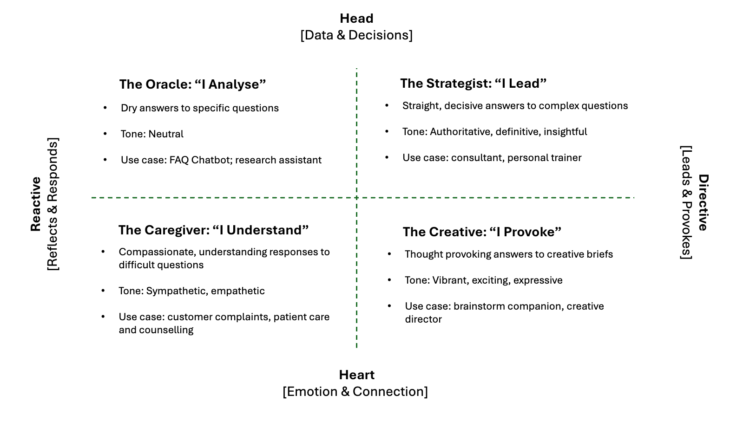
On the vertical axis: Head to Heart. Head employs logical intelligence for data-based responses. Heart delivers human responses grounded in emotional intelligence.
On the horizontal axis: we have Reactive to Directive. Reactive requires nothing more than straight information retrieval via the echoing or playing back of specific information. Directive gives an AI the power to be more improvisational, and claims license to think beyond preset parameters.
Four AI behavioural personalities
Cross-tabulating these two axes gives us four behavioural personality models.
The Oracle is a mix of Head and Reactive, and is a classic chatbot giving dry, factual, accurate answers. A basic decision tree for FAQs. I would argue that this AI personality is currently the most common.
The Caregiver is a mix of Heart and Reactive and strives for compassionate, human interactions that reflect frustrations back with a sympathetic tone.
The Strategist is a mix of Head and Directive, and aims to use analysis, data and calculation to make key decisions, converting insight into forward momentum.
The Creative is a mix of Heart and Directive, blending its understanding of human creativity with provocative and propulsive inputs.
Left-hand models – The Oracle and The Caregiver – are more strictly confined by parameters, ensuring accurate and considered communication.
Right-hand models – The Strategist and The Creator – are programmed to offer open-ended answers and are free to respond beyond the prompt, which means less predictability in which word comes next.
Alternatively, the top models provide concise answers, distilling complexity into neat responses. The bottom models provide longer and more complex answers.
Within these four models lie the raw ingredients for constructing an AI persona.
How brands can use the model
The aim is not for a brand to adopt just one of the above models, though that is perfectly legitimate. Rather, it is to blend different concentrations – like mixing colours from a paint set – to determine the personality of the AI.
Brands could draw a Tetris-like ‘shape’ across the quadrants. Or be given, say, a notional 100 tokens to ‘spend’ across the four models depending on the desired objective or purpose.
For example, a B2B tax bot might be 80% Oracle, 10% Strategist, 10% Caregiver, 0% Creative.
A trendy fashion retail bot, however, might be 50% Creative, 30% Caregiver, 20% Oracle, 0% Strategist.
Or brands could shift the mix according to the nature of the customer’s response.
Imagine a travel assistant whose default allocation is: Creative 40%, Caregiver 30%, Oracle 20%, Strategist 10%, when being quizzed on holiday recommendations.
But when a customer’s flight is cancelled, it could automatically rebalance to Caregiver 45%, Strategist 35%, Oracle 20%, Creative 0%
Think of this like a personality graphic equaliser, mixing the treble, mid and bass until the mood music is just right for the brand.
AI as a brand extension
I hasten to add I am not an AI coder, so please treat the above as a way to conceptualise and categorise an approach. It’s not a programming model.
It is designed to do nothing more than highlight that our future chatbots, AI assistants and avatars can go beyond cold FAQ answers and overly praiseworthy interactions. It is an opportunity to (almost literally) embody brand values via a pseudo-sentient interactive character.
Brands spend a lifetime working to make their brands distinctive, differentiated and memorable through colour, sound, and font.
You may have seen quizzes that challenge you to identify the brand from its tagline, its pixellated logo – or in some cases just a mere colour palette. There’s no reason that wouldn’t extend to AI.
If AI becomes a primary interface between people and organisations, how do we deliberately design its character so that interacting with it feels unmistakably like interacting with that brand?
Can we get to a stage where we can study two separate AI-customer transcripts from two rival brands and know which brand is which purely from the style of the answers?
Today we recognise brands from their logos, colours and advertising. Tomorrow, we may recognise them from the way they think.
 Phil Rowley is head of futures at Omnicom Media Group UK and author of Hit the Switch: The Future of Sustainable Business. He writes for The Media Leader about the future of media.