



IPA white paper: Walled-garden data ‘no substitute’ for JICs

The media industry’s increasing reliance on proprietary data from walled-garden platforms is undermining decision-making on media budgets, leaving advertisers with a “mosaic of incomparable and opaque datasets”.
That is one conclusion from a white paper published by the Institute of Practitioners in Advertising (IPA) and co-authored by Tony Regan, partner at consultancy Work Research, and outgoing Barb CEO Justin Sampson. (Regan works with The Media Leader‘s parent, Adwanted, on its Adwanted Consulting product.)
“We have never had a better scientific understanding of how advertising works, yet the data environment makes the measurable the enemy of the meaningful,” Regan commented.
The white paper serves as a sequel to the 2023 report, Signals in the Noise, which itself made the case for joint-industry audience measurement in an era of data abundance.
It comes after ITV commercial measurement innovation lead Sameer Modha warned that adspend was moving away from JIC-measured media at last December’s Future of TV Advertising Global conference.
Whereas 95% of purchased media was JIC-measured in 2002, this fell to 69% in 2010, 26% in 2020, and just 16% in 2024.
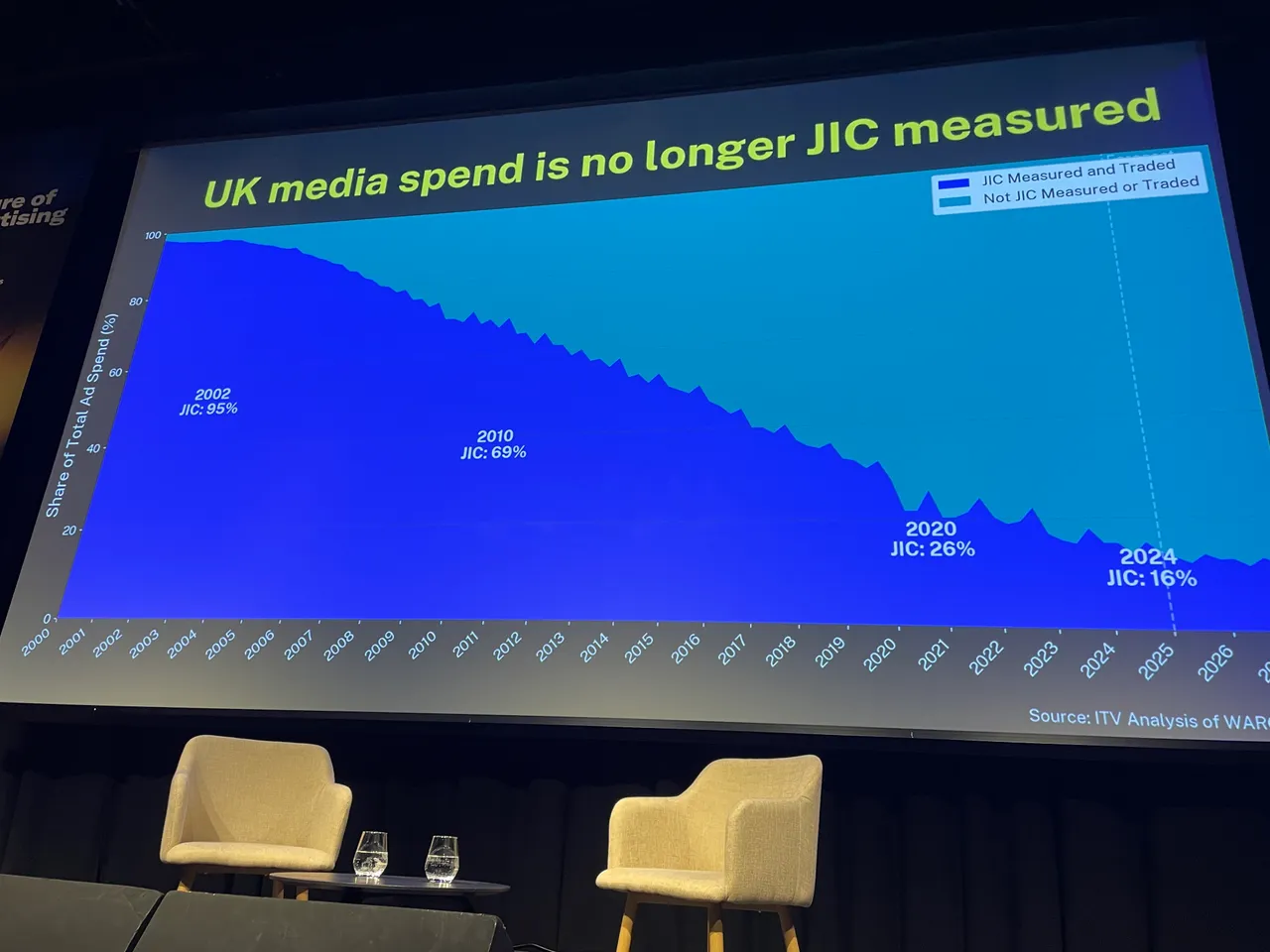
The phenomenon has occurred as advertisers have moved to embrace advertising with walled-garden platforms and increasingly valued their purported ability to deliver measurement on how marketing spend is attributable to business outcomes.
As Modha described, UK advertisers “simply do not worry about measurement quality, transparency.”
Two issues: data incomparability and short-termism
Signals in the Noise 2 identifies two core problems at the heart of the dichotomy between better research and worse data: data incomparability and short-termism.
As the paper explains, “platform owners have provided advertisers with proprietary data as a proxy for audience measurement, but reporting definitions are bespoke to each platform and often not fully disclosed.” For example, there is a lack of clarity and comparability between what is simply considered a “view” on TikTok, Facebook, and YouTube.
In addition, the paper argues that “attribution metrics that over-claim their contribution to consumer actions compounds this problem”, as advertisers may be “paying for demand that was there anyway” or dealing with multiple suppliers “claiming the same sale or click”.
An overreliance on last-click attribution, for example, could lead an advertiser to overinvest in the media channel that most closely delivered a sale, rather than the other media channels that contributed to their brand being recognisable, trusted and desirable to a given consumer in the lead-up to purchase.
A lack of independent measurement also creates conflicts of interest. As independent econometrician Alex Vass commented, “When a platform builds the tool that’s supposed to evaluate that platform’s performance… what do you think the recommendations will be? Many of these tools lack rigour, overstate impact, or bury assumptions.”
There is demand from agency strategists for cross-platform viewability standards, which has led to efforts such as the cross-media measurement service Origin. The initiative, which officially launched last summer, has, however, also found itself mired in disagreements over how to display differences in viewability standards favoured by different media owners.
Short-termism is also a considerable hurdle for marketers to overcome. The ease of use and availability of short-term performance data “has created a gravitational pull towards channels that appear most measurable,” the white paper reads.
Yet, as EssenceMediacom UK chief strategy officer Rich Kirk notes in the paper, “it holds true that in most categories, 95% of the people who see the advertising are not ready to buy right now,” suggesting an overfocus on short-termism can be wasteful and ineffective.
Calls to action for JICs, advertisers and platforms
According to IPA joint research director Dan Flynn, while the ad industry has benefitted from a “profusion of data” about media audiences amid the shift to digital practices, this data “has not led to an equivalent increase in knowledge.”
“With ongoing pressure on marketing accountability, the industry’s ambition to account rigorously for the investment in media advertising is being clouded by the noise that comes from a variety of proprietary definitions of audience exposure,” he said. “This new paper is a call to action for all sides of the industry to prioritise the use of trusted, joint-industry sources as a foundation stone for strategic planning and campaign evaluation.”
New thinking, not new analogies, are needed to sell quality media amid an economic storm
Signals in the Noise 2 indeed makes four direct calls to action to improve advertising effectiveness.
For the media industry as a whole, it urges stakeholders to “invest in and treasure the joint-industry currencies”.
Meanwhile, joint-industry currencies are called upon to “make their data work harder” for the data analytics community. Likewise, it asks for data analysts to “apply the same rigour to assessing data quality that they bring to building models.”
Finally, the white paper also calls for online platforms to make “tangible commitments to the joint-industry principles of transparency, objectivity and independence.”
The report notes that the marketing data analytics community is willing to embrace joint-industry sources over proprietary data, but that it “needs those sources to be more accessible, better documented, and more readily integrated into the modelling and analytics workflows that now sit at the heart of effectiveness measurement.”
It reads: “What effectiveness experts need from audience data is consistent, comparable evidence of how many people have seen an ad; how often and for how long; insight into effective levels of exposure across different channels; and the ability to calculate share of voice across the full media mix.
“These are not luxuries or refinements — they are the foundations on which sound investment decisions are built. And they are precisely what joint-industry measurement, at its best, is designed to deliver.”