



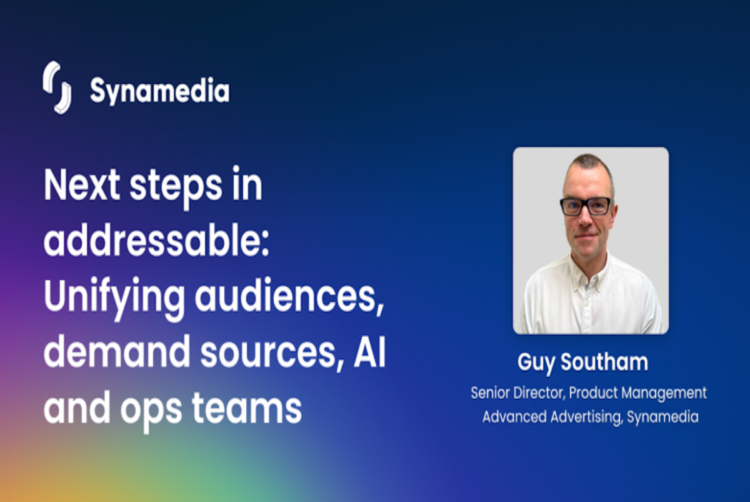
Next steps in addressable: Unifying audiences, demand sources, AI and ops teams
Partner content – Cannes Lions preview
The TV industry can generate incremental advertising revenues from local advertisers and small-medium advertisers thanks to addressable TV.
It can try to take a greater share of digital-first brand budgets, while helping to maintain cost-effective audience reach for existing advertisers.
These are all important strategic aims in the battle for budget share versus social and video sharing platforms, but success will require large volumes of cross-platform addressable inventory that is easy to buy.
It will also rely on cross-platform campaigns that are managed and optimised holistically.
This is according to Guy Southam (pictured), director of product development, advanced advertising at Synamedia, who is at Cannes Lions next week to meet with advertising, media, and tech leaders to explain the benefits of his company’s addressable TV advertising platform, Iris.
His big message is the need to unify and simplify addressable TV operations and campaign management, with a process he calls ‘platformisation’ alongside greater automation.
There is a growing requirement, he believes, for Pay TV operators to create multi-broadcaster addressable audiences that span both linear broadcast and streaming and which are understood and managed holistically.
Operators, working with their broadcast partners, must create a unified view of direct and multiple programmatic demand sources so targeting decisions are made with a full understanding of all campaign needs.
He also argues they should harness agentic AI, where appropriate, to track campaign performance and recommend or even undertake inflight optimisations.
Greater certainty for buyers
The results will be yield maximisation for operators and broadcasters, and greater certainty for buyers that their campaign goals will be met, Southam predicts.
“The addressable advertising market has become more complex: there are more inventory sources and more targeting segments including contextual and behavioural,” he explains.
“There are multiple demand sources and multiple ad servers in the decisioning mix.
Southam refers to the concept of the ‘easy button’ for TV – first articulated by James Rooke, president at Comcast Advertising – that makes it as easy for advertisers and agencies to buy TV as it is to buy Facebook or YouTube.
Like Rooke and others, Southam is convinced there are digital-centric advertisers who will buy more TV if that buying process is easier. He sees unification of audiences and demand sources as one of the building blocks for that easy button.
Synamedia’s Iris acts as an orchestration layer to help unify all audiences and inventory (broadcast or streaming, live and on-demand) and establish common addressable campaign decisioning across them.
It works with installed adtech workflows, so it does not replace anything. There is a focus on using standards and creating a common framework capable of handling different campaign strategies and objectives.
Common decisioning (spanning campaigns, demand sources and cross-platform audiences) allows operators and broadcasters to achieve win-win outcomes for them and advertisers.
Southam points out that media owners decide their yield and campaign strategies, while Iris orchestrates the execution.
This could mean incentivising the ad server to match an audience segment to a campaign that is willing to pay the most for a viewer (subject to any reach or frequency capping).
Maybe there is another campaign with a lower CPM, but which ends sooner or which is behind on its goals, so should be prioritised for the next inventory opportunity in the same audience segment.
“Nobody wants to under-deliver against campaign objectives so you could focus on a campaign that needs help,” Southam explains.
The benefit – less immediately tangible than yield – is keeping buyers happy.
“AI will help us look at the broader context, like whether this is the last opportunity to deliver against a particular campaign,” he adds.
Potential of agentic workflows
Synamedia is using Cannes to outline the potential for agentic workflows that monitor and optimise addressable campaigns and ultimately help media companies to navigate the cross-platform, multi-segment, hybrid-demand complexities.
“Agents can interrogate campaign performance and provide a heads-up without scouring thousands of line items,” Southam declares.
“Our first agentic tool was for reporting, so you can see if a campaign is falling outside of a performance threshold.
“The next step is for an agent to proactively recommend an action to address issues, and if appropriate, alert the operations team.
“The agent might say that it expects this campaign to struggle for these reasons and recommend remedies. It will forecast the impact of taking or rejecting those alternative steps.”
In a simple example, the agent could suggest expanding the dayparts used in order to avoid reach under-delivery.
“Even the best media plan is impacted daily by changes in viewing behaviour or the pipeline of programmatic campaigns that compete for eyeballs, and the prices each of those campaigns is willing to pay.
“So, a campaign that was on track yesterday can be off track tomorrow,” says Southam.
“If the agent does make a recommendation, the operations team can approve the action, which the agent executes. You could also reject the recommendation.
“The operations team can tell the agent that they are happy for it to always perform this action under these circumstances, or that they will never be happy with certain actions under set circumstances.
“As trust grows, the potential is to empower agents to look for issues, take corrective action, alert the team on the basis that ‘I have done this, so let me know if you want me to change something’, and then provide status updates.”
While pitched primarily at platform operators (notably Pay TV) for their addressable advertising businesses, Iris can be used by individual broadcasters for addressable campaign management and optimisation, yield management, reporting and forecasting, among other things.
It is also available for non-broadcaster streamers like FAST and AVOD services.
Iris is a modular solution that spans server-side ad insertion, ad routing and programmatic demand access. It also supports ad downloads to devices – enabling targeted ads on one-way broadcast networks if necessary.
Maintaining mass reach
Southam positions Iris as an important weapon in the battle media companies face to maintain mass reach and suitable frequency in a fragmented industry where there is increasing competition for attention.
He highlights video sharing platforms like YouTube and global SVOD ad tiers from the likes of Netflix and Prime Video as competition to broadcasters for ad spend.
Broadcasters are fighting to maintain younger audiences, and TV generally must achieve the reach advertisers need for successful targeting.
Converged broadcast and streaming audiences are part of the reach story, and hybrid demand sources are part of the yield story.
Southam believes that with Iris, a greater proportion of addressable campaigns should meet advertiser objectives – which will help safeguard existing TV budgets and attract new money.
“We know agencies and advertisers who are spending money with the digital giants not because they want to, but because it is the only option available to them.
“We have a chance to show them the value of TV and premium video. I believe TV can win back some budget that has migrated to digital.
“There is an opportunity to take new money from digital and social-first buyers,” he continues.
“The small-medium business market is part of the opportunity for new money.
“Addressable TV started with brands who had not advertised on TV before, and today production barriers [for smaller and local businesses] are being lowered.”
In all cases, addressable TV is the key that, more than anything, will unlock the door.
In Cannes, Southam and Synamedia are making the case that this greater ‘platformisation’ and automation of addressable TV advertising will then help to push that door open.