



Publicis acquires LiveRamp to build world leader in data co-creation
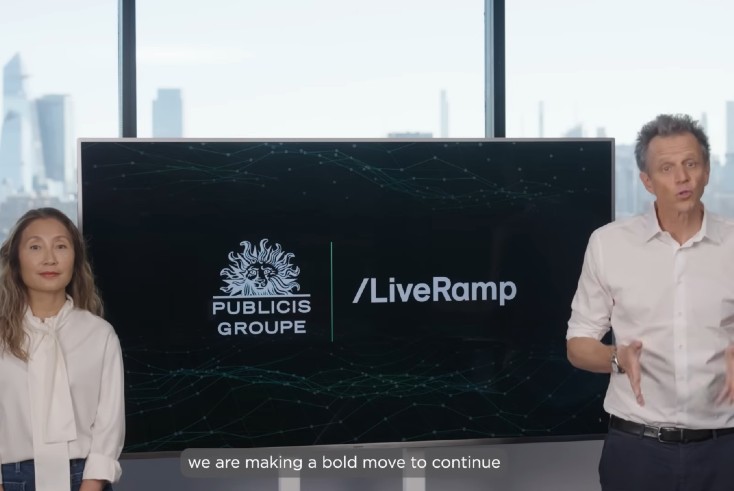
Publicis Groupe announced on Sunday the acquisition of the American data collaboration platform LiveRamp for $2.2bn, paid entirely in cash.
The third largest acquisition in the group’s history—after Sapient in 2014 and Epsilon in 2019—the deal repositions Publicis at the heart of the agent-based transformation of large companies, in contrast to the strategy of its main rivals.
“After acquiring Epsilon in 2019 in the name of personalisation at scale and enabling our clients to take back control of their data from the walled gardens, by shifting from cookies to identity, once again we are looking ahead to what’s next,” commented Publicis Groupe CEO Arthur Sadoun, who situated the acquisition as part of the holding group’s strategy to develop leading agentic solutions.
He continued: “By building the future of data co-creation, we’re empowering our clients to generate new, exclusive and proprietary data, to build the smartest, most differentiated AI agents on top of the leading LLMs.”
A bet against the grain
Sadoun argued that the company’s aggressive M&A strategy “runs counter to the market and our rivals”, who he said are “increasingly resorting to layoffs, share buybacks and divestitures”, alluding to the likes of Omnicom, which became the world’s largest holding group after its merger with IPG but has subsequently focused on cost savings through synergies.
“We have always said that we would not acquire similar assets with a purely financial rationale to achieve economies of scale,” Sadoun said.
LiveRamp will continue to be led by CEO Scott Howe following the acquisition, which is expected to close before the end of 2026, subject to regulatory approvals and shareholder approval. Upon closure, LiveRamp’s financials will be reported within the Groupe’s Technology segment, alongside Sapient.
The holding group is committing to operate LiveRamp as a “neutral, interoperable platform”.
Howe added: “Our customers and partners have always been our North Star, and by joining forces with Publicis, we will have greater resources and flexibility to scale our business, continue innovating our platform, and help them unlock even greater value from their data.”
Co-creating data to support AI agents
LiveRamp was born from a spin-off with Acxiom in the late 2010s and has since become a global player in data collaboration.
Its technology allows its clients to access a vast network of partnerships—advertisers, platforms, publishers, data providers—to enrich their own assets and use them in various ways: ad targeting, customer insights, measurement.
It is precisely this capability that Publicis intends to leverage to accelerate what it calls the “agent revolution.”
“With Epsilon’s data, we perform large-scale personalisation for our clients. With LiveRamp, we want to help them achieve their agent revolution by co-creating data that will make their AI agents more efficient and generate concrete business results,” said Sadoun.
“The fundamental problem many companies face with AI models lies in their weak data foundations. Today, 93% of them don’t have access to the right data to build their agents. Many groups also use the same datasets, which prevents them from differentiating themselves from their competitors.”
Financial targets raised
LiveRamp generated $813m in revenue during its 2025-2026 fiscal year, with an adjusted operating margin of 22.4%.
Publicis is simultaneously raising its growth targets for 2027 and 2028, now anticipating net revenue growth of 7% to 8% at constant exchange rates, compared to the previous forecast of 6% to 7%.
It comes after Publicis led both the total and net new media business global rankings in 2025, according to Comvergence. Last year Publicis Media generated $10bn in new client billings, equivalent to one-third of all media spend that shifted agencies. It was the seventh consecutive year Publicis outpaced its rivals in global new business.
Sadoun concluded: “This acquisition is also a way for us to position ourselves in a new addressable market with significant potential, as the agentic sector is booming.”
The strategy behind Publicis Groupe’s landmark year — with Niel Bornman
This article was translated and adapted from an article originally published on The Media Leader France by editorial director François Quairel.