



Real-time outcomes measurement could win budget back for Australian broadcasters
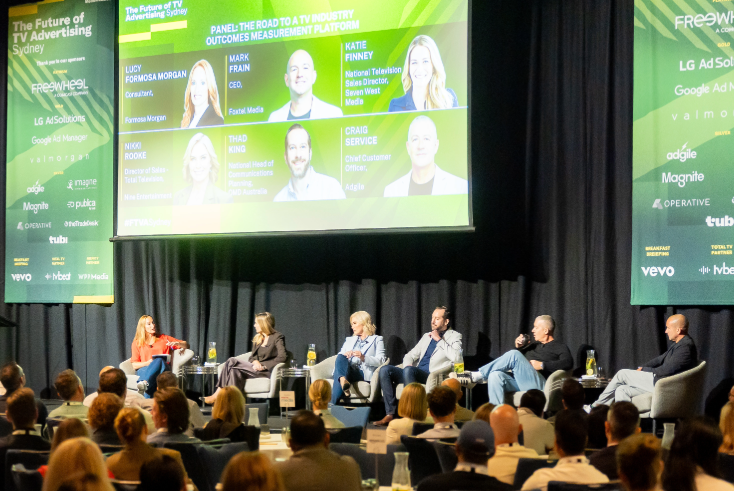
Analysis – The Future of TV: Global Series
Seven, Nine, and Foxtel Media are collaborating with Adgile to build a shared TV analytics platform that links TV exposure to business outcomes in real time. One buyer reckons it could be the most important shift in TV during the next three years.
Broadcasters in Australia can have an equal seat at the performance table alongside global tech platforms by developing their own systems to demonstrate how TV exposure directly drives business outcomes.
That is the view of Katie Finney, national television sales director at Seven West Media, one of the major commercial broadcasters in the country (running Seven).
Commenting on a multi-broadcaster initiative to provide real-time insights into TV-driven activations, Thad King, national head of communications planning at media agency OMD Australia, declared: “This is potentially the most powerful shift from the TV industry for the next three years.
“It has the potential to bring significant revenue back to television.
“When TV can offer outcomes planning, which it has been missing, it becomes attractive to many more clients.”
Both were speaking at The Future of TV Advertising Sydney in March about the future of TV measurement.
King summed up the challenge to broadcasters. “Marketers will lean towards channels that give them attribution and [outcomes] measurement in real-time.
“The ability for real-time results will make people more comfortable investing in a channel [TV] they already know works.”
Seven, Foxtel Media, and Nine Entertainment have been working with adtech vendor Adgile to create the always-on TV analytics platform, and the door is open to other broadcasters who want to join.
The platform has reached the proof-of-concept stage, and there are hopes of a live demonstration by mid-year.
The platform uses intelligent content recognition to capture ad exposures across linear TV, BVOD, SVOD, AVOD, FAST and more, and link that to business outcomes, with independent verification.
The buyer-facing dashboard will help clients and media agencies optimise their TV and cross-media planning, its supporters say.
Finney declared: “We know TV and BVOD work, and this gives people the tool to show that in real-time.”
Nikki Rooke, director of sales – Total Television at Nine, commented: “I believe this can help us stop the decline [in TV spend] and reverse that trend.
“We’ve heard how marketers are turning more to short-term planning and outcomes, and we must play there – and we are about to.
“We know we play in the lower funnel, and we are taking control of our destiny by reclaiming our place in lower funnel metrics. We are about to start showing what we do in real-time.
“We can do that for anyone who wants to be on this platform. It will be independent and transparent.”
Most exciting thing since streaming
King strongly approves of the development – going so far as to say, “It is the most exciting thing to happen to the industry since the arrival of streaming.”
He added that outcomes measurement is the one thing that will shift spending back towards TV in Australia.
“I commend those [media owners] who are coming together to do this. This collaboration would not have happened a couple of years ago.
“I don’t think everyone realises yet how impactful this will be.
“We see how important TV is for driving ROI – we see that from MMM (Marketing Mix Modelling) every time we use it, not just for growing brands but for short-term sales. It plays two roles.”
He noted that MMM, while good, provides insights every three to six months, typically at the channel level, and is not used by all clients.
Clients who do not use MMM are leaning into channels where they can already measure outcomes in real time, especially among challenger brands, King observed.
“I think this new [outcomes measurement] platform will help marketers understand the real-time impact that has been missing [for TV].
“TV has not been able to deliver the real-time outcomes insights that would put them on a level playing field with the digital players. That is a huge issue and a reason why TV has not been getting the share of budget it used to.”
He added: “MMM tells us the ROI for TV, but this platform shows you what is driving that, in real-time.”
Craig Service, chief customer officer at Adgile, which views itself as an outcomes intelligence provider, emphasised the importance of real-time insights, noting that “we live in an always-on world.”
Revealing what buyers had told his company during research, he said: “Until now, TV has not provided outcomes reporting in real-time.
Post-campaign is not good enough
“Post-campaign is not good enough. One month later is not good enough. We were told it must be now – that is a given.
“They wanted unification, and asked for one place where they can see all video performance.
“The market is too fragmented; there is too much data and too much stitching from too many data sources. So, they wanted a single source of data and a single agreed-upon set of metrics.
“They wanted to avoid all the manual data stitching. They also wanted independence.”
This is what Adgile will deliver to the broadcasters, he declared.
Mark Frain, CEO of Foxtel Media, noted that each broadcaster already worked with Adgile, which made the project easier. “They are an independent company and do not work for us,” he emphasised.
“We have made a significant start [on the new real-time outcomes measurement capability]. We want to make this the industrialised, scalable solution the industry needs.”
Asked who would pay for the capability, Frain suggested broadcasters would manage a good deal of the costs.
Rooke at Nine added: “Not all clients can afford to engage Adgile. We want to democratise this capability if we can, making it available to advertisers of all sizes.
“We want this to be the robust platform that shows what their dollars are doing, what causes and effects are happening, and how they can leverage that to optimise [planning] even more.”
Earlier at the same event, Frain told the audience that Australian TV is on course to lose $200m of ad budget in the next two years but can turn that into a $200m inflow with better measurement and lower friction trading.
He views outcomes measurement as a way to avert that revenue loss disaster, as you can read here.
Rooke returned to the theme of proving what TV already delivers in performance marketing.
“Our studies show that our TV and streaming drives one-in-four app interactions or website visits for advertisers,” she revealed. “Of TV-generated search, 66% was direct or organic.
“With MMM we saw those short-term effects proven out.”
Outcomes and audience measurement are complementary
Rooke pointed out that improved outcomes measurement would not reduce the necessity for audience measurement, as “that is something we are held very accountable to.”
Service and Finney agreed that the two types of measurement are complementary.
Frain does not want the new measurement platform to get caught up in JIC-style governance, because of the delays he believes this would create.
King observed that the Australian industry has been using Adgile’s insights for many years and its methodology is proven.
“This is not a new toolkit, but this platform does democratise the capabilities to a broader group,” he stated.
Main image shows, from left: Moderator Lucy Formosa Morgan, Katie Finney, Nikki Rooke, Thad King, Craig Service and Mark Frain.