



Reform Political Advertising campaign picks up momentum with MPs
Campaign group Reform Political Advertising is upping pressure on MPs to pass a number of amendments to the Representation of the People Bill (formerly known as the Elections Bill) aimed at strengthening transparency and trust in political advertising.
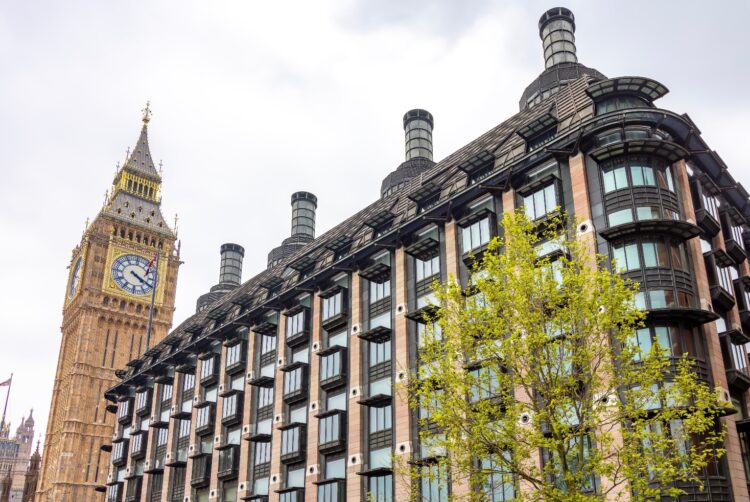
On Monday, the group hosted an event at Portcullis House in Westminster attended by around 20 MPs, two representatives from the Electoral Commission, multiple Lords, fact checking charity Full Fact and others in support of the effort.
MPs that spoke in favour of election advertising reform included Justin Madders (Labour) and Zöe Franklin (Liberal Democrats). Green Party MP Hannah Spencer, who in February became the first Green member to win a by-election, likewise gave an account of how disinformation personally impacted her during the campaign.
At the Representation of the People Bill’s second reading last month, George Freeman (Conservative), Emily Darlington (Labour), and Samantha Dixon (Labour) also expressed support for strengthening rules around election advertising.
Founded in 2018, Reform Political Advertising is a politically-neutral non-profit run by volunteers, largely from the advertising industry, that are seeking improved rules for transparency and factual accuracy in election ads.
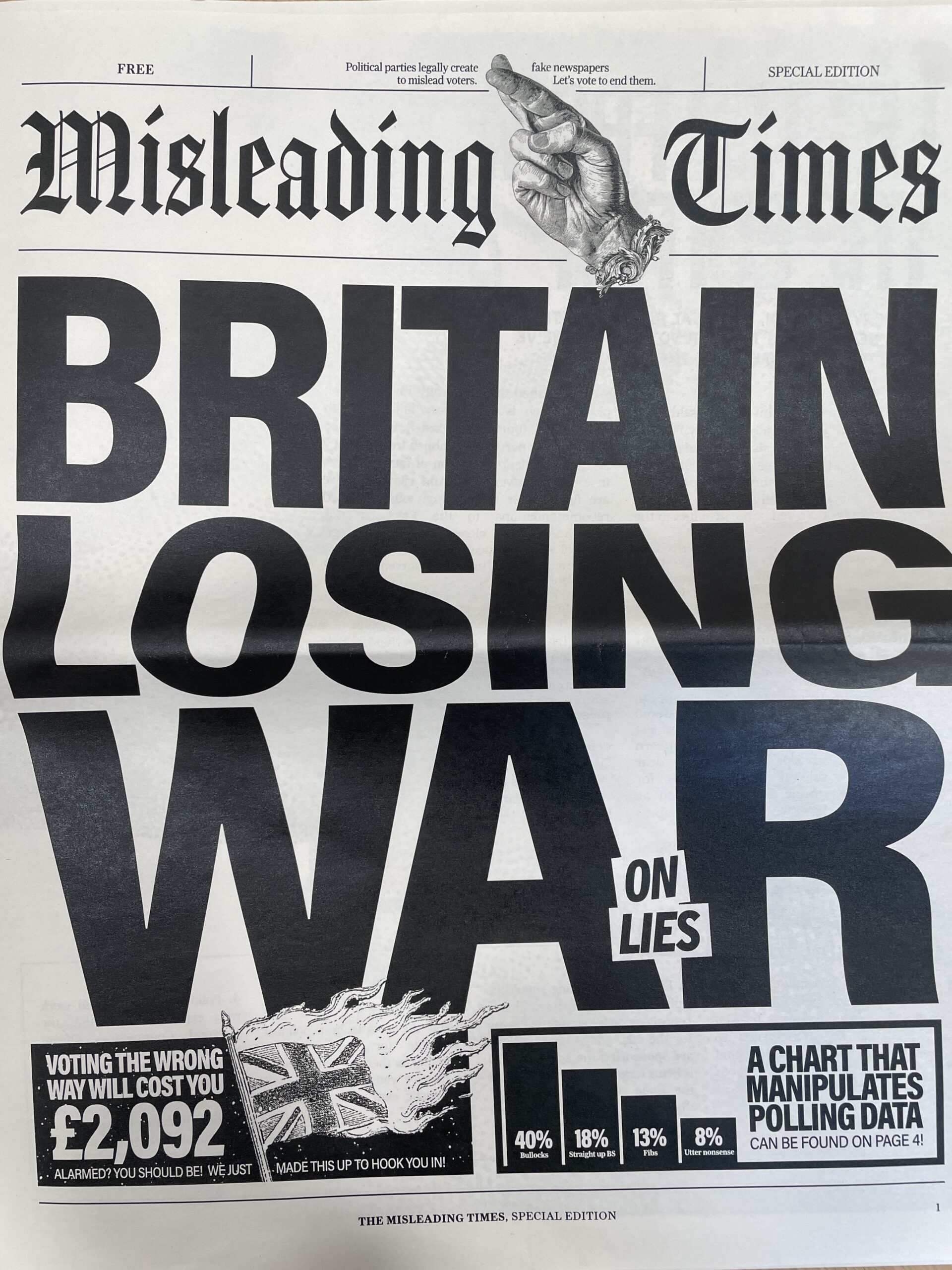
The recent momentum follows a years-long lobbying effort. In February, the group circulated fake print newspapers to MPs cheekily titled the Misleading Times, warning that Britain is “losing the war on lies”.
“In every election, political parties write fake newspapers to trick voters,” the paper’s “letter from the editor” reads. “Now we’ve done the same to expose their tricks.”
Four policy proposals
Reform Political Advertising is backing four policy initiatives for the bill, which are included in a number of proposed amendments:
1. Requiring imprints at the bottom of all political advertising that state the political party responsible for the ad.
2. Creating a transparent, searchable database of all election ads, aimed at helping prevent “dark advertising” efforts.
3. Making it illegal to create deepfakes of politicians (except for the purposes of parody, satire, or artistic expression), and requiring ads that use AI to be labelled as such.
4. Creating a code of practice, in partnership with the Advertising Standards Authority (ASA), Electoral Commission, Ofcom, and the UK Statistics Authority that requires stated facts to be substantiated in political advertising around elections, thereby restricting “fundamentally inaccurate advertising” during these time periods.
The bill is currently in the report stage before it is taken up by the House of Lords.
The campaign has the expressed support of the Green Party and Plaid Cymru, with other politicians increasingly leaning in. Mayoral candidates Sadiq Khan and Andy Burnham signed its ad code during the 2024 London and Manchester mayoral elections, for example.
Need for involvement from the ad industry
The renewed lobbying effort comes just days ahead of the May local elections.
In conversation with The Media Leader, Alex Tait, co-founder of Reform Political Advertising and media consultancy Entropy, explained that with five competitive political parties currently vying for votes, information integrity has become increasingly crucial to driving informed electoral outcomes.
Disinformation more broadly has become an extreme concern in recent years amid what Tait referred to as the “technological shift” that has allowed bad actors to create and disseminate false information and propaganda at immense scale across platforms both off and online.
Improving political advertising standards, he said, is therefore just one “part of the jigsaw” in tackling disinformation. However, as Tait noted, electoral advertising law has hardly changed since 1999, before the advent contemporary social media, making its current iteration woefully underregulated.
According to Tait, disinformation is common across media channels, with particular focus needed on direct mail leaflets as well as platforms like Facebook and X. Likewise, it is identifiable “across parties”.
“There is momentum behind it,” Tait said of the latest lobbying effort following the Portcullis House event, which he added demonstrated a “consensus of support”.
He continued: “I am pretty confident we’re going to get a few MPs behind it, but there’s a long way to go.”
In the meantime, Tait is not just lobbying MPs in support of legislation, but the advertising industry at large to be more involved with policymakers as they seek to shore up information integrity around elections. He noted to The Media Leader that the Advertising Standards Authority’s explicit mission is to “make every ad in the UK a responsible ad”, which would by definition include political ads.
“We need more people who are subject matter experts being involved,” he said.
According to research commissioned by Reform Political Advertising and conducted by Opinium in 2024, political advertising is the least trusted form of advertising, which one quarter (25%) of respondents “completely distrust[ing]” ads from political parties, and a majority (57%) “mostly” or “completely” distrusting such ads.
However, the same survey found that 56% of people would trust political ads more if they knew they were regulated “by an authority such as the Advertising Standards Authority”.
Tait expects the full legislative process relating to the Representation of the People Bill will not complete until September in all likelihood, and has vowed to keep up on the pressure on MPs in the meantime.
Young voters most likely to say they’ve seen election misinformation
Editor’s note: This article has been updated since publication. An earlier version of this article wrongly stated Ellie Chowns MP and Manuela Perteghella MP spoke at the Portcullis House event. It also wrongly stated electoral advertising law has “not” changed since 1999; this is misleading, as there have been minor changes instituted since then, such as requiring imprints on digital ads.