



SMB advertising and investor interest in content libraries could boost broadcasters
Analysis – The Future of TV: Global Series
Small medium business advertising represents the biggest growth opportunity for broadcasters, if they can grab it.”
That’s the view of Ian Whittaker, former equities analyst and MD at the advisory firm Liberty Sky Advisors.
He also predicts that the vast libraries of old content owned by media owners will prompt a favourable rethink among investors about the value of some broadcasters and studios.
Investors could start to view this intellectual property as a capital asset that can support solid, recurring revenues.
Whittaker points to the music industry for inspiration, where US investment company Pershing Square has reportedly offered to buy Universal Music Group for $64bn.
“Music has been pre-priced as a capital asset. It is being treated almost like a utility [company], offering a reliable cash flow and visibility of what happens over the next 10-15 years,” he explains.
Media assets treated like infrastructure
“Artists from 40 or 60 years ago are still in fashion, and to investors that means their music is no longer a media asset but something that can be treated like an infrastructure asset.”
Whittaker says of broadcasters: “They have a huge amount of value sitting on their balance sheet.”
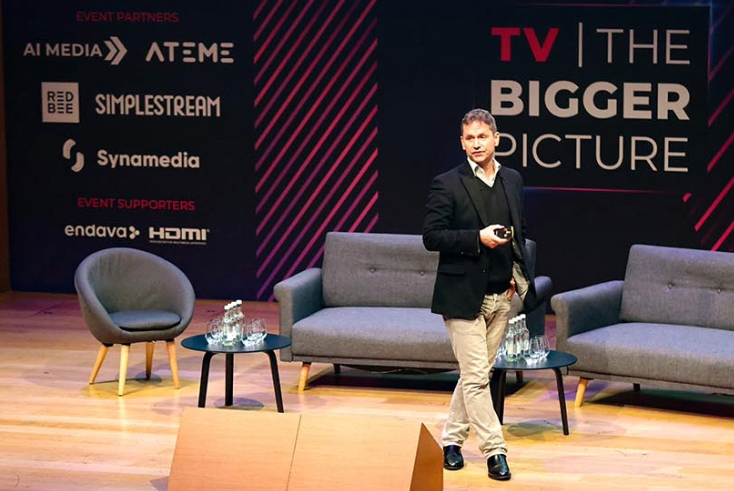
Speaking at DTG Summit in May (pictured above), Whittaker says of the new advertising opportunity: “There is a two-tier advertising market.
“The first is big advertiser spending, from the likes of P&G and Unilever. Most of the world’s advertising is in the second tier, from the long-tail SME (small to medium enterprise) market that Meta and Google control.
“85% of Meta’s money is from the SME market.
“Traditional media owners hardly have a foothold here. The SME advertising market is expanding very quickly, which is why digital platforms are doing well.”
Whittaker characterises a risk-averse investment market today, and this could have positive implications for big brand advertising, however.
He views advertising as a risk management for brands, saying, “When the cost of capital stays high, the brands that protect their advertising investment beat the ones that fold to performance budgets.
“The CFO conversation [with marketers at brands] becomes the strategic conversation.”
Risk-averse investment market
Risk was a key theme of his presentation. He believes recent M&A and partnership activity across the TV industry can be explained by investors’ desire to reduce their exposure to the TV industry.
“The market is looking for stability, and I think this will determine the action in the streaming space,” he suggests.
“The age of making risky bets is gone. The market wants stability and security, which is why streaming services now focus on ARPU growth and profitability rather than growth alone.
“The market forced that change.”
Even low-growth assets could be rated highly if they offer stability, he explains.
Whittaker listed the types of media companies that, over five years, can reduce risk and capture value for shareholders.
He pointed to Apple, Amazon and increasingly Disney as companies with the ability to reduce churn risks by bundling different products. Bundling reprices streaming assets favourably, he said.
All these companies have cash. He added Netflix to this category of leaders, calling it “the profitable tier that will be the market leaders”.
He reiterated that some investors would start to view intellectual property as infrastructure, thereby attracting infrastructure-style capital investment.
Media owners with sports rights and premium catalogues would be beneficiaries (alongside music publishing).
Re-rating media owner values
This trend benefits broadcasters ready to harness what he called a ‘library thesis’. “A library re-rate is the cleanest credit-positive narrative they have,” he declared.
He is describing the re-evaluation of media owner values based on their content libraries.
At the UK conference, Whittaker listed BBC Studios, ITV Studios and Banijay-style production companies as examples of companies that can benefit from a ‘library re-rate’.
He also listed the types of companies that will carry structural exposure over the next five years.
These include what he calls sub-scale standalone streamers, who will need to “either consolidate, get bought or run a wasting-asset scenario.” Without these fixes, these media owners will see the cost of capital rising faster than their ARPU (average revenue per user).
They will have to go niche [focus on a genre-based fan base] or consolidate, he suggested.
Broadcasters without a ‘library thesis’ are also among the at-risk media owners.
“Their library is treated as a wasting asset rather than a second monetisation curve and their [investment value] multiple decays accordingly,” Whittaker states.