



Two-thirds of UK news articles about wildfires this summer haven’t mentioned climate change
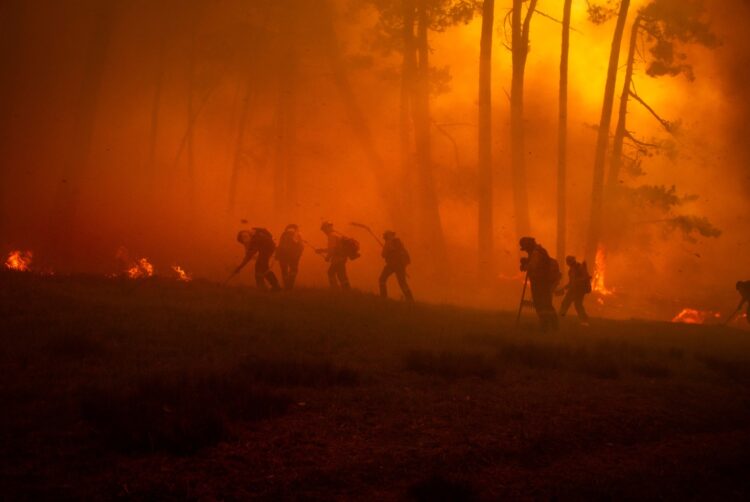
Two-thirds (65.4%) of articles in UK national newspapers that referenced wildfires this summer amid record-breaking temperatures and a lack of rainfall failed to mention climate change.
That is according to media analysis conducted by the non-profit Energy and Climate Intelligence Unit (ECIU), which also found that just 2.9% of articles referring to wildfires or climate change also mentioned “net zero.”
The latest study builds on earlier research by the ECIU, which found that 72% of coverage of the UK’s June heatwaves likewise failed to mention climate change. An analysis by Climate News Tracker in May found that more than half (54%) of UK TV and radio news coverage of that month’s heatwave also failed to link it to climate change.
Last week, the UK experienced its fifth heatwave of the summer, with temperatures surpassing 38 degrees Celsius. 71.3% of England is currently experiencing drought conditions.
Using the news monitoring tool Factiva, the ECIU’s analysis examined all articles (excluding live blogs) relating to the wildfires by nine UK national newspapers: The Daily Telegraph, The Times, the Financial Times, The Independent, The Guardian, the Daily Mail, the Daily Express, The Sun, and the Daily Mirror. It covered the period from 22 May (the date of the first heat-health alert of 2026) to 31 July, accounting for 2806 articles.
The ECIU found that mentions of climate change (defined as any use of the terms “climate”, “climate change”, “climate crisis”, “climate emergency”, “global warming”, or “global heating”) varied widely by newspaper.
The Financial Times (64.4%) and The Guardian (63.7%) were the only two newspapers to mention climate change in a majority of articles about wildfires. In contrast, The Telegraph (32.2%) and The Times (34.2%) mentioned climate change in just one-third of such articles. Tabloids, the Daily Mail (26.8%), Daily Express (26.2%) and Daily Mirror (21.9%) did so in one out of every four or five articles.
The Sun mentioned climate change by far the least, in just 5.8% of articles about the wildfires.
By volume, the online-only Independent published by far the most articles about wildfires during the review period (689). In contrast, the Financial Times published the fewest (180).
Will Vowell, an analyst in the climate intelligence unit at the ECIU, told The Media Leader that there could be reasonable explanations for why media coverage does not link wildfires to climate change in every case. “Most people would acknowledge that wildfires often start through other means such as a disposable barbecue, arson, etc, and perhaps the media have been focussing more on that specific source,” he offered.
But what scientists have been clear about, he continued, is that climate change has made the conditions for fires to start and spread more likely. Indeed, scientists from World Weather Attribution have concluded conditions caused by climate change made the blazes in Spain this summer 20 times more likely, and twice as likely in France. Vowell argued this causal relationship is not being reflected in the vast majority of British news coverage.
“This, along with our recent analysis showing that heatwave coverage is also omitting mention of climate change, suggests broader issues with media coverage of extreme weather events and climate change impacts,” Vowell said.
The same applies to coverage of net zero goals. No newspaper mentioned “net zero” in articles that also mentioned wildfires and climate change more than one-tenth of the time, with all but three papers (The Telegraph, the Financial Times and The Guardian) mentioning net zero in fewer than 2.5% of such articles.
It is worth noting that the simple mention of climate change or net zero in such coverage does not necessarily mean the coverage has been in favour of embracing net zero policies.
Much of The Telegraph‘s recent reporting on net zero, for example, has focused on homes being damaged by solar panels, “net zero pylons” reducing home valuations, green investments leaving pensioners worse off, and net zero farming policies raising the risk of wildfires.
The Times has likewise run articles on how net zero “risks blackouts and higher bills”, amid other costs for households, without apparent consideration for the financial cost of doing nothing.
As Media Leader columnist Raymond Snoddy argues, coverage of this summer’s extreme heat has regularly been pushed off the front pages of right-wing press in particular, which are also “replete with columnists who are either climate change sceptics or who downplay the threat.”
Experts have concluded that achieving net zero carbon emissions is a requirement to slow and eventually halt climate change, with global carbon emissions needing to reach net zero by around mid-century to meet Paris Agreement goals of limiting average global temperature rises to 1.5 degrees Celsius. As Jim Skea, chair of the Intergovernmental Panel on Climate Change told the Financial Times‘ Pilita Clark last week, “If you don’t get to net zero, the world will continue warming.”
The heat is on for the press to start taking climate change seriously
As Vowell has previously written, ECIU research has shown that news coverage of net zero goals has become “increasingly divorced from climate change in media coverage”, leading to public confusion over what net zero is.
A YouGov poll conducted in partnership with Climate Barometer last year found that the UK public still broadly supports net zero (63%), but 22% wrongly believe net zero means producing no carbon emissions at all.
Concern around the UK press’ heatwave coverage led a group of climate scientists, including Royal Meteorological Society CEO Liz Bentley, to send a letter to UK news organisations last month, urging editors to better link carbon emissions to extreme heat.
The letter, first published in Press Gazette, was addressed to leaders at BBC News, ITV News, Channel 4 News, 5 News, Sky News, and Global, as well as regulators Ofcom and IPSO.
It reads in part:
The UK public are frequently not well served with clear information about the scientifically indisputable connection between greenhouse gas emissions and extreme heat. News stories about heatwaves often do not mention the influence of climate change or the burning of fossil fuels on increased temperatures.
It is essential that the public are well informed about such a crucial issue as climate change, particularly at a time when it is affecting their lives ever more directly and also becoming more debated politically. While it is right to debate policy and implementation, coverage increasingly overlooks the fundamental ‘why’. Net zero is not an arbitrary slogan, but a boundary dictated by the laws of physics.”
The letter recommends that coverage of heatwaves mention “the certain influence of greenhouse gas emissions, primarily from burning fossil fuels, on making extreme heatwaves more intense and frequent”, as well as the conclusion that “extreme heat, among other consequences, will continue to worsen until the world reaches net zero.”
Advertising has contributed to fossil fuel companies’ ‘shifting messaging’, study finds