



Why the future of outdoor advertising is hand-painted
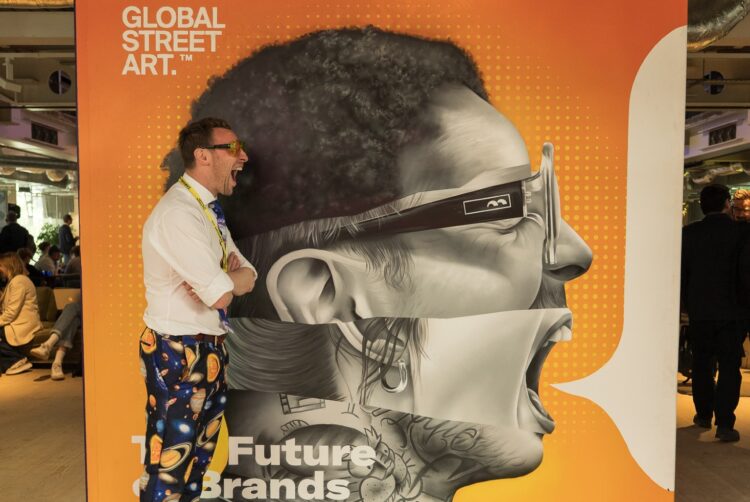
The Media Leader Interview | The Future of OOH Week in Focus
Global Street Art CEO Lee Bofkin offers a peek inside his extraordinary archive and shares why he thinks artistry is undervalued in OOH.
It’s better to make something that people want instead of making people want something.”
Lee Bofkin can typically be found sporting orange-tinted glasses, statement clothing pieces and an endlessly excitable personality.
Holding a master’s degree in biology from the University of Oxford and a PhD in Mathematical Models of DNA Evolution from the University of Cambridge, Bofkin of course works in outdoor advertising.
Since 2012, he has headed up Global Street Art as its CEO. The outfit employs graffiti artists to create hand-painted murals for brands across its inventory of urban wall space.
“Any way you can get onto a wall, we do it,” Bofkin tells The Media Leader. The company’s mission: “To live in painted cities.”
Global Street Art proudly boasts on its website that it “didn’t set out to work in advertising, and that’s assuredly a good thing”. Bofkin warns that, because Global Street Art emerged from the graffiti community, discussions about finances were “the biggest no-no”, as “being seen to make money was like the worst thing you could do.”
Nevertheless, he shares that Global Street Art’s annual turnover is just under £10m, with the majority of revenues deriving from the UK. “Margins suck, we’re trying to fix that a little bit, but that’s because of a high fixed-cost base,” Bofkin shares candidly.
Revenue is driven by the 150 to 200 commercial projects the company completes annually for brands including Nike, Google, Gucci, Burberry, Netflix, Fendi and Bupa. Murals typically take three to five days to paint and on average stay up for a period of four weeks.
The company’s second-largest office is in Belgium, with additional “start-up” offices in France and Spain that are “revenue-generating” albeit comparatively modest. The expansion into the three ex-UK territories occured within the same year, a decision Bofkin acknowledges was “too ambitious, too fast” though he views it as creating “scars not wounds”.
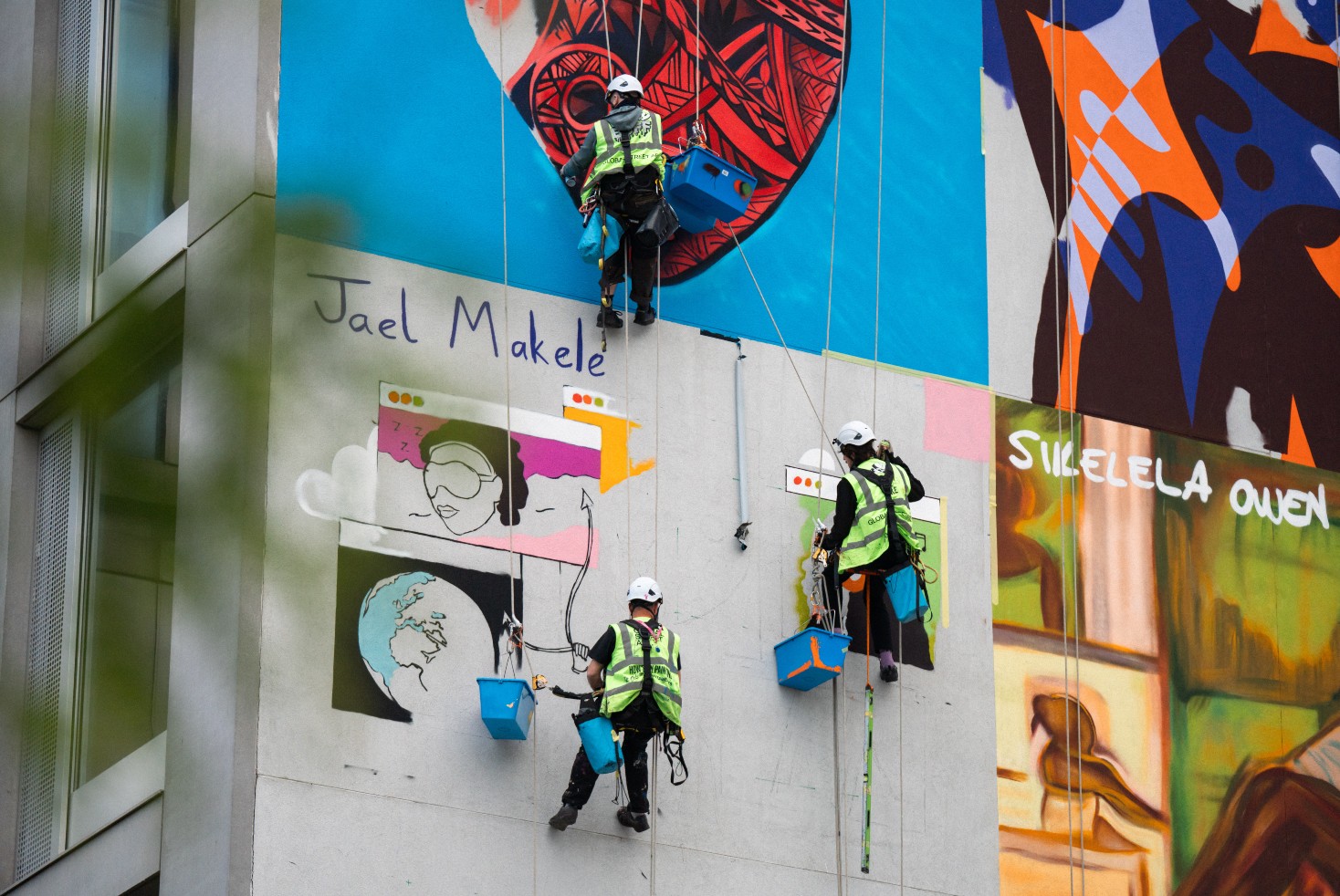
Global Street Art painters abseiling in London’s Waterloo. Image credit: Global Street Art
“The entrepreneur’s trade-off is explore versus exploit,” he says. “And I think like all entrepreneurs, we got too bored too fast and that’s the mistake we made.”
Following the speed of expansion, Bofkin is planning for the next five years to be “painfully boring” as Global Street Art sharpens its go-to-market approach with media buyers.
“We believe that spend in the UK into hand-painted advertising is way lower than it could be,” Bofkin says.
“As an upstart challenger media owner, we’re lucky we’ve got such a brilliant product because it should eat everyone else’s lunch. But having a great product doesn’t mean you have the routes to market.”
Diving into the archives
Apart from displaying and communicating the quality of hand-painted murals, Bofkin has crafted his business persona around helping to improve the wider media industry’s creative process. While he describes Global Street Art as essentially “a property company with an art wrapper,” Bofkin has also positioned the firm as not just a media owner but also an “inspiration partner” for brands, some of which, like Fendi, have adapted murals into merchandise.
The Media Leader was invited on a tour of Global Street Art’s studios in Shoreditch last month to experience both the workspace and a slice of Bofkin and his team’s creative ideation process.
He shares details of mural painting: the company’s artists work interchangeably between liquid and spray paint, with unused paint given away to local artists; murals are typically placed on a wall via a design process known as pouncing, which essentially stencils a sketch onto a wall. The same process, Bofkin points out, was used by Michaelangelo to transfer his designs onto the ceiling of the Sistine Chapel.
Bofkin advises clients to “give us the constraints of a tight brief”, providing a sandbox for Global Street Art’s visual creativity.
Perhaps more than any other media owner CEO, Bofkin has collected a practically endless source of inspiration to pull from. Within Global Street Art’s basement offices is an unmatched archival collection of commercial artwork, from branded lunchboxes and cookie jars to ash trays and tea towels.
“If you want to have an understanding of an industry that produced something, have 500 of what they made,” Bofkin advises.
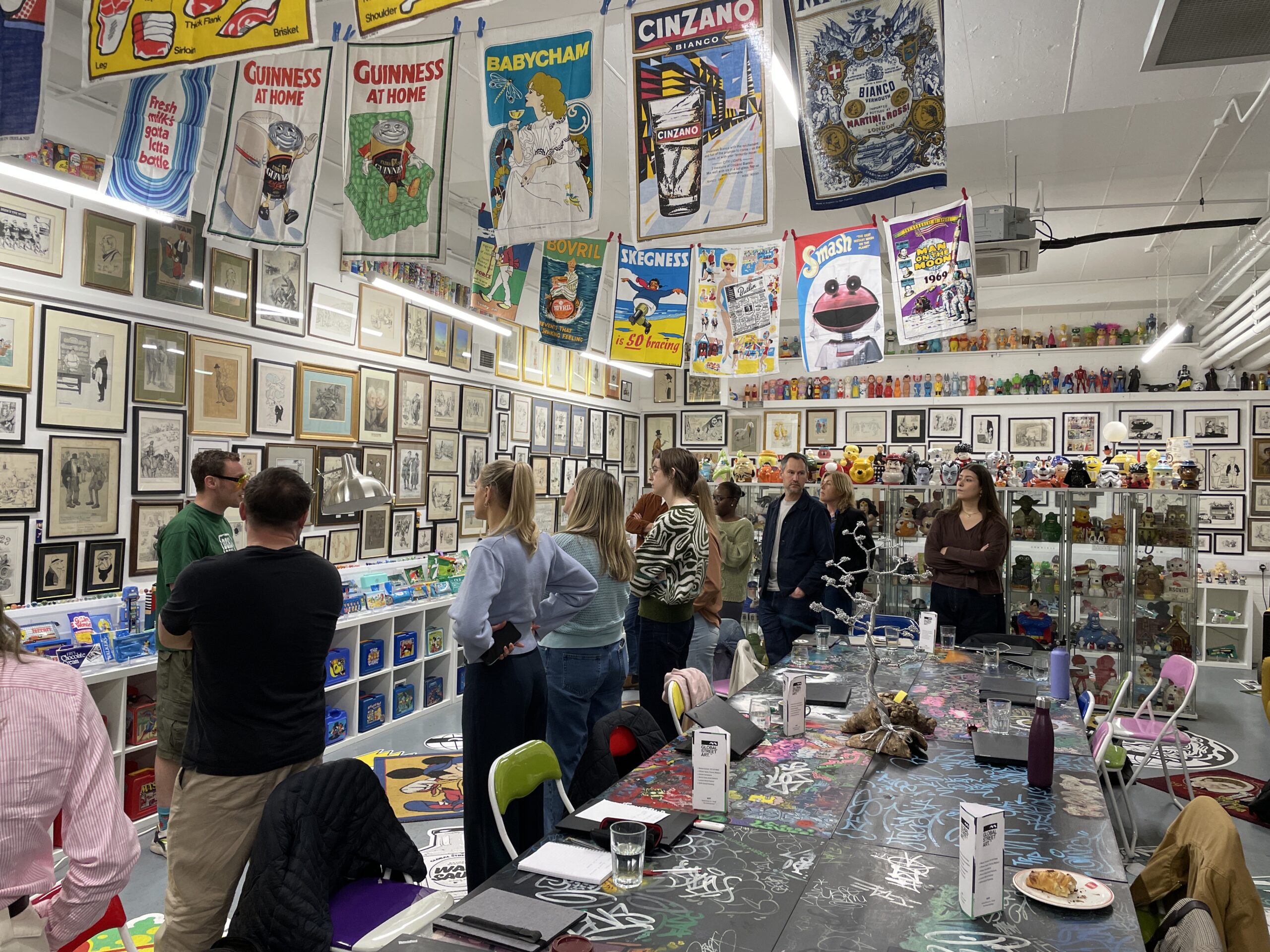
Adwanted UK staff tour Global Street Art’s collection of commercial artwork.
Referencing the tea towels, he argues that poster advertising “has gone backwards in the last 50 years” because technology, especially photography, has created fewer limitations for artists, no longer requiring them to make use of vibrant but limited colour palettes.
Within the archive is an “offline paper collection” of over 1,000 folders stuffed with all kinds of branded paper marketing material: napkins, matchboxes, flyers, crisp packets, postcards, fruit stickers, paper bags, cheese labels, tickets, phone cards, gramophone needle tins, bookmarks, catalogues, bank notes.
“Anything distributed large enough is an advertising channel,” Bofkin says. “Packaging is advertising.”
The 20th century was a unique time in history in which paper products were produced at scale never before seen until the Industrial Revolution, and likely never to be seen again in the digital Information Age. Likewise, as most retail shopping has moved online and industries have globalised, there are generally fewer locally produced and distributed brands operating today, limiting the amount of unique brand creative that is circulated.
But these creative items still have enduring value; for Bofkin and his clients, the archive is a constant source of design inspiration.
“We forget the lessons of this stuff,” he says. “Creative people are really good at connecting the dots. Our goal [with the archive] is to add more dots.”
When asked if he has ever had the collection appraised, Bofkin replies that he believes the cultural and artistic value is effectively priceless.
‘Fuck me, that’s painted’
For Bofkin, Global Street Art’s unique advertising proposition is a double-edged sword. Brands tend to use the hand-painted opportunity as a special activation, often bought through a specialist agency, but Bofkin wishes clients viewed it as “boring media”, as part of a common OOH consideration set (albeit one with exceptional wall assets — “Good luck to any outdoor media owner that tries to compete with us on our space,” he challenges).
He is pragmatic about the concerns of marketers and their only oblique interest in the artistry of his company’s work. Global Street Art has nevertheless organised 3,000 public art murals since 2012, including the annual London Mural Festival, a “massive unsung contribution to public art and culture” that advertising professionals largely don’t consider.
“We’ve had an incredible impact on culture across London,” Bofkin says. “The number of murals, people’s expectations of murals, we’ve shifted the dial on that. But planners, it’s not what they’re focused on.”
He adds, however: “If CMOs and brand people knew that’s what we were doing, they’d probably answer more emails.”
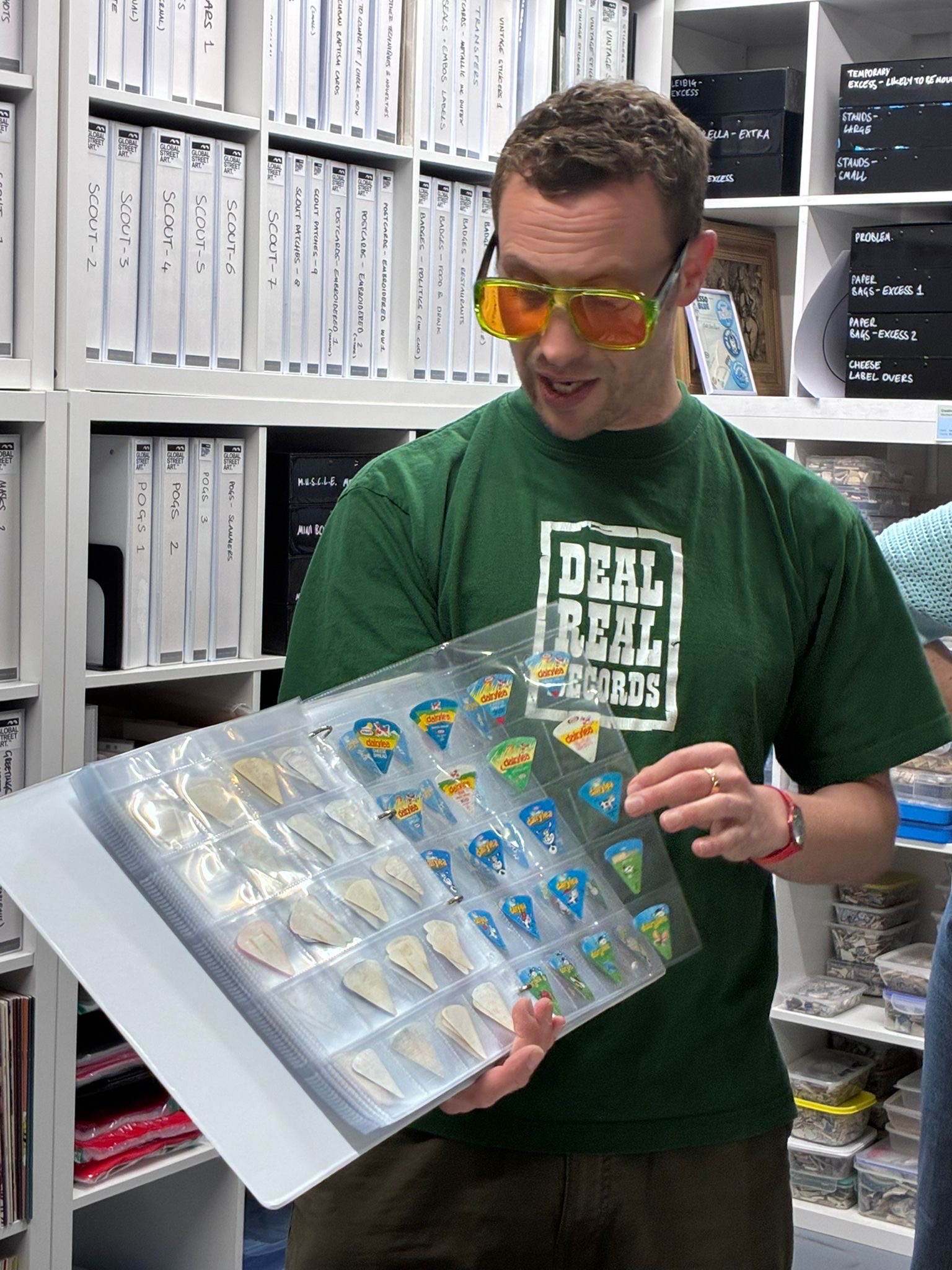
Bofkin shows his archive of cheese labels.
Still, the power of painted OOH is a unique selling point for marketers. As Bofkin says: “No one ever looks at a digital screen and goes, ‘Fuck me, look at that airbrushing.’ But people look at a painting and go, ‘Fuck me, that’s painted.'”
Embracing performance akin to selling OOH short
That pride in handmade output situates Bofkin in a unique position within an OOH market that is rapidly digitising, with digital OOH (DOOH) and automated media buying practices driving market growth.
Some industry leaders have further pushed for OOH to enter its “performance age” by seeking to better prove the channel’s contribution to short-term sales conversions. This has come as spending on sales conversions (“performance”) has dominated media budgets relative to demand-generation (“brand”) efforts.
“If OOH is just about conversion, there are better ways of converting a client, where their wallet is in the same device as something else” Bofkin says, holding up his phone.
He warns that conversion metrics, by definition, overstate their value because they fail to capture who would have purchased a product anyway. Purchasing decisions, he notes, are often long-term developments that are derived from brand equity.
“The path to purchase is messy,” he argues. “We want data that says someone saw my billboard and made a purchase, but you can’t measure that. […] Obviously OOH needs to have an ROI greater than one, because otherwise why would you bother. But the look-back period is longer. And the longer the look-back period is, the more conflated the data is with other factors.”
Bofkin also believes OOH’s move to embrace digital screens is “devaluing the medium a little bit” by reducing share of voice for individual advertisers by rotating through several different ads on a single screen at once. This contrasts with the 100% share of voice delivered by Global Street Art’s murals as well as similar high-impact poster imagery.
“If you’re in demand generation, and now all of a sudden you’re trying to compete on performance, I think you’re selling yourself short,” Bofkin adds.
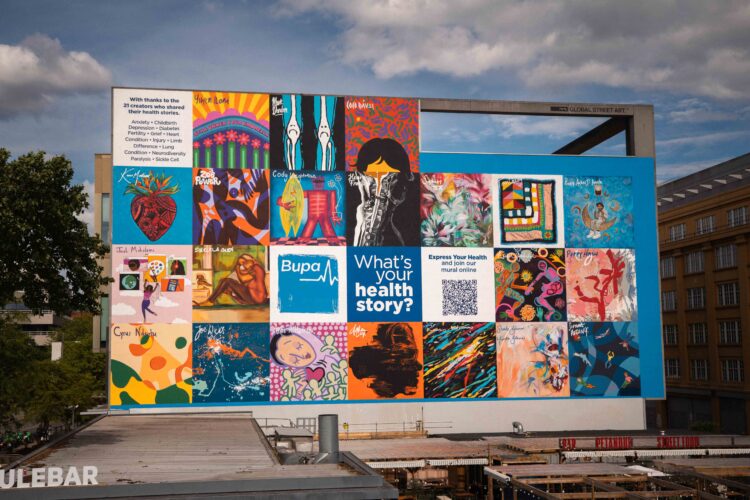
A 780-square foot mural completed for Bupa. “It was a monster.” Image credit: Global Street Art
For him, the value of OOH is that it’s a peacock, a way to engage in costly signalling within a trusted medium.
“If you spend enough to get on a billboard, people are more likely to trust it than a spam ad you can report for being fraudulent,” he continues. “Trust in OOH advertising is relatively high, and the costly signalling of painting it? You can’t get more craft than that.”
OOH has always benefitted from high earned media value, with especially attention-grabbing activations often photographed and shared on social media. Painting, Bofkin argues, is particularly shareable, allowing OOH to “play the platform game”, albeit outside of a performance context.
“Painting makes content,” he says. “We painted a 780-square meter mural with six artists by abseil for 12 days straight. It was the equivalent of 22 murals in one building. It was a monster. But each of those sections was designed by someone. It was content. And in an era of AI slop, authentic human content should count for more.”
Insisting Global Street Art represents “the most human form of OOH”, Bofkin says hand-painted artwork competes well not just for earned media, but also on dwell time and emotional response relative to posters.
But ultimately, what success comes down to is the belief that artists will create remarkable, quality work on behalf of clients.
“What I think we’re selling, because the product is handmade, is reassurance,” says Bofkin.
“It’s either finished and it’s perfect, or it’s not finished.”