



AI-driven advertising to account for one-third of digital adspend by 2030, IAB UK forecasts

AI-driven adspend in the UK is forecast to hit £18bn in 2030, accounting for 32% of all digital adspend.
That is according to IAB UK’s latest survey of 200 advertisers. The State of AI in Advertising: Charting the Shift from Automation to Autonomy, found a digital ad market that is rapidly shifting to agentic marketing workflows.
More than half (58%) of IAB UK members reported already experimenting with or piloting agentic AI within their organisations. An additional 12% say they are scaling agentic systems, while 4% are already operating on an “agent-first” basis.
IAB UK defines “AI-driven” advertising as “a media buying and delivery decision which is made by an AI-powered algorithm”. This is distinct from brands using AI in earlier stages of media planning or creative development.
Current top use cases for AI reported by advertisers include creative optimisation and personalisation (41%); analytics (41%); media planning (39%); audience insights and analytics (38%); and written content generation (37%)
Google launches AI marketing assistant as it expands search and agentic commerce advertising options
Trust issue
The relative lack of early “agent-first” adopters comes as advertisers warn of ongoing concerns around transparency, governance, data security and accountability in fully automated media buying.
Trust is a broad issue. Nearly half (47%) of advertisers told IAB UK they do not trust agents in advertisers due to a lack of transparency in how they make decisions. This rises to 67% among IAB UK members.
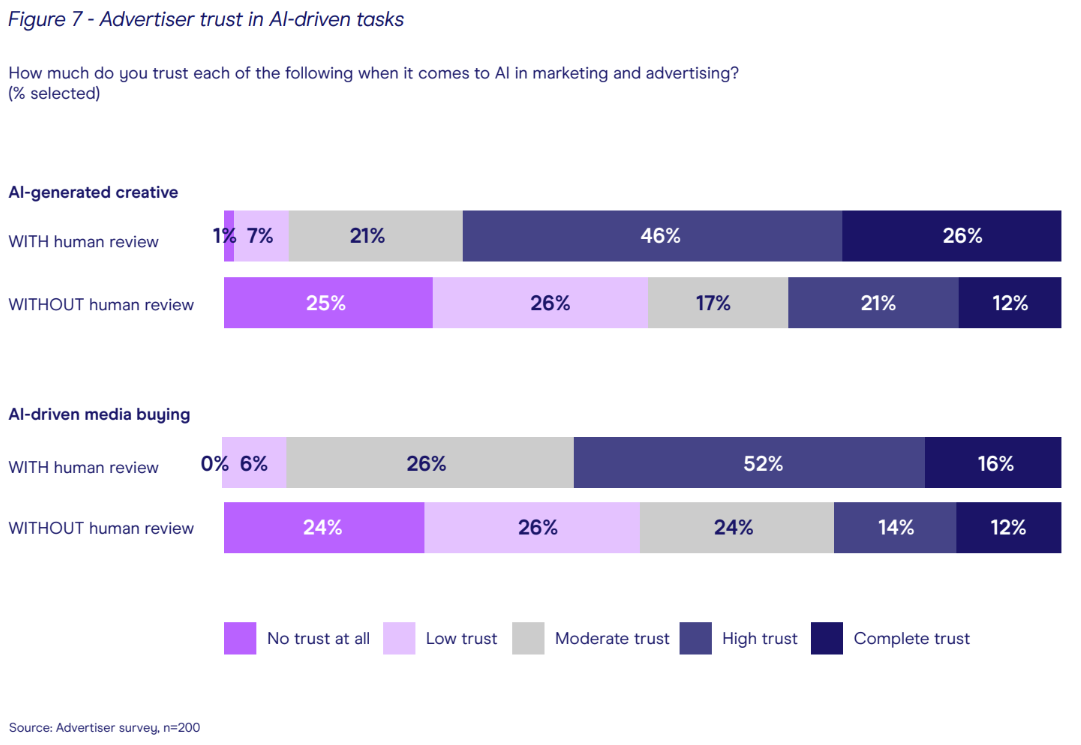
Maintaining human review processes for AI material does substantially improve trust, however. For example, a majority (51%) of advertisers have low or no trust in AI-driven media buying that is not reviewed by humans, but this decreases to just 6% if humans are kept in the loop.
“We are now seeing the emergence of agentic systems that can actively participate in media planning, optimisation, creative adaptation and commerce,” described IAB UK chief strategy officer James Chandler.
“The opportunity is significant, but the industry also needs to solve for transparency, accountability and interoperability if AI is to scale sustainably.”
Five things I’ve discovered after a year of talking weekly about AI
Search upheaval
IAB UK members reported expecting the strongest near-term commercial impact to come through such AI-powered solutions in search, social and programmatic advertising, especially as tech platforms, such as Google, Meta and Amazon.
Nearly two-thirds (63%) also expect AI to have an “accelerating or transformative impact” on creative development within the next year.
Meanwhile, two-thirds of advertisers reported already introducing changes to how they structure their website, metadata and content strategies to better align with generative engine optimisation (GEO) best practices.
This is occurring even as three-fourths (74%) likewise believe AI summaries are actively reducing traffic to brand websites.
The report reads: “As zero-click moves focus away from keyword intent to wider journey intent, the bigger opportunity is likely to be around sponsored discovery and consideration.”
IAB UK asks the Government to create ‘right environment’ for AI-driven ad market growth