



Google launches AI marketing assistant as it expands search and agentic commerce advertising options
We’re moving from marketing automation to marketing intelligence.”
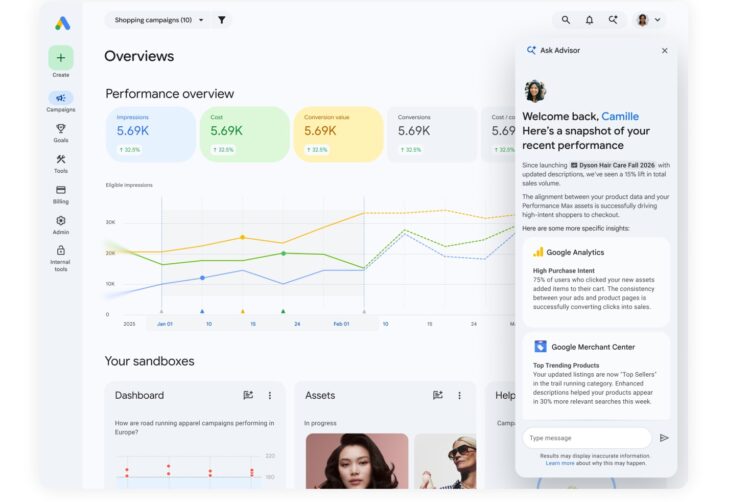
Dan Taylor, Google’s global ads VP, outlined a series of innovations for marketers at the tech giant’s annual Marketing Live event yesterday. They include expanding ad formats across AI Mode and search, rolling out its Universal Commerce Protocol (UCP) in AI Mode and YouTube, and a “Ask Advisor” AI marketing assistant to help brands automate campaigns across Google’s inventory.
The changes come as Google revamps its traditional search experience, eschewing the “ten blue links” in favour of more AI search features, making it even less likely that users click on links to find information from around the web.
The development of conversational AI queries and answers is changing search behaviour beyond clickthrough rates. People now ask longer, multi-turn queries, Taylor described, with the average search query tripling in Google’s AI Mode compared to its traditional search product. One in six AI Mode queries now use voice control or uploaded images as search moves beyond text.
Taylor argued that AI is creating an “expansionary opportunity” for advertisers by simplifying the inputs marketers need to run effective campaigns and making them more effective. He claimed Gemini, Google’s large-language model (LLM), has driven a 40% reduction in “irrelevant ads” served to users because the model better “understands intent”.
Insights from chatbot conversations, Taylor suggested, are beneficial to advertisers seeking to better understand consumers holistically.
Ask Advisor
For brands, however, Google is now offering to automate the vast majority of marketing practices, with Taylor unveiling Ask Advisor, its AI marketing assistant.
Ask Advisor provides “a single continuous conversation” with marketers across Google’s full advertising product suite, including Google Ads, Merchant Centre, Google Analytics and other platforms.
Taylor referred to Ask Advisor as an “always-on strategic partner” that can make recommendations and take actions across Google’s marketing solutions.
In a demonstration video, Google described, “All you need to do is ask the assistant to create a media plan or creative assets, and it will generate and act on them.” For example, a marketer can type, “I want to focus on new Dyson customers”, and the tool can offer and act upon a plan to do so.
Is AI accelerating Google, Meta and Amazon’s dominance? Takeaways from Big Tech’s Q1
With Ask Advisor, Google is seemingly wading into the territory more traditionally served by media and creative agencies. As Meta CEO Mark Zuckerberg espoused last year, tech platforms are broadly moving to automate the entire planning, buying, and creative process for advertisers by leveraging data from billions of historical ad campaigns.
Such tools can be especially useful to smaller businesses, many of which are unlikely to be able to afford the services agencies provide.
As Taylor described: “Marketers can spend less time running campaigns and more time running their business.”
AI search ads expansion
The new AI-driven marketing features come as Google looks to overhaul its search experience in favour of a conversational interface with agentic features, rather than the classical list of ranked links to websites. At the company’s annual I/O Summit on Tuesday, Google revealed that its AI search agents will effectively search the web for users. As TechCrunch described, “links will become an afterthought.”
This new search experience has already received backlash from journalists and academics who have warned that Google’s AI responses to queries may be fallible and will further undermine referral traffic to the online publishers from which Google’s AI is deriving information, placing publisher business models at risk.
The break from traditional search experiences has already driven one senior editor at New Scientist to design and share a prompt to get Google’s AI search to simply deliver a list of links.
But a new search experience requires new ad formats, and Google has unveiled two new such innovations for its AI Mode, as well as an expansion of direct offers on the feature.
Conversational Discovery Ads are designed to trigger when users ask complex questions, such as “what is the lowest maintenance way to make their house smell like a spa”. Gemini then uses the context of that query to “generate a customised ad creative from a business that offers a solution”, according to Taylor.
The other new ad format is dubbed Highlighted Answers. This triggers when AI Mode curates a recommended list. Within this, an advertiser can appear as a featured (highlighted) recommendation “if it’s high quality and relevant to the search”.
Publishers advised to be ‘niche at scale’ amid the winding road to Google Zero
In both cases, the advertiser’s creative will be paired with an “independent AI explainer”, Taylor said, with Gemini evaluating whether a product or service is relevant to the query. Ads will continue to be labelled as sponsored.
It is not clear whether or how advertisers will retain control over how their brands appear in these formats, given that the process is automated.
The tech giant also revealed new ad formats for its now-standard AI Overviews search results, including AI-powered shopping ads that can appear alongside query responses.
As Taylor described, the format surfaces “relevant shopping ads along with an AI explainer about why it might be the right choice [for purchase], anticipating specific needs before the person even asks.”
In addition, Google is launching Business Agents for Leads, which Taylor described as a “brand agent”. In the search experience, users can now “speak” with agents trained on an advertiser’s website to ask it questions about a given product or service.
Shoppable everything
The tech giant is also embracing commerce, turning each of its consumer products into a shoppable experience via UCP. Earlier this year, Google launched the single-item checkout experience in search, which is soon expanding to a multi-item checkout experience.
As Ashish Gupta, Google’s VP/GM of merchant shopping, explained, consumers “are really embracing AI for shopping, driving a transition towards agentic commerce where AI actually takes action on behalf of shoppers.”
Google will roll out UCP in AI Mode and on YouTube, allowing people to purchase relevant items without leaving the chatbot or the video-playing app. Following testing in the US, the global rollout will begin in Canada and Australia in the coming weeks before launching in the UK later this year.
Why shoppability is becoming infrastructure across content, media, and platforms
Additional features coming to UCP include options to book travel and food delivery services, as well as a buy now, pay later scheme for Google Pay users. Merchants will now also be able to display member-exclusive pricing across Google’s wider shopping experience.
Despite the additions, Gupta reiterated Google’s position that it does not see itself as a “retailer” nor a “marketplace” but rather as a “matchmaker” that connects shoppers with businesses, though it is unclear how this is distinct from a “marketplace”.
MMM is coming to Google Analytics 360
The Marketing Live event highlighted several additional AI developments, including an upgrade to its Asset Studio AI creative hub that allows marketers to upload their marketing briefs and an expansion of Google’s Demand Gen feature to Google Maps.
Notably, Google Analytics is integrating Google’s open-source marketing mixed modelling (MMM) tool, Meridian, allowing advertisers to unify first-party and cross-channel data and engage with “predictive scenarios” based on past campaign results.
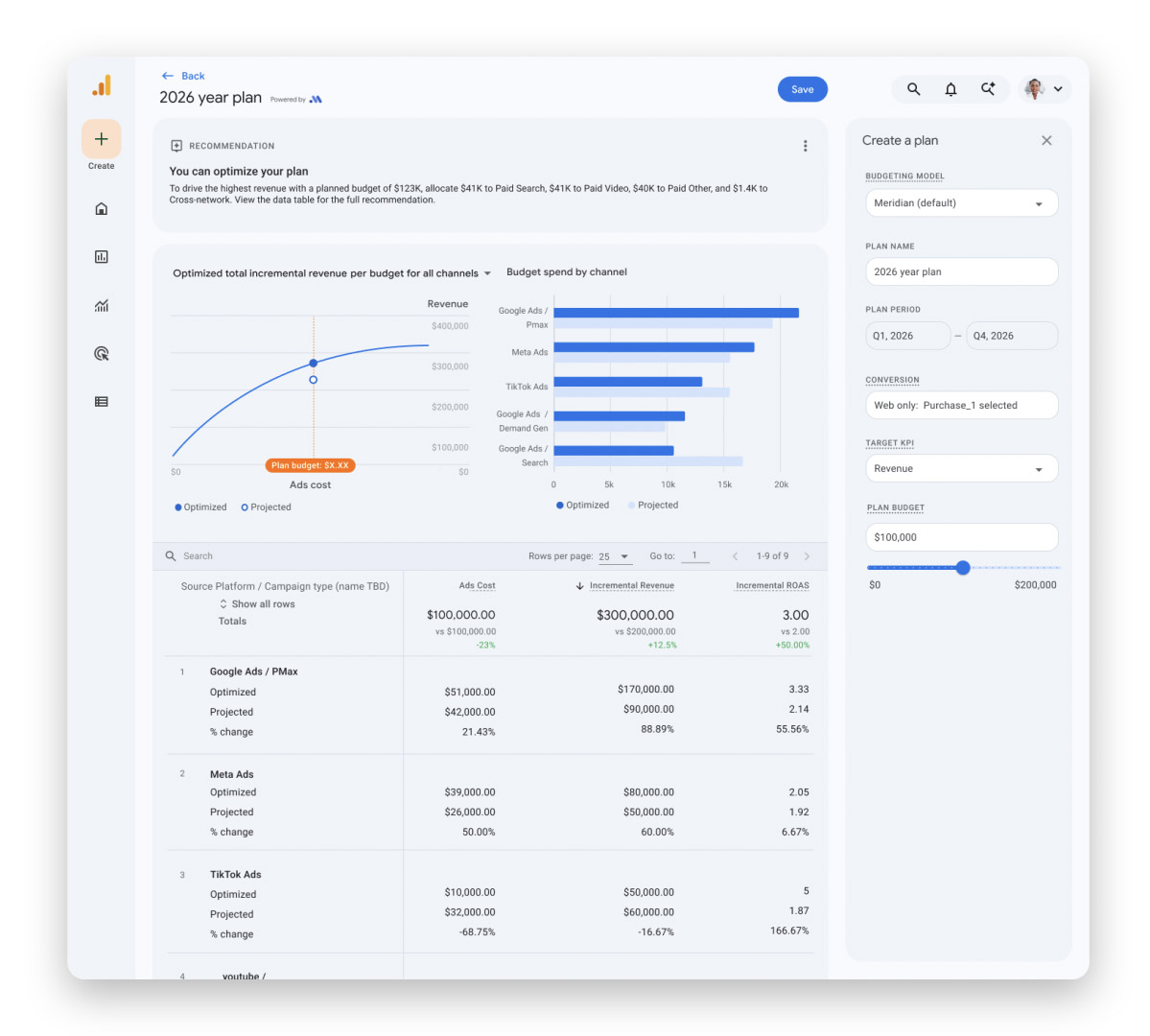
“Brilliant, creative, and expanded campaign opportunities really only matter if they drive the AI toward a marketer’s specific business goal,” Taylor said. “Measurement is no longer just a report card; it’s an unlock to guide AI where to invest next.”
Taylor concluded: “I see 2026 as the year we fully transition from AI’s potential to AI’s everyday reality.”