



AI search is reducing traffic to brand websites — but not sales
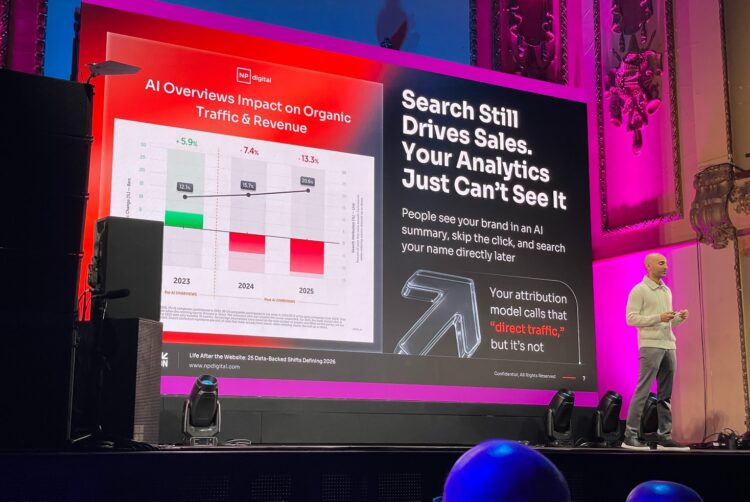
Brand websites are seeing steep declines in traffic as Google has embraced AI search, but online sales have grown despite this.
That is one conclusion made by Neil Patel, co-founder of American digital marketing firm NP Digital, during a presentation on the “death of the website” at SXSW London last week.
Patel noted that the majority of brand websites, like most online publishers, have seen their organic traffic decline over the past two to three years. Following the introduction of Google’s AI Overviews, web traffic to brands fell by 7.4% year-on-year in 2024 and by a further 13.3% in 2025.
Importantly, AI search is still driving sales for brands. Before Google introduced AI Overviews in 2023, the percentage of sales attributed to consumers from search was 12.1%. This grew to 15.7% in 2024 and to 20.6% in 2025.
“If you do things right, you’re actually seeing revenue growth,” Patel said. “The website isn’t dead, the journey has just changed.”
Whereas consumers used to conduct product research via keyword searches and clicking links to various websites, including brand websites, that research phase is now conducted on platforms using AI tools, not websites. But, crucially, at least for now, consumers are still going direct to websites to make purchases.
Brand attribution models refer to this as “direct traffic”, but as Patel argued, in reality this traffic consists of “AI-driven conversions”, 40% of which will never be trackable with current technology.
Patel outlined that AI search is in fact driving a high proportion of sales. While traditional search brings in 50x more visitors than AI search, it currently generates only twice as many sales.
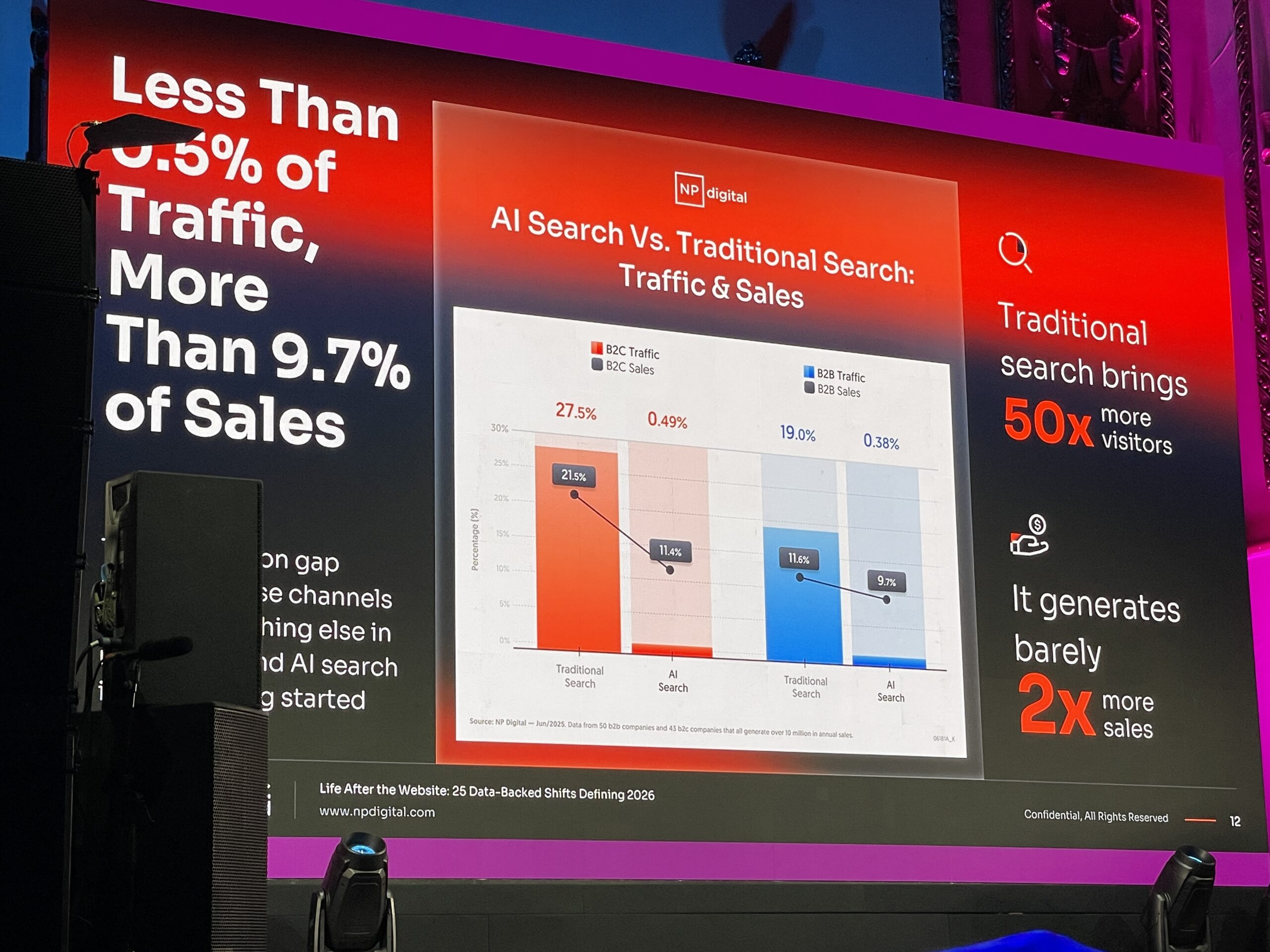
This is important for brands, as one-third (36%) of consumers are currently turning to AI search for answers to queries rather than traditional search, and this number is only set to increase as Google rolls out its recent changes to the search experience beyond the US market.
What brand website visitors do come via AI search, Patel said, are the highest-converting digital visitors he has ever seen.
What makes AI cite you?
Patel outlined that there are three major players in consumer AI search currently: Google, OpenAI and Meta, with the latter particularly underestimated by brands (Instagram, Patel argued, should be seen as a major search engine).
How do brands get cited by these companies’ large language models (LLMs) in response to queries? Not by Google rankings; as Patel shared, there is little overlap between a website being referenced by a chatbot and it showing up in Google’s first 10 pages of traditional search.
Rather, chatbots draw from a mix of social platforms, forums, old-school blogs, and news publishers.
Patel said all brands must be developing Reddit strategies in particular, as a plurality of content LLMs cite are derived from user-generated content on the platform. Other major platforms currently being overweighted by LLMs include Wikipedia, YouTube, Quora and the long tail of “random blogs”.
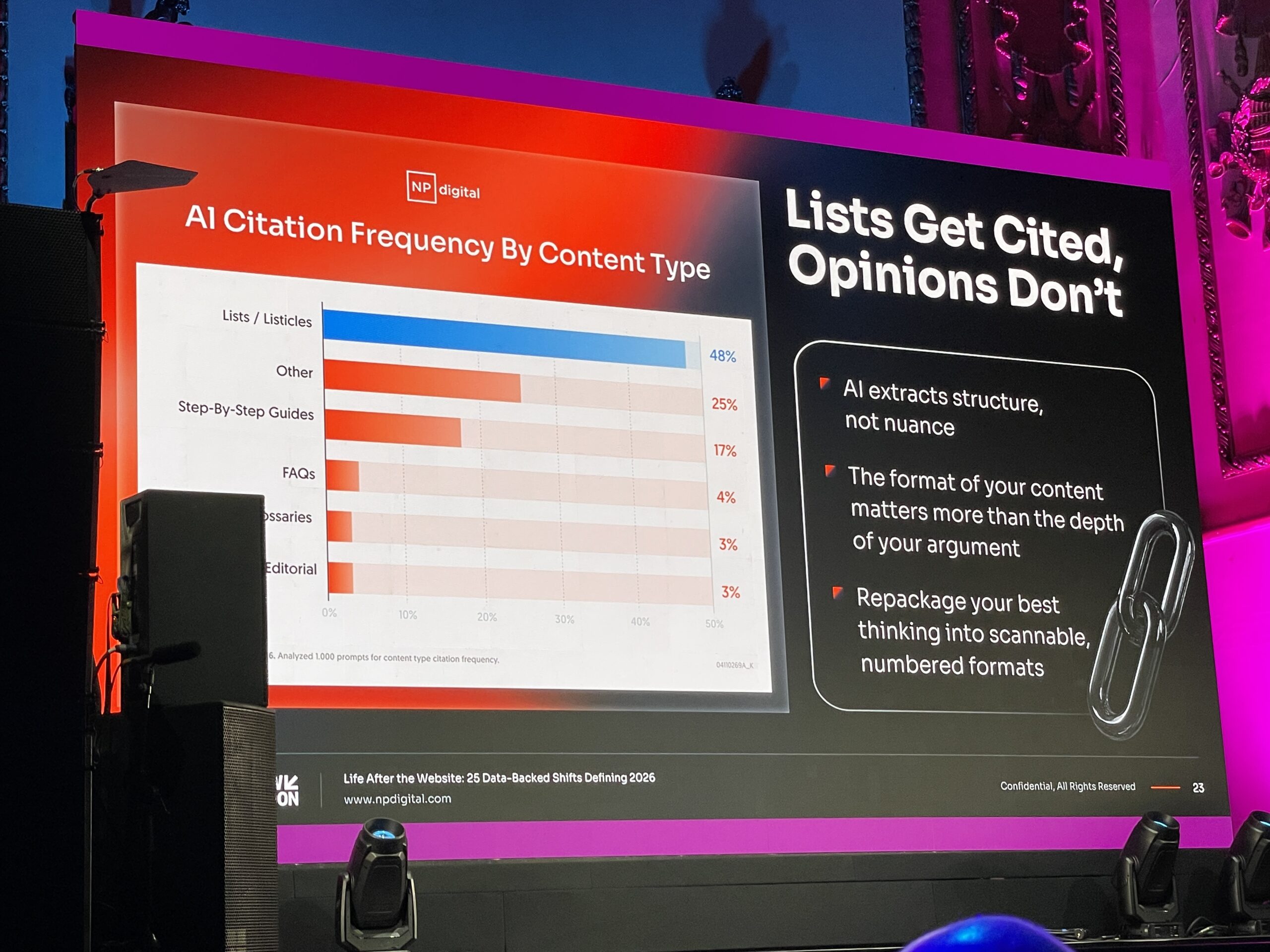
Breaking down AI citation frequency by content type is also illuminating: 48% of AI citations are derived from listicles, according to Patel’s analysis. This is compared with 17% for step-by-step guides and just 3% for editorial content.
Of these, “fresh” or otherwise recent articles are more likely to be cited than older ones, as in traditional search.
Advice: Invest in ‘digital PR’
Patel advised that brands should consider public relations and brand advertising as core to their generative engine optimisation (GEO) strategies. “Invest in brand, it lifts everything else,” he said.
He acknowledged KPIs will need to shift for online brands, with a greater focus on incrementality lift and share of voice in search viewed as indicators of success.
Patel’s main strategy recommendation is to focus on what he called “digital PR”. He explained: “You want [published] articles to mention you in a specific way, in a specific sentiment, that showcases how your product, your service, your business is better than the competition.”
Ceding power to platforms
Speaking to The Media Leader after delivering his presentation, Patel acknowledged that the development of AI search has harmed publishers, many of which are now selling their data to third parties like AI companies which, in some cases, is now driving more revenue “than they are making per visitor from ads.” This is causing many publishers to embrace subscription models.
When asked whether the changing search landscape is healthy for the open web, for brands, and for publishers driving original content creation, Patel replied: “I wouldn’t look at it as whether it is healthy or not. I just look at it as a reality.”
Patel took a similar stance when prodded about what will happen to brands when the tech giants integrate shoppable features across their portfolios, as Google has signalled it is coming to AI Mode and YouTube later this year.
“Do you care? Or do you care if you just get the revenue?” Patel asked rhetorically. “Do you really care if Amazon is the one driving your sale? You just want the revenue as a business. Sure, you may prefer them to go to your website to collect their information and be more first-hand, but you tend to get a lot of that anyway because they’ll have to pass it through.”
How brands can win authority in LLMs – with Havas, Heineken and Publicis
Patel continued: “Companies shouldn’t care if someone buys a product on Instagram directly or goes to their website. You should just want the sale, want it to be profitable, and you should want the customer to have a great experience.”
Patel acknowledged that he believes this is the right strategy, even though platforms would increasingly take a cut of sales if products are sold through shoppable features rather than directly from the brand website. Amazon, he noted, takes a 15% cut of sales.
“But how much are [brands] spending on marketing? Based on our analysis, the amount you spend on marketing for your website is roughly the same. Sometimes you’re spending even more on your website to get them directly.”
“The new reality,” Patel acknowledged, is that tech platforms will have even greater power over global commerce.