



Beehiiv launches programmatic advertising, community-building features
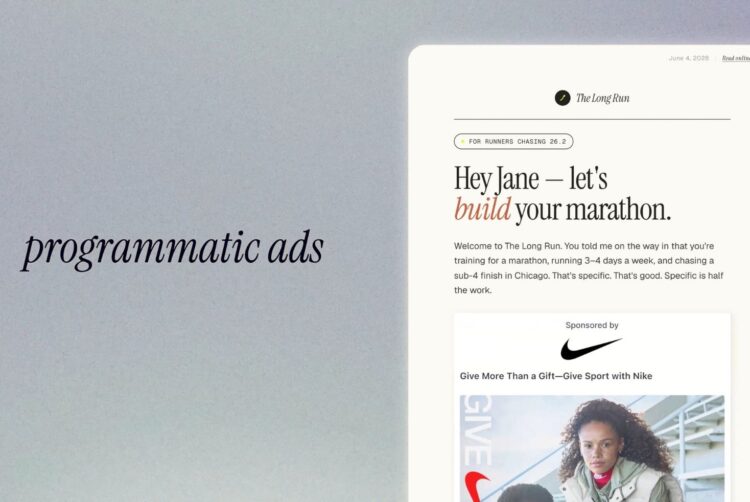
 Newsletter-first content platform Beehiiv is introducing programmatic ads as part of a broader update to its creator services.
“What YouTube did for video, we want to do for newsletters,” declared Tyler Denk, Beehiiv’s CEO.
Programmatic ads will be available to all writers on the platform’s paid tiers. While the option will at first be limited to placing ads within newsletters and websites, Denk outlined that Beehiiv’s ambition is to soon facilitate advertisers’ ability to sponsor across podcast content on Beehiiv as well.
Denk described that Beehiiv’s take rate — its cut of programmatic ad revenue — will be flexible. “We typically hover in the 15-20% range,” he said. “Obviously [with] very competitive ads, we take less because we want to pay out more.”
Beehiiv first dipped its toes into advertising with the launch of its Ad Network in 2022. The feature allows Beehiiv to present sponsored ad opportunities to opted-in publishers within the platform, allowing them to accept or decline payments.
This winter, the Ad Network expanded to include “On-Demand Ads”, which presents publishers with sponsorships when they type in “\ad” into their site’s editor, rather than needing to wait for deals to surface. Publishers can then manually choose which ad they would like to surface from a list of potential options.
With programmatic ads, writers will merely need to insert a programmatic ad block, which will be filled automatically with the “most relevant, highest paying [ad] opportunity,” according to Denk.
Advertisers, meanwhile, are given the option to create category exclusions to avoid being placed against content they deem brand unsafe.
Brands seeking to advertise will still need to approach Beehiiv directly. The Media Leader understands Beehiiv leadership has discussed integrating with demand-side platforms (DSPs) in the long-term, but that this is not something the company is currently actively pursuing.
“We’re still powering it, it’s not like we’re licensing it out to a DSP,” Denk said. “It’s all of our ad inventory being pushed through it.”
He continued: “It’s our job as a platform, and what our machine learning team does, is understand how quality is the audience and what is the type of opportunity that they see.”
It follows then, that higher-valued ads will generally be delivered to the platform’s most popular newsletters, depending on brands’ targeting goals.
Beehiiv claimed its Ad Network has paid out “millions” to publishers since launch, with newsletters collectively earning “more than $1m per month” from advertisers, including Netflix, Nike, Roku and HubSpot.
In 2025, Beehiiv also launched Direct Sponsorships, a way for publishers to host a “sponsorship storefront” on their own website to manage ad inventory, coordinate scheduling and pricing, invoice advertisers, and insert ad placements. Beehiiv charges a flat $10 fee to facilitate each such direct placement.
Substack and Patreon, Beehiiv’s closest competitors, do not currently offer ads, though Substack has reportedly tested ad integrations.
Unlike those businesses, Beehiiv notably does not take a cut of subscription revenue; its revenue comes from paid tiers and advertising.
Additional monetisation options for writers include metered paywalls, free and paid trials, discounts and promotions, payment tiers, paid webinars and guides, as well as receiving donations and gifts.
Multichannel offering
Beehiiv launched as a Substack competitor in 2021. Founded by Denk and fellow former Morning Brew employees Benjamin Hargett and Jacob Hurd, the company has sought to provide tools for writers and, increasingly, multimedia creators to maintain a direct relationship with their audience.
As of Q2 2026, the company claims to play host to over 170,000 publications serving over 450m unique readers. Beehiiv publications have earned $60m in collective revenue, though this is likely dominated by major titles such as Oliver Darcy’s Status and Carole Cadwalladr’s The Nerve.
Allowing publishers on the platform to integrate programmatic advertising will likely boost that figure and give independent writers a way to more easily monetise their audiences without needing to put up a paywall or manually handle direct sales, let alone employ a sales team.
This spring, Beehiiv also moved into multimedia production, launching podcast hosting and monetisation tools for creators.
Denk outlined that Beehiiv expects to launch dynamically inserted podcast ads sometime in Q3 and to support video hosting “later this year”.
“The most successful creators today are multichannel, and our roadmap has reflected that,” said Denk.
‘The division between church and state isn’t sustainable’: Journalists weigh-up life as a creator
Centralising community
The embrace of advertising comes as part of a wider expansion of features for writers and creators on the platform.
Beehiiv has also launched Community, a feature aimed at helping publishers launch discussion spaces around their newsletters, websites and podcasts. This includes via a full messaging suit inclusive of direct messaging, group chats, and channels à la Slack.
Denk pitched Community as akin to a Discord server or Facebook group dedicated to the publication, aimed at deepening engagement, improving audience retention, and creating new revenue opportunities, such as offering exclusive experiences for paid subscribers.
As a one-to-many service, newsletters often fail to capture the full value of their readers, Denk argued. By integrating community functions within Beehiiv, publishers can, for example, create membership options or host conversations with and between fans.
While Denk said Community meets “by a long shot” Beehiiv writers’ core demands, he tempered that by noting that, given how challenging it is to migrate communities from elsewhere, most communities on Beehiiv will likely be “net new communities.”
The platform has also launched a new visual editor that will eliminate the need for writers to switch between editing and preview modes, and a native AI assistant called Copilot, which can connect to AI agents like Claude and ChatGPT to assist in managing audience, analytics and commercial work.
“Where we see AI fitting in, is can Copilot do all the admin tasks around being the content creator, so creators can spend more time creating the content,” Denk explained.
‘Consolidation that users really want’
Denk explained that Beehiiv wants to offer a way for creators to consolidate the services they use to produce content. Rather than, for example, hosting a website on WordPress, sending out a newsletter via MailChimp, developing a community on Discord, and hosting a podcast via Acast, Beehiiv is aiming to create a single platform to play host to all of it, linking up disparate audience data and providing AI tools to improve ease of use.
“We are the platform where you can run your entire content business,” Denk said, likening Beehiiv to “Shopify for the creator economy.”
He continued: “There’s a trend of consolidation that users really want. […] We’re seeing more and more of our top users go multichannel and launch a community on a third-party platform, or sell a course or a digital product. Managing four or five different platforms with different data siloes is inconvenient. And I think we’re really good at building product.”
When asked why independent journalists and creators would choose to embrace Beehiiv as opposed to competitors like Substack or Patreon, Denk argued that neither competitor “has an all-in-one solution as we do.”
He added: “I think that they cater more to hobbyists, and I think we have much more sophisticated, outcome-oriented operators and creators that are trying to build a business around their content.”
That includes by giving creators the tools to truly customise their websites, unlike how all Substacks broadly look and operate the same way.
Denk also believes Beehiiv is “philosophically different” to Substack and Patreon. He contrasted their “closed, walled garden ecosystems” with Beehiiv’s “open platform” mantra that allows users to connect with an affiliate market or opt to connect a Slack or Discord channel.
“Data portability is really important for us,” he continued. “We don’t want platform lock-in. We think we can do consolidation, and that you can move yur entire business to us. But if you ever change your mind, making it very easy for you to move your business off is very important.
“There’s been a theme of closed ecosystems that have a take rate model, of locking you into the platform and increasing their take over time,” Denk said, calling such a strategy “predatory.”
He concluded: “We are not opinionated on how our users generate revenue. That’s the one thing that we care most passionately about. Where other platforms, I think, are very opinionated of how you use the software and make money and grow, we firmly [believe] every content creator is very different. And we want to empower them to build their business however they want.”