



‘The division between church and state isn’t sustainable’: Journalists weigh-up life as a creator
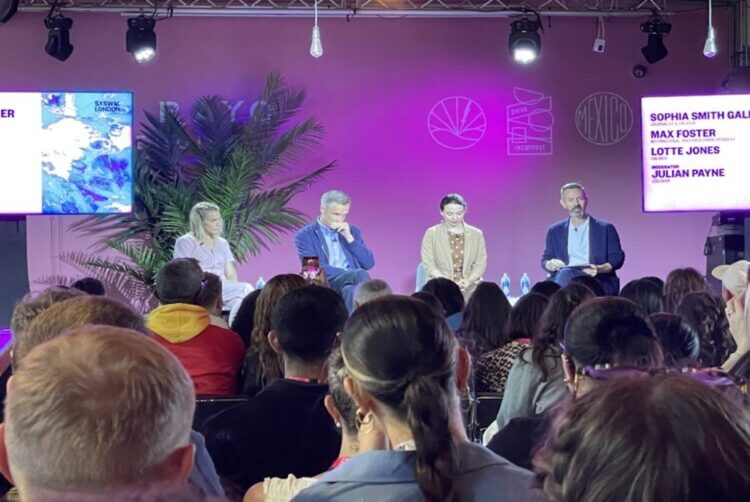
Creators are driving the news agenda.
That was the new reality agreed upon by a panel of journalists at last week’s SXSW London event.
“Audiences still want trusted news sources, but where they’re going for that has changed,” declared Julian Payne, EMEA CEO of communications firm Edelman. “Creators have become the new trusted voices.”
Edelman published its annual Trust Barometer in January. This year’s report found that consumers are “retreating to insularity”, showing increased relunctance to trust news sources from people perceived as different from oneself.
Sophia Smith Galer, an independent journalist who formerly drove the BBC’s TikTok strategy and now runs a “social media storytelling consultancy” named Viralect, agreed that trust is presently being placed in the hands of individuals who are “visible online”, and that the primary way to be visible online is to embrace short-form video platforms like Instagram and TikTok that algorithmically serve content to users.
Smith Galer acknowledged the creator economy of news influencers would not exist without news organisations actually doing the work to break news, but she warned that platform algorithms tend to promote individuals rather than established media brands, creating challenges for how newsrooms manage their staff.
Podcast: can you do complex news justice in one minute videos?
Max Foster, a London-based anchor and correspondent for CNN, now works vertical video production into his standard workflow, producing short-form segments for platforms when news breaks. He views this as a natural extension of his work as an anchor, believing journalists and news influencers can “coexist” even though he agreed the creator ecosystem “can’t exist without the networks doing the reporting.”
While that may be true, Lotte Jones, the chief commercial officer of Caliber, which owns the short-form news outfit The News Movement, argued that news brand mastheads “aren’t helpful anymore”, as they signal negative connotations to audiences by their being “mainstream media”.
Entertainment and opinion, or journalism?
Are rigorous journalistic standards being upheld by individual creators on platforms in the same way as they are on regulated broadcast mediums?
When that question was posed by The Media Leader at the PPA Festival last month, Georgie Holt, CEO and co-founder of Steven Bartlett-backed media and investment company Flight Story, responded with a flurry of questions of her own: “Who sets the standards? Where do the standards lie? Who has the standards? Who holds the standards? Who is the guardian of the standards? Who tells us what the standards are? What is the guardian of the standards? […] I think those standards are being reset and rebuilt.” (Bartlett has been criticised for amplifying harmful health misinformation on his podcast.)
For Foster, “reporting doesn’t change: you have to be accurate, fair and balanced”, with first-hand journalism remaining invaluable.
He contrasted “entertainment” and “journalism”, however, noting that “entertainment is really led by the talent” while “journalism has always been about the content”, with different creators fulfilling different audience needs depending on if they produce original journalism or merely opinions about the news.
So what happens when journalism becomes talent-led? For Smith Galer, it’s important as an independent journalist to “hold myself to the same standard” as if she still worked for a news brand, though not all creators make the same commitment.
Journalistic rigour on platforms is derived from disciplined scripting in short-form, balancing the need to create “thumb-stopping content” with accuracy, she said. Smith Galer further advised creators develop trust with audiences by interacting with them in comment sections, something news brands should encourage from their staff.
With the demand for more personality-led journalism on platforms comes a reconsideration of the relationship between church and state — editorial and commercial — which often have conflicting incentives. For that reason, the teams have historically been cordoned off at news brands, with journalists free to make editorial decisions without concern for how clients might react.
“The division between church and state simply isn’t sustainable,” Jones said bluntly, arguing that the historical divide harms commercial prospects while “infantilising journalists”.
She added that Caliber expects its journalists to “hold two facts in their brains at any one time”, leading to “fertile discussion in the newsroom” around how to cover news stories that involve commercial clients. “Every time we have one of those debates, it sets a new precedent for us going forward with our clients,” Jones said.
In search of a sustainable business model
While the panel recognised the importance of short-form video for reaching new audiences, how to sustainably monetise that effort remains another question, one left largely unanswered.
As Lucy Kueng, a senior research fellow at the Reuters Institute, presented at the PPA Festival, just 8.7% of professional creators expected to earn more than $100,000 in 2025, with nearly half (46.5%) earning less than $500.
Jim Waterson, The Guardian‘s former media editor and the founder and editor of London-based local news Substack London Centric posted in May about his own travails in attempting to drive business through TikTok videos.
The effort, he shared on LinkedIn, required “journalism that took weeks, then scripting/filming time, then paying for a high-quality edit and legal checks.”
London Centric’s TikTok videos generated 1.5m views on the platform over a 60-day period (TikTok defines a “view” as any time a video has been shown to a user for any amount of time), which may sound like impressive reach for a local news startup, except Waterson only earned an estimated £140.76 for the trouble.
“£70/month doesn’t cover the cost of reporting and never will! But it might if I was banging out dozens of hot takes a day,” Waterson posted.
Despite this reality, Foster’s advice to young journalists is to embrace work as a creator: “pick up the phone and go”. He expects the next great journalists to “come through” via platforms, as “brands are there and they’re feeding the system.”
New York Times publisher warns journalism faces its ‘Napster moment’
Smith Galer acknowledged that the business prospects on social media are challenging, but the same is true of traditional news outlets. “To get a starter job in journalism, you are paid nothing. Nothing,” she said. “It’s embarrassing how low the salaries are, and this is because newsrooms don’t have the money anymore. Only a small number do. I don’t necessarily think it’s the place to start out like it used to be. I wish it were.”
For Smith Galer, creator-journalists like her have had to get creative with the number of revenue streams they nurture, acting the part of entrepreneur. Apart from her consultancy, Smith Galer has also launched an iOS app, Sophiana, that provides script-writing guidance and a teleprompter for journalists seeking to embrace short-form video. She has also earned publishing deals for books on her areas of subject expertise.
Given pressure within the creator economy and news industry, however, she expects to see more partnerships between newsrooms and creators, as well as creators bundling with other creators on larger projects.
Smith Galer continued: “As it currently stands, someone is possibly more likely to create a sustainable journalistic model for themselves by relying on Californian advertising companies than they are from a UK newsroom. And I can’t believe I’m saying that.”