



Cultural relevance drives 15% of UK sales, Newsworks research finds
“Cultural relevance” accounts for 15% of UK sales, worth an estimated £147bn in UK consumer spending, research from Newsworks has concluded.
The study, conducted by the marketing body for the UK national news media in partnership with consultancy Trajectory, is the first of its kind to attempt to quantify the commercial value of culture.
It modelled sales and media investment data of 80 brands across four categories: automotive, travel, retail and digital subscriptions. Newsworks also surveyed 4,000 UK adults to define consumers’ perceptions of cultural relevance, its worth, and the role different media environments play in creating it. Survey results then allowed Newsworks to assign “cultural relevancy scores” to the brands studied.
Culture was broadly defined as learned behaviour, with relevance linking an idea to the behaviours of a group of people. As it pertains to brands, cultural relevance was defined as “being visible in the places and moments that matter in an authentic and credible way.”
Newsworks identified five core dimensions of cultural relevance: authenticity, credibility, visibility, timeliness and aspiration. The study concluded that the vast majority of cultural relevance is driven by word of mouth and brand heritage, but advertising also plays a substantial role.
Using categorical regression analysis, the study found that not only does cultural relevance drive 15% of sales, but media adspend also drove an additional 20%. Advertising also provided an additional 2% boost generated through its effect on cultural relevance.
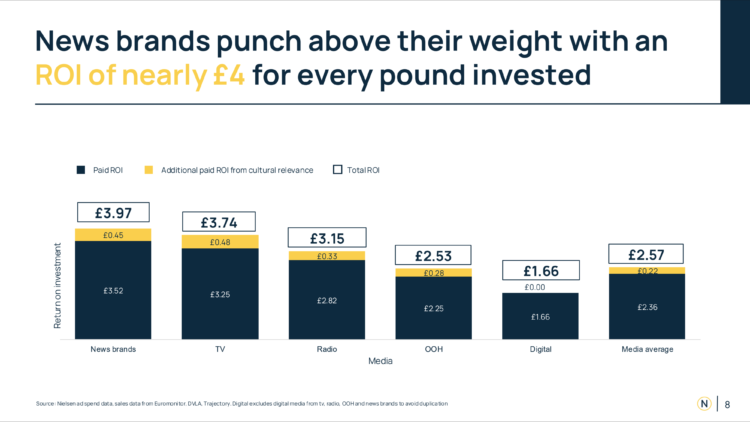
Among the media channels examined, the modelling found news brands to be the highest-performing channel, delivering a return on investment (ROI) of £3.97 for every £1 invested.
This included £0.45 attributed to news brands’ impact on cultural relevance, about double the average uplift across the other media channels studied.
TV, radio, and OOH also performed strongly for commercial effects, with TV achieving the highest cultural relevance boost of $0.48.
In comparison, digital advertising did not generate additional paid ROI from cultural relevance, though it was still profitable.
 Newsworks’ analysis did not include social media. While it did include cinema and magazines, neither received enough investment from the brands studied to provide a statistically significant conclusion as to how cultural relevancy drove sales through those channels.
“We’re not just saying [news brands are] a culturally rich environment. We’re saying we’re a culturally rich environment that has an impact”, Heather Dansie, Newsworks’ insight director, explained to The Media Leader.
The survey also showed that consumers increasingly expect brands to participate meaningfully in “cultural conversations”.
More than seven in 10 survey respondents, for example, agreed brands should “reflect the values and realities of modern society”. A majority (57%) also said they believe brands that ignore culture risk becoming irrelevant.
The Newsworks study is the latest attempt by industry bodies to understand how different media channels contribute to culture. In July, Digital Cinema Media (DCM) and consultancy MTM debuted research aimed at uncovering which media channels contribute most to cultural relevance.
That report focused primarily on audiovisual media rather than publishing or audio-only media. It found that cultural moments were most commonly associated with traditional media channels and current events, with TV (23%), sport (21%) and news (20%) the most common media channels cited as originating cultural moments. This was followed by events (11%) and cinema (10%). In comparison, social media trends accounted for 5% of cultural moments spontaneously recalled by survey participants, though the report noted social platforms do play home to wider conversations around cultural moments that originate elsewhere.
“For years, marketers have chased cultural relevance, and our new study reveals they were right to do so,” Jo Allan, Newsworks’ CEO, commented. “Culture shapes the way we see the world. It influences what we talk about, what we value, and ultimately the choices we make.
“For brands, being culturally relevant is more important than ever. And now, for the first time, we can demonstrate that cultural relevance is a significant driver of business growth.”
Allan added the latest findings show that “media environments matter” and that news brands “sit at the heart of culture, helping people understand the world around them.”
She continued: “By advertising alongside trusted journalism and culturally rich content, brands aren’t simply buying reach; they’re building relevance. At a time when marketers are under increasing pressure to prove effectiveness, this study provides compelling evidence that cultural relevance delivers commercial results, and that news brands are uniquely effective at creating it.”
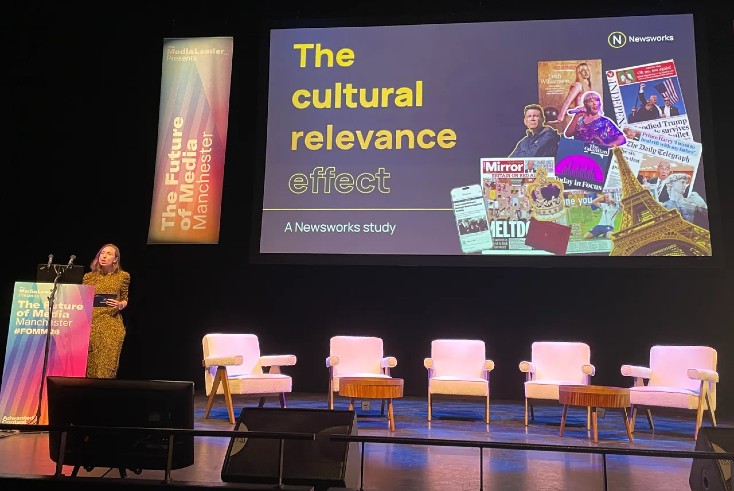
Newsworks insight director Heather Dansie will present findings from the report in detail at this morning’s Future of Media Manchester event. This article will be updated with further information.
DCM upfront: Cinema, TV, sport and news carry majority of culturally resonant content, study claims