



Digital terrestrial TV switch-off could lead to 16% decline in PSB revenue by 2034, analysts estimates
Switching off digital terrestrial television (DTT) in 2034 would be “a risk too far” for the financial sustainability of the UK’s public service broadcasters, a report from Ian Whittaker’s Liberty Sky Advisors has concluded.
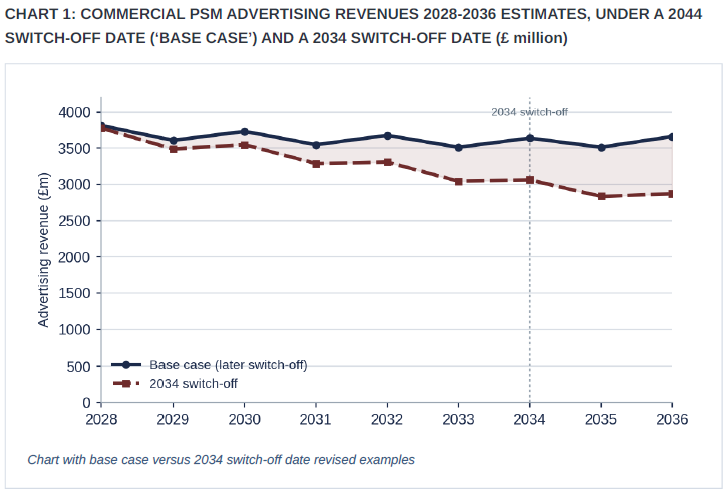
According to the report’s estimates, the commercial public service broadcasters’ combined advertising revenues would total £3.1bn in 2034 under a confirmed switch-off that year compared to £3.64bn without a switch-off until 2044, a difference of 16%.
Liberty Sky Advisors prepared the report for telecommunications company Arqiva, which has lobbied to delay a full switch-off of DTT until the mid-2040s, rather than the mid-2030s desired by the broadcasters.
The broadcasters have generally lobbied for a full DTT switch-off in part because maintaining broadcast infrastructure comes with high fixed costs, which become harder to rationalise as audiences continue to decline. They have previously warned that satellite, and eventually DTT, will reach a tipping point where distribution costs outweigh the benefits.
As part of their effort to move to a post-broadcast era, the PSBs collaborated to launch Freely, a streaming platform aimed at helping viewers migrate to live TV over broadband. Sky has also spent the past several years developing streaming-only solutions like Sky Glass televisions and Sky Stream set-top boxes.
But Liberty Sky Advisors’ analysis suggests an earlier switch-off could have a detrimental impact on broadcasters’ ad revenue, with a predicted cumulative loss totalling £3.5bn from 2028 to 2036 under the earlier switch-off date.
Steve King, the former CEO of Publicis Media, commented that the implications of the switch-off nevertheless “run one way”.
“The broadcasters are the ones pushing hardest for switch-off, and it may well turn out to be the thing that kills their own premium product,” he said. “And you have to be careful here, because once it is done, you cannot turn it back.”
Whittaker forecasts the gap will open sooner than 2034, beginning when the 2034 switch-off is announced as advertisers move to proactively realign their budgets, with TV likely, in his estimation, to be “fold[ed] into one internet video budget alongside YouTube, Meta and Amazon, where the money is already flowing.”
The extra decade, the analysis argues, would give broadcasters more time to transition their revenue models so growing video-on-demand (VOD) revenues more fully offset linear declines.
The Department for Culture, Media and Sport and media regulator Ofcom are currently considering options for the future of TV distribution and the potential retirement of DTT services next decade. A consultation on the topic closes at the end of the month.
“What has held linear television’s advertising revenue up is not really price. It is classification,” the report reads, noting that linear TV ad revenues have remained more resilient compared to linear viewing. It argues “advertisers’ boards still treat television as a separate, known category, and a safe place to keep money,” and that “a confirmed end date removes that protection.”
‘Downward spiral’ plausible
Linear TV, the report argues, benefits from a “market structure that prices and budgets linear separately from digital,” as well as a perception among advertisers that these are two separate categories.
Whittaker argues this risks changing if TV is no longer viewed as a category separate from digital video. Competitor platforms like YouTube, he previewed, are likely to argue their product is more akin to “TV” if both products are delivered via IP, with no further need for advertisers and agencies to maintain a broadcast “silo”.
Agency holding groups, the report further argues, also have an economic interest in “converging linear and digital video into a single budget line” because doing so would move budget “into the line items they trade as principal with greater margins”. Given holding groups’ increased reliance on principal media for profit, Whittaker reasons less-transparent programmatic and CTV inventory is more appealing.
Among the broadcasters, the analysis says Channel 4 “would be the first casualty” of the new IPTV regime, especially if Sky’s acquisition of ITV is greenlit.
Channel 4, the report notes, would not only be dwarfed by its competition, but it is also “almost entirely advertising-funded, cannot raise equity as a state-owned corporation, and carries some of the highest committed content costs in the sector”. A collapse of revenues for the broadcaster would therefore “flow directly into the independent production sector”, an industry the Government has said is a growth priority.
Whittaker also noted that Sky only pledged to meet the obligations of ITV’s public service licenses until they expire, should its acquisition of ITV go ahead. Those licenses notably also expire in 2034.
What’s next for digital terrestrial TV? The industry needs to decide
A decline in public-service broadcaster revenues could create a “downward spiral” if ad revenues fall: with less income, broadcasters’ ability to commission premium programming would decline, putting the quality of their output at risk, ultimately leading to further audience declines and ever worse prospects for ad revenue.
The same is true for live sports. Any drop in broadcaster revenues will make it harder for public-service broadcasters to keep affording highly competitive sports rights, particularly as streaming companies seek to buy them up to promote their own services. Without robust live sports rights, broadcasters’ financial outlooks would worsen.
Live sports, the report argues, would also no longer be truly free-to-air once DTT is switched off, as access to sports would at least require a broadband subscription.
Broadcasters seek switch-off to reduce costs
“This has been treated as a question about transmitters and streaming. It is not. It is a national security decision and a commercial one,” Whittaker, a regular columnist for The Media Leader, commented.
He warned that DTT is also “the only layer of the UK’s communications network that is sovereign, terrestrial and broadcast rather than internet-based,” noting that giving up this defensible broadcast network would come at a time when “hostile states”, such as the Russian Federation, “step up their targeting of British infrastructure.”
In June, DCMS published a paper, independently produced by the Audiences Working Group ahead of the Future of TV Distribution Stakeholder Forum, laid out three potential policy options, each with their associated costs and benefits: allowing households to continue choosing between DTT and internet protocol television (IPTV) or a combination of the two; requiring a full transition to IPTV; or creating a limited “nightlight” DTT service that is maintained as a stopgap “beyond the primary transition period to IPTV” to ensure all households have access to public service broadcasting.
These could occur as soon as 2034, or be instituted later to allow more time for any transition.
The paper acknowledged, however, that it lacks “good quality data because Barb/Ofcom do not routinely distinguish between live viewing on DTT and on IPTV, making it hard to assess the viewing habits of those in DTT-only, hybrid, and IPTV-only homes.”
In January, Sky published independent research by Oliver & Ohlbaum Associates (O&O) that found the UK could move to fully internet-delivered TV at some point in the 2030s so long as the Government sets a clear timetable and invests in targeted help for the estimated 330,000 households that will still be left to transition away from terrestrial TV. It argued that the “nightlight” DTT or satellite service would be “costly and little used” given minimal audience demand.
According to that report, 94% of Brits already have internet access at home, with 92% of households using a video-on-demand (VOD) service.
Consumers ready for broadcast switch-off in 2030s, without a nightlight