



‘Fresh team, fresh approach’: Mail Metro Media on becoming a ‘modern broadcast publisher’
Meet the Media Owner
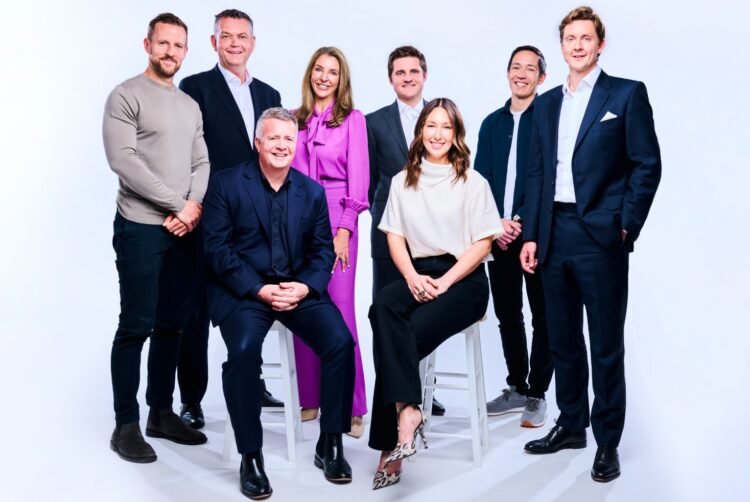
In the latest in our series, The Media Leader sits down with Mail Metro Media’s new-look commercial team to discuss how the publisher’s sales arm is ‘moving as quickly as a tech company’ amid an ‘existential’ time for the publishing industry.
This spring, Mail Metro Media shifted its commercial model and reorganised its sales team.
“Fresh team, fresh approach,” describes Dominic Williams, Mail Metro Media’s chief revenue officer. “It’s the most exciting time of my career.”
Under Williams now sit six members of a new-look senior leadership team. Pierce Cook-Anderson, the former UK MD for Equativ, joined Mail Metro Media in March as its first-ever MD, advertising. Claudine Collins, the 30-year veteran of WPP agency MediaCom (later EssenceMediacom), joined as chief client officer in May.
Rounding out the team are DMG Media veterans Steven Fletcher as MD, commercial editorial; Hannah Blake as MD, New Media; Nick Timms as MD, ad product; and Ryan Uhl as MD, commerce.
The group met with The Media Leader at Mail Metro Media’s offices in Kensington weeks after the new team was revealed. They were joined by Vere Harmsworth, the son of DMGT owner Lord Rothermere, who at the time was working as the company’s chief commercial officer.
In the weeks following the interview, Daily Mail and General Trust (DMGT) shifted its organisational structure. Its consumer news division was renamed from DMG Media to Daily Mail, and Harmsworth was promoted to executive chairman of Daily Mail. Metro, meanwhile, has been transferred from DMG Media to Harmsworth Media, which includes the publisher’s other titles New Scientist and The i Paper.
The conversation also comes months after German publisher Axel Springer swooped in to acquire The Telegraph out from under DMGT. The £575m takeover was completed at the end of June. While the team declines to comment on the failure to close the Telegraph acquisition, Williams indicates that leadership is “always looking for acquisitions.”
‘It’s not a scale game anymore’
Speaking to The Media Leader while still in his role as chief commercial officer, Harmsworth was modest about his mantle. “Fundamentally, success for me is making these guys successful,” he says. The prior commercial team structure, he adds, “worked well, but it was a kind of unnatural split between the direct and the programmatic. It became increasingly obvious, as the market evolved, that that model wasn’t where we needed to be.”
The thirty-one-year-old continues: “Our titles are very valuable to advertisers because they really resonate with readers, ultimately. 30 years ago, it was readers; today, it’s readers, listeners, and viewers. God knows what it’s going to be in the next 30 years, but however we produce our content, we have to resonate with and be valued by our users and customers. It is because of that that we can have these fantastic relationships with clients, with agencies, with brands.”
Those relationships are set to expand with the addition of Collins, who brings with her “a black book of clients bigger than mine,” Williams says with a grin.
Indeed, Collins sees herself as a “door opener” for new business. Calling Mail Metro Media “a breath of fresh air,” she praises the “bench strength” of its commercial team, noting she had no interest in working at any other publisher.
‘Trust us and test us’: Daily Mail launches two social publishers led by creator talent
Echoing Harmsworth, Williams views the Mail not merely as a tabloid but as a “modern broadcast publisher”. He continues: “When people say, ‘You’re new into social, you’re new into podcasts, you’re new into video,’ well, we’ve been doing it for 130 years. It’s just a different format. It’s not new. What’s exciting about it is it’s where our audiences are going. […] The future is all about our audiences, following them, and leading them.”
At Mail Metro Media’s upfront event last October, the Mail launched two dedicated social publishers, New Media and Creator Media, aimed at “shap[ing] the future of news and entertainment for young people around the world”. Creator Media was subsequently subsumed under New Media, comprising the Mail‘s social accounts and the company’s lifestyle brands, including Eliza, Eliza’s Brother and You. Blake oversees the commercial business of the whole set.
It’s a new definition for what comprises a 130-year-old paper, and it comes as Williams and his team are testing a “new narrative” in market, driven by demand from clients, around the importance of capturing valuable attention from audiences, something that can only be done by building trust in the news brand.
As such — and in part because the company was taken private in 2022, giving it the flexibility to take a “longer view” — the Mail has instituted a significantly lighter ad load on its new .com website.
In the past year, the title has moved from averaging seven ads per page to five. As Timms describes, this has resulted in the amount of attention to a given ad doubling, thanks to reduced clutter.
The upshot? Better outcomes for clients and a better reader experience. The average time readers spend on articles has grown 25% year-on-year, Timms claims.
As Uhl says, the change also gives Mail Metro Media the ability to be more discerning about the clients it’s working with. A more premium environment provides a better canvas for brands that are “right for our readers”, he explains.
“It’s not a scale game anymore,” says Williams. “It’s about time spent. […] We’re going for attention, for trust, because it’s essential to clients.”
Not being carried by the waves
That’s not to say scale isn’t important at all, but the change in tactics comes amid falling audience figures, which Williams acknowledges are linked. The Mail, like most major publishers, has suffered from declining referral traffic from social media platforms and, most notably, Google Search, with its AI Overviews and AI Mode features disincentivising users from clicking links.
Citing Ipsos Iris data, Press Gazette reported that the Mail’s UK digital audience has fallen by double digits this year. Yet total minutes spent with its content rose 1% to 1.5bn in December, providing evidence of the Mail‘s strategy shift to focus less on reach and more on quality time spent with its brands.
For Williams, it’s about providing advertisers with less “wastage” and providing access to more a more highly-engaged audience segment.
Cook-Anderson is clear-eyed about the challenge facing publishers, particularly those that lack the scale and long-term brand value of Mail Metro Media’s titles. “We are at an existential moment for publishing,” he says. “I think the vast majority of mid- and long-tail publishers are in question.”
He adds that it is important for the Mail not to rely on others to distribute its journalism. “We are not just being carried by the waves here,” he says.
The Mail still counts over 3m registered readers and its subscription business, Mail+, has over 400,000 subscribers, with a target to grow this to 1m by 2028 (the sales team is being incentivised to drive subscriptions to reach this figure).
Notably, Timms claims 60% of the Mail‘s readers arrive direct via the home page. And while many readers come to the Mail for news, a majority (60%) of news readers also read articles from other verticals, such as lifestyle, travel, and health, while on the site.
Publishers advised to be ‘niche at scale’ amid the winding road to Google Zero
Mail Metro Media’s print business also remains by far the largest in the country in terms of circulation. Metro (952,000), the Daily Mail (619,000) and the Mail on Sunday (518,000) rank as the top three national newspapers by circulation in the UK. The fourth-largest paper, the Daily Mirror, has a circulation of over 166,000 in comparison.
“The decline of print is overstated, certainly for this business,” says Cook-Anderson.
Still, DMGT’s digital ad revenue fell 15% year-on-year last year to £148.3m, and consumer media revenue has reportedly declined every year since Lord Rothermere took the company private.
Cook-Anderson’s priority as MD of advertising is therefore to grow digital sales, with the company also hiring a new head of programmatic.
A “massive tick” for him is the relative strength of Mail Metro Media’s direct business. The “overwhelming majority” of the publisher’s digital ad revenue comes from direct deals rather than programmatic, a positive indicator that will allow Cook-Anderson to focus on driving programmatic growth.
As he expects open-market monetisation to “continue to decline”, embracing premium PMPs (private marketplaces) will become increasingly important for the business.
Further, Cook-Anderson is keen to extract more value from the Mail‘s first-party data, such as by unifying its identity solution, DMG ID, across its full portfolio.
“We’re actually moving as quickly as a tech company,” Cook-Anderson continues. “I think we are one of the few publishers that have got on top of this, diversified our revenue streams. I see us more as a platform business than a traditional publishing business.”
Embracing social video and commerce
Meanwhile, New Media is positioned to give a fresh coat of paint to Mail Metro Media’s brands, one that is youth-facing and video-first.
Blake argues there is “not a lot of supply” in the social-first publishing market, with few players challenging first-mover Ladbible. LGB Media, the parent of Ladbible, has seen its share price decline by 63% since the start of the year amid multiple profit warnings. The culprit? Changes made by Meta to more heavily promote creator content on Facebook and Instagram, rather than publisher content.
It is just the latest in a long line of evidence proving the fraught nature of relying on tech giants for content distribution, another reason to not be “carried by the waves”. As Cook-Anderson adds: “Owning our audience, whilst delivering the right content in the right environment that they want it on, will be critical.”
Blake positions New Media as a way for the publisher to add scale through incremental audiences and to attract new advertisers more familiar with social-first marketing strategies. New Media’s net-new advertisers comprised one-fifth of the total new advertisers brought into the business in Q2, she shares.
The key question for the sales team, Uhl adds, now becomes whether social video should lead a brief or supplement it. Blake views social brands as primarily an upper-funnel opportunity, though through Uhl’s work, the social publishers are looking to move into commerce.
Uhl’s new role is to integrate commerce into more of Mail Metro Media’s wider offering. Describing commerce and affiliates as historically a “very siloed industry”, he sees himself as an “enabler” for the rest of the team by helping to put brands against quality content and using affiliates to track performance.
Apart from social publishing, Uhl is also looking to create commerce opportunities within newsletters and to use audience data to develop more personalised content to readers.
‘Social as a destination itself’: Inside Mail Metro Media’s two new social publishers
For his part, Fletcher acknowledges that “not every platform we have is suitable for every client,” and that the Daily Mail‘s greater diversity of ad solutions and formats is contributing to new sales deals.
Fletcher has a unique role; a former Mail journalist and homepage editor, he moved to the commercial team in 2023 and now effectively acts as a bridge between the commercial and editorial functions at the paper.
“I’m a filter,” he describes. “Our clients are sitting on a treasure trove of stories; it’s just about finding what they are and passing it to the editorial team.”
Branded content, he adds, can’t be a box-ticking exercise. It must work to “stand on its own” with strong editorial value. In line with Mail Metro Media’s agility, such pieces can be both pre-planned or reactive to daily coverage.
One exemplary recent partnership with the Alzheimer’s Society was the first-ever branded “Deep Dive” activation for its Defeating Dementia campaign. It included social video and written editorial coverage, including an article that received over 300,000 page views with an average dwell time of one-and-a-half minutes.
While Williams is keen to emphasise that the separation of church and state is being maintained, he says Fletcher’s role allows the commercial team to be more dynamic with how it engages with editorial output on behalf of clients.
Change and stability
A closer relationship between commercial and editorial, new distribution strategies, new social publishers, an embrace of subscriptions. It’s a lot of change in a short time. And that’s before considering changes to advertisers’ buying practices.
Williams is sure to “never miss out on an agency, never bypass them”, but agencies’ AI planning and buying tools are already requiring adjustments to working practice.
Mail Metro Media – Commercial Leadership Team – Meet the Media Owner
Mail Metro Media has received AI briefs, and Timms’ is tapping into a team of five AI engineers sitting across the newsroom to develop proof of concepts for AI tools that respond to those briefs, assisting the commercial team with ideation and pitching.
“We’re using AI in a sensible way,” Williams says. “How you respond to a Wavemaker brief is different to how you should respond to an MG OMD brief.” While AI can help processes move faster, Cook-Anderson is keen to emphasise that “the idea has to come from our seller”, and that AI “enables salespeople to sell”, while salespeople and editors alike can use AI to “speak to the data pool” to inform their work.
Another change: When Williams first started at the Mail, the board was obsessed with competing for share of audience with The Sun, The Telegraph and others.
“I said in my first board meeting (I thought it might be my last as well), they are not your competition. We want to work with these other publishers.” Today, while competing on sales, Williams can “go into any media owner and say, ‘I want to work with you.'” The industry, he says, has become more collaborative in service of advertisers.
“We work with everyone, and we compete with everyone,” he says.
But while change is inevitable for a publisher with such a long history, there is also stability in working for a private, family-owned business.
“Vere did himself a disservice by saying his role is just internal facing,” Fletcher says. “Working for a family company that has owned it for 130 years means that we know they’re going to want to be here for another 130 years. They’re not looking for a quick buck. Vere is always forward-looking. He’s looking at where we can be in five years’ time.
“That is a real benefit of working here. Knowing that and having that security that everything is looking ahead.”
Editor’s note: This article has been updated after publication. An earlier version of the article said Steven Fletcher joined Mail Metro Media’s commercial team in 2025, when he in fact joined in 2023. It has also been updated to note that New Media has subsumed Creator Media, and to clarify that Nick Timms does not oversee a team of AI engineers, but rather has tapped into their expertise (the engineers sit across the newsroom rather than the commercial team).