



Viner says the Guardian is not ‘a content business’, yet publishers are warned about losing to creators who embrace it
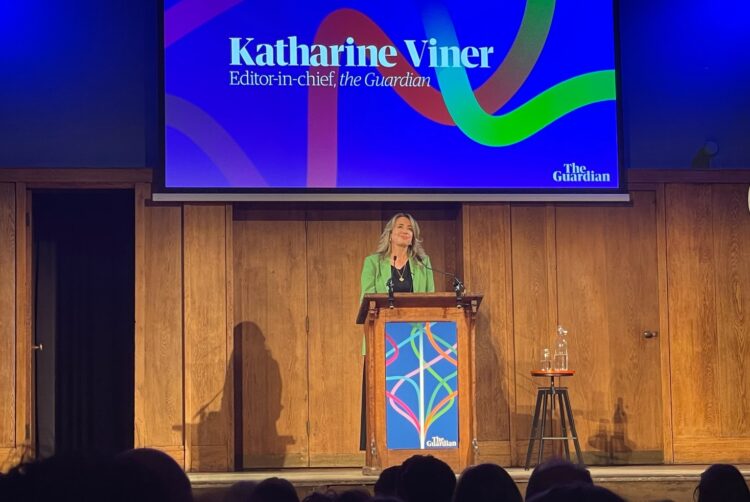
“Journalism is not a content business,” Katharine Viner, The Guardian‘s editor-in-chief declared during a pointed, 50-minute speech at Conway Hall in London last Tuesday.
Viner’s speech, written to align with the 205th anniversary of The Guardian and the release of a new campaign that harkens back to the title’s renowned 1986 Points of View ad, praised the importance of independent journalism as tech platforms have “downgraded truth”.
Warning of attacks on independent media and killings of journalists, Viner lamented the world is in an “information crisis without any comparison in human history”. This is “compounded and driven by the digital revolution”, with platforms “designed to produce conflict and promote lies over truth” in a bid for user attention.
Such a toxic information ecosystem is contributing to our “age of crisis”, Viner continued, referencing the climate crisis; eroding democratic institutions; the “death” of the rules-based international order; wars in Ukraine, Gaza, Sudan and Iran; widening wealth inequality; housing crises; loneliness and despair; and rising inflation.
Viner noted that the world’s greatest young minds, rather than being put to use solving local and global problems, have instead been attracted to work in support of companies whose sole purpose is monetise “numb attention”.
“Social media influencers get rich extolling individualist capitalism, self-improvement, misogyny, crypto schemes and offering an empty sense of belonging,” she continued. Thinking and writing, meanwhile, have become harder even for her in an era in which attention spans “have been degraded”. Viner herself acknowledged having to lock her phone away in another room just to write the speech, her first delivered in a public forum in over eight years.
The speech, which echoed similar warnings as the United Nations’ recent report on information integrity, framed The Guardian — and quality, “transparently-funded journalism” more broadly — as “part of the solution” to global crises, one which “helps nourish civic life”.
UN and CAN warn of AI-driven global information integrity crisis
The Guardian‘s own journalism is backed by the Scott Trust, which Viner acknowledged offers unique benefits including the ability to make long-term investments in journalism.
The paper, which was loss-making when she took over as editor-in-chief in 2015, is now profitable. This is thanks in part to its voluntary contributions model, which generated £125m in the publisher’s last financial year. Through this model and the Scott Trust, Viner noted she is encouraged to “speak truth to power and support democracy” without concern for secondary interests.
Viner directly contrasted this with tech moguls, most of whom “are happy to suck up to demagogues if it’s good for business”. She called out X owner Elon Musk for changing the platform’s algorithm to align with his interests and for his work dismantling USAID with the Trump administration, which has led to hundreds of thousands of otherwise preventable deaths.
Viner also criticised Amazon founder and Washington Post owner Jeff Bezos for ordering the paper’s editorial staff to decline to endorse Kamala Harris for president in 2024 and for subsequently forcing its opinion section to focus on “personal liberties and free markets”.
“Now everyone can see why independent ownership matters” Viner said. “We challenge authoritarianism and we’re comfortable to say that’s what we’re doing.”
‘A party we need to join’
Viner’s speech received a standing ovation from the packed crowd of Guardian readers, journalists and advertisers. But while it praised the importance of journalism with strong, sustainable business models, most publishers do not have a Scott Trust to fall back upon during challenging times.
At the Professional Publishers’ Association (PPA) Festival later in the week, other news brands were advised on how to navigate rapid changes in media consumption and the decline of the advertising-led business model.
Lucy Kueng, a senior research fellow at the Reuters Institute, warned that publishers “are being squeezed” by the advent of generative AI and by the creator economy. “Advertisers have shifted because audiences have shifted” to platforms, she said, adding this shift “will be swift”.
Kueng warned that the perception of “creators”, rightfully or wrongfully, is becoming bundled with “journalists”, and that the appeal of creators has already extended well beyond young audiences into consumers of all ages.
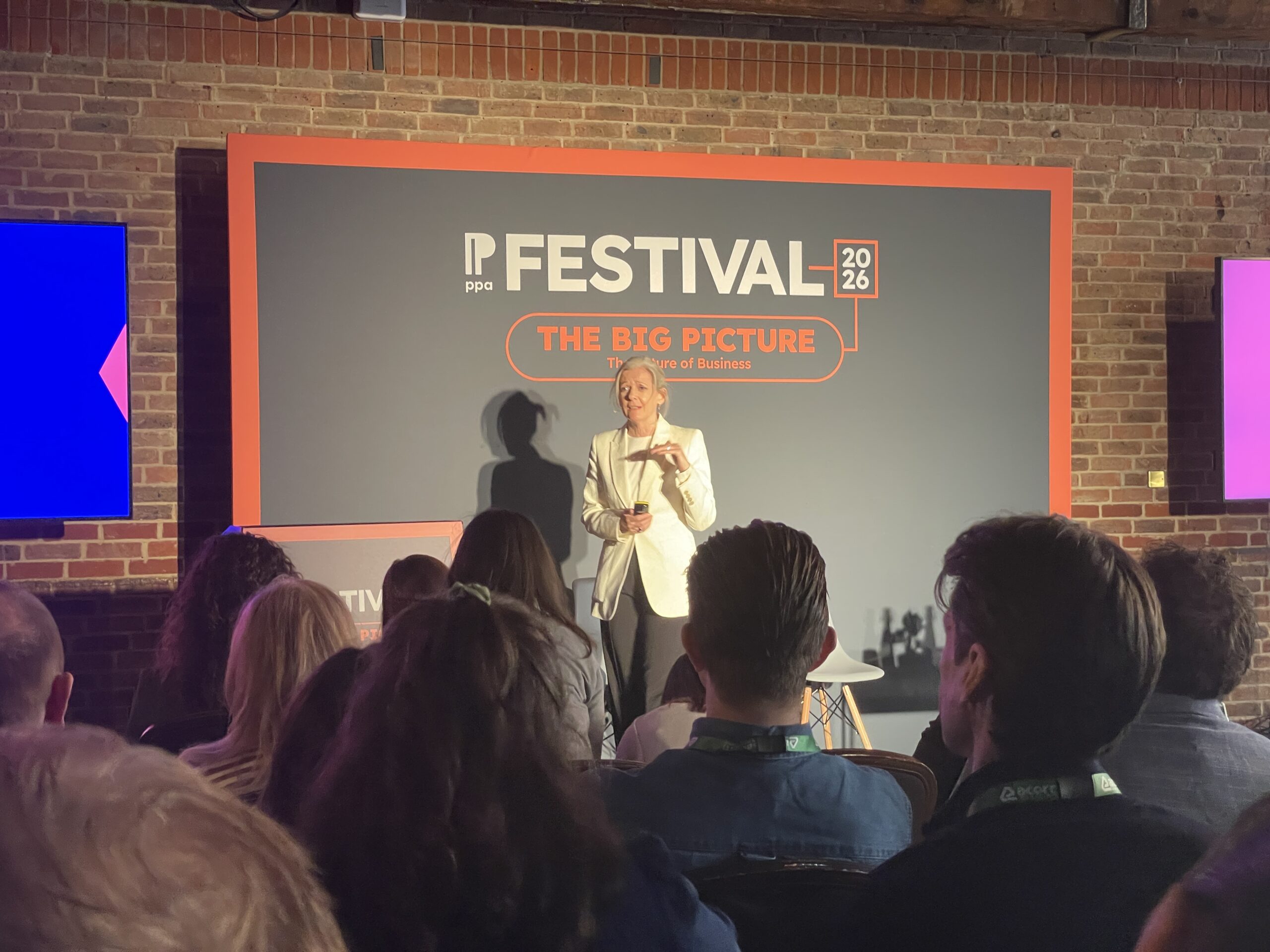
“This is a party we need to join,” Kueng (pictured, below) said.
This was echoed later in the conference by Georgie Holt, CEO and co-founder of Steven Bartlett-backed media and investment company, Flight Story, which invests in influencer talent. Trust, Holt suggested, has eroded in traditional institutions and now resides in individual creators, who appeal to audiences with “unfiltered” and “raw” content.
When asked by The Media Leader whether and how individual creators — such as Bartlett, who has been criticised for amplifying harmful health misinformation on his own podcast — work to maintain trustworthy editorial standards, Holt responded by asking: “Who sets the standards? Where do the standards lie? Who has the standards? Who holds the standards? Who is the guardian of the standards? Who tells us what the standards are? What is the guardian of the standards? […] For creators, it depends on what they’re talking about. […] I think those standards are being reset and rebuilt, and holding onto them is something interesting that will be changing, I believe, in the future.”
For Kueng, apart from maintaining a higher degree of editorial standard, the opportunity for traditional publishers is that while the creator economy is scaling fast, it is “very fragile”. Despite investment pouring in, just 8.7% of professional creators were expected to earn more than $100,000 in 2025, with nearly half (46.5%) earning less than $500.
That opens the way for publishers to collaborate or partner with established creators, turn their journalists into creators, or build or acquire their own talent agencies. Kueng’s advice: pick entry points and “test with discipline”.
Publishers advised to be ‘niche at scale’ amid the winding road to Google Zero
One such publisher that is asking its journalists to act more like creators by partaking in more multimedia content and interacting with subscribers in comment sections is The New York Times. Elsewhere at the conference, the ‘Gray Lady’s’ VP of global advertising, Tom Armstrong, boasted of the title’s own “resilient strategy” to a standing room-only crowd of publishers.
In an information ecosystem dominated by tech platforms, The New York Times has become a daily destination for its subscribers, Armstrong explained, in part due to strong investment in its bundle of verticals including Games, Cooking, and The Athletic alongside news. This has aligned with ongoing product innovations to deliver more personalised and audiovisual presentation of stories, as well as and participatory features across all its verticals.
“The goal is to get more people spending more time with our products,” Armstrong said, echoing similar strategies as platforms — albeit with entirely different tactics around gaining and maintaining attention.