



Could Lisa Nandy turn out to be the media heroine that we need?
Opinion
Having escaped the latest Cabinet cull, the culture secretary has sprung to life with concerns over Nigel Farage’s GB News gig. It’s time for Nandy to intervene urgently.
Lisa Nandy, who wasn’t expected to be culture secretary by now in a department that was supposed to have been broken up, has apparently been energised by her unexpected escape from Sir Keir Starmer’s comprehensive summer cull.
Nandy had been heavily briefed against from somewhere inside Downing Street (or not so far away).
Perhaps that was the reason she survived. Sir Keir may have decided he was not going to be pushed around by anonymous briefers.
Whatever the reason, the culture secretary, who couldn’t manage to turn up to the Society of Editors conference devoted to press freedom earlier this year, has suddenly burst into song and has been talking passionately about the threats posed by Nigel Farage’s activities at GB News.
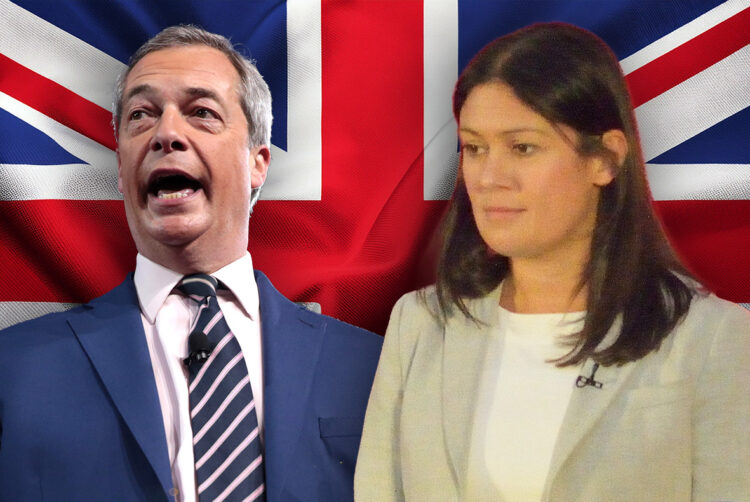
Nandy has described having Reform UK leader Farage hosting a show on GB News as “completely unsatisfactory”.
She has also criticised GB News for blurring the lines between news and “political polemic” and believes viewers might find it difficult to tell whether they are watching political messaging or impartial information.
Absolutely. It’s what many people have been saying for ages.
So does the culture secretary feel so strongly about such an important matter that she is actually going to do something about it at last? Obviously she is, isn’t she?
Here the runes start to read with a lack of rigour.
Who’d shut down a whole department just to get rid of one politician?
Taking action… sort of
Nandy has said, according to The Guardian, that ministers “intend to act” where there is concern about mixing political content with news formats, especially if it undermines impartiality or public trust.
Let’s give her the benefit of the doubt — at least for now.
You don’t have to be a semiologist, however, to have concerns about her intention to act. Obviously, it’s merely an “intent” rather than a promise or determination. Nandy didn’t even attach her own name to the intent, farming it out instead to unnamed ministers.
And that is before you get to the qualifications, such as “where there is concern” — when of course there are already concerns, not least expressed by her good self.
Then there’s the biggest “if” of all. It is near impossible to prove objectively that one particular act alone is undermining public trust. But, as a matter of judgement, and I suspect Nandy’s judgement also, it does undermine public trust.
Just by appearing regularly as a host on GB News — and the precise nature of the programme really doesn’t matter — Farage is being handed, for large sums of money, both prominence and a form of authority.
It is time for Nandy to intervene urgently because Ofcom moves at the speed of glaciers.
Ofcom has to grapple with medieval arguments over the difference between news, current affairs and entertainment, and GB News lawyers could exploit such distinctions.
It could be simple to give Ofcom the power to exclude all serving leaders of political parties and government ministers from presenting programmes on all the TV and radio organisations it regulates. Such a ban should really be extended to all sitting MPs.
Get it done and Nandy would be a media heroine.
News, analysis, comment and community — Join The Media Leader
Changing tunes
There are signs from the rest of the media that the near-uncritical love affair with Farage — apart from the usual exceptions such as The Guardian, the Daily Mirror and The Independent — is coming to an end.
Even the BBC, which has been rightly credited for creating the Farage public personage in the first place, is rising from its torpor.
Amid the controversy over who bought Farage’s constituency home for more £800,000 — with the answer finally settling on his Brussels-based partner Laure Ferrari — Farage had suggested that the money had come from her wealthy family.
BBC reporters found no evidence that Ferrari’s parents had the means to give their daughter a significant contribution to the cost of the house.
If the BBC is right, then its next trick should be to track down who really provided the cash. If it should turn out to be Farage himself, Her Majesty’s Revenue & Customs might want to have a closer look.
Meanwhile, a study by Cardiff University demonstrated what had been clear before our eyes for ages: Farage’s party, with four (and now five) MPs, has appeared more on BBC and ITV news bulletins than the Lib Dems with 72 seats.
It found that Reform featured in a quarter of all News at Ten bulletins between January and July, often with man-of-the-people images of Farage in a pub. The Lib Dems were in 17.9 of the bulletins, with less prominence for leader Sir Ed Davey.
In a fifth of the Reform appearances, there was no analysis of the party’s policies or claims.
At least Channel 4 is rising to the occasion: during Donald Trump’s second state visit to the UK, on Wednesday night it is showing “the longest uninterrupted reel of untruths ever broadcast on television”.
 Raymond Snoddy is a media consultant, national newspaper columnist and former presenter of NewsWatch on BBC News. He writes for The Media Leader on Wednesdays — bookmark his column here.