



The view from the columnists
Opinion
From Littlejohn and Quentin Letts to Andrew Neil and Leo McKinstry, leader writers have had their say on the Iran war.
A barrage of bile has been launched at Sir Keir Starmer by battalions of the British press, led by no less a figure than the President of the United States, Donald J Trump.
Trump handpicked The Daily Telegraph and The Sun to convey how “very disappointed “ he was in Starmer for initially blocking the use of British bases for air strikes against Iran. Later, the British PM allowed the Americans to use the bases for defensive purposes.
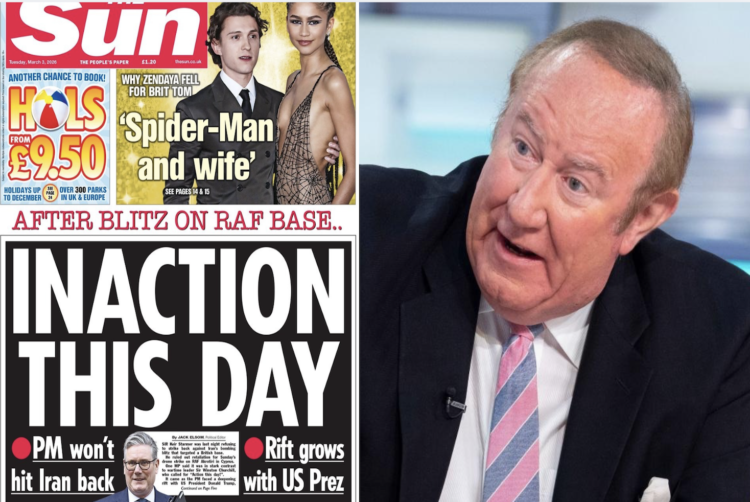
The headlines told the Trump story from The Daily Telegraph’s splash “ I am very disappointed in Keir” to the Daily Mail’s “U.S. lambasts ‘hand-wringing, pearl-clutching’ Starmer as Kemi say he’s ‘scared of his own voters’ “and The Sun’s “Inaction This Day.”
Apoplectic columnists
The real firepower directed at the British Prime Minister came from the massed ranks of the columnists and leader writers, many of whom came close to apoplexy.
Littlejohn in the Mail suggested that if Starmer managed to survive until the next Labour Party Conference, which naturally he very much doubted, “perhaps he might close proceedings by leading delegates in singing his very own version of the party’s traditional anthem ‘We’ll Keep The White Flag Flying Here’.
Quentin Letts accused Sir Starmer of being no more belligerent than the speaking clock and droning on about “the law, the law”.
Strange that a distinguished human rights lawyer should drone on about the law in circumstances where thousands of lives could be at stake across the Middle East.
Andrew Neil (pictured) produced a bit of a backflip in his ever-changing estimates of the phenomenon that is Trump. First, Neil gave Trump the benefit of the doubt when he started his second Presidency despite all the evidence of his first four years in office.
Then, across the last few months, Neil has become more critical of Trump, in particular correcting his many lies and saying that the way he has treated Canada was a “disgrace”.
Now that Trump has embarked on what looks like an illegal war, certainly in US terms, he is back in Neil’s favour.
According to the columnist, the prize is huge -the prospect of a post-Islamist Iran no longer intimidating its neighbours.
It would be far from perfect, but so much better than what we have now.
“So stay the course, Mr President,” says Neil as the chaos and the violence spreads to almost every country in the Middle East with unpredictable consequences.
At least the former Sunday Times editor has nothing to say about Starmer.
The Sun, of course, had plenty to say.
According to Leo McKinstry, the last shreds of Sir Keir’s authority “have vanished in the fog of war.”
Starmer is cowering in Downing Street “paralysed by indecision and left-wing dogma”.
And of course, according to The Sun columnist, under Starmer the UK is now a third-rate power “squawking from the sidelines about legal niceties and dithering over despots”.
The paper itself goes even further, launching a devastating and irrefutable accusation against the Prime Minister.
“In a new world order dominated by hard political power, our Prime Minister has proved himself to be a complete and utter lawyer.”
You have to read that sentence twice to make sure the author is serious.
Measured and proportionate
The ultimate condemnation of the Prime Minister apparently is that he believes in upholding the rule of law both at home and abroad. Such an argument is well up there with the Daily Mail calling Supreme Court judges “enemies of the people” when they did something the paper disapproved of.
An alternative view would be that Starmer has been measured and proportionate in his response to a serious crisis.
It can also be plausibly argued that in the past, he may have got too close to the totally unpredictable, quite possibly mad US President, who is capable of anything.
It is obviously clear that right-wing newspapers in the UK have little respect for lawyers, sometimes little respect for the law itself.
So, here goes from a mere journalist, not a lawyer of any kind. As an outsider, it looks as if Trump’s actions are illegal under both US law and international law.
The US case is perhaps the clearer and sharper. There are credible reports that the Pentagon’s view was that Iran posed no immediate threat to the US and that it is years away from having credible nuclear threats. After all, didn’t Trump himself say the American attacks on Iran in June had obliterated its nuclear industry?
Trump has said he was not doing it for now, but for the future.
Waging such a war with no urgent threat to the US would require Congressional approval, and none was sought.
The Iranian regime is horrific, and it would be a wonderful thing to see the end of it, but again, under international law, Trump’s actions appear disproportionate given the degree of any immediate threat to the US.
The scale of such attacks in crowded urban areas will inevitably lead to “collateral damage”, such as the 153 girls who died when bombs hit their school.
Then there were the three US fighters shot down by Kuwaiti “friendly fire” at an approximate cost of $290m – although happily the pilots survived.
Already, six Americans have died, and Trump, contradicting everything he has said before, is now not ruling out putting “boots on the ground” in Iran.
If the behaviour of the right-wing press has been predictable, the comprehensive and factual coverage of the BBC has been exemplary.
Orchestrated by Clive Myrie in Tel Aviv, the BBC can turn to its own correspondents in all the Middle East countries where they are permitted.
The Washington Post, owned by multi-billionaire Jeff Bezos, can say no such thing after recently firing most of its foreign correspondents.
In the midst of a war likely to affect all Americans before long, the Post published a truly remarkable story.
The paper sent texts to 1,000 Americans asking them what they thought about U.S. strikes in Iran.
The replies ranged from “not our problem” through “regime change” and “Iran is a threat” to “I am not sure”.
Cutting-edge journalism, Bezos style, obviously.
Meanwhile, unlike what you read in the papers, this could turn out to be Starmer’s finest hour. The latest opinion polls this week show him in tune with the majority of Britons, who oppose military action linked to Iran and do not approve of the use of British bases by the US.
 Raymond Snoddy is a media consultant, national newspaper columnist and former presenter of NewsWatch on BBC News. He writes for The Media Leader on Wednesdays — bookmark his column here.