



An image to define the Monarchy?
Opinion
It has been quite the week for press photography, and there’s nothing like a well-laid-out and illustrated page of print to showcase iconic imagery, says Ray Snoddy.
There is absolutely nothing that sums up a story or a person so completely as the single picture on the front page of a newspaper, as long as it is the right image capturing the vital, significant moment.
The picture of the former Prince Andrew, now the mere Andrew Mountbatten-Windsor, leaving a police station after hours in custody was just such an image.
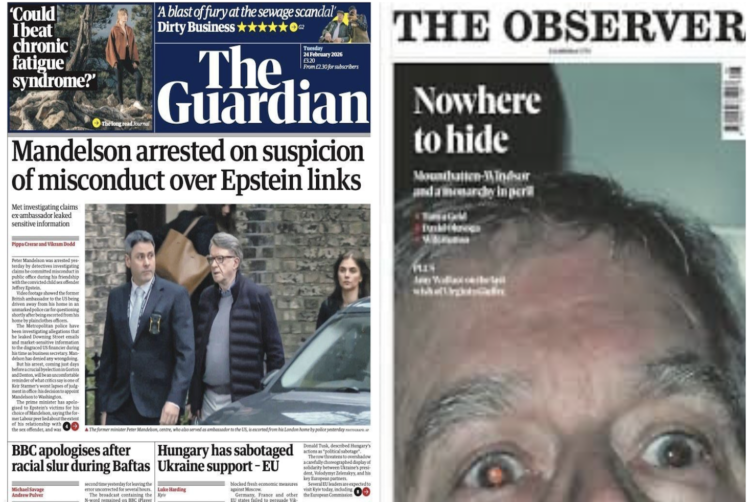
The haggard face of the 66-year-old, trying to lie low in a police car, his eyes made even more sinister by the flash, summed up, in a way what words never could, how far he has fallen from his life of former privilege.
It is as if all the thousands of pictures of Andrew the Prince on the balcony of Buckingham Palace, in military uniform, bedecked in medals, or riding large horses, have been erased and replaced by that single stark image.
Even by Sunday, The Observer was still using it on its front page – cropped tightly and enlarged to show only the eyes (pictured).
There were reports that a prankster even smuggled a copy of the picture into the Louvre in Paris and hung it on the wall.
Yet it was a picture that very nearly never happened, as the man who took it, Reuters cameraman Phil Noble, has explained.
The story behind the photo
Most photographers remain largely anonymous, except sometimes for names in tiny print below their work, but The Times had the great idea of talking to the “snapper” who has defined the future status of Andrew Mountbatten-Windsor and, to some extent, the Monarchy itself.
It had been a long day waiting, as many photographers’ days are, and Noble had just decided to walk back to his hotel when a colleague tipped him off that Andrew was about to be picked up by two Range Rovers.
The photographer got back in time to see the two cars speeding away.
Noble aimed his camera at the second car and got off six frames.
Two showed policemen, another two were blank, and one was out of focus. The final one, the first after Andrew’s arrest, will now win awards galore.
Noble had driven six hours from his home in Manchester to be there in Norfolk. But where to go? Andrew could have been questioned under arrest in any of 20 police stations.
Acting on a tip – which turned out to be correct- he headed for Aylsham, an hour’s drive east of the Sandringham estate, where Andrew is now in exile.
“You can plan and use your experience and know roughly what you need to do, but still everything needs to align,” explained Noble, who claimed it was not the best photo he had ever taken. Maybe not the best, but surely the most significant.
Plaudits too for freelance photographer Terry Harris, who had been on ‘Andrew watch’ for 16 days outside Sandringham when he pictured the six-strong cavalcade of Thames Valley police cars taking Andrew for questioning on suspicion of misconduct in public office.
The BBC claimed its special correspondent, Lucy Manning, was the first to broadcast that Prince Andrew had been arrested at 9.54 am on Thursday.
There were also nice snaps of Lord Mandelson being arrested and taken for questioning on Monday morning for allegedly passing secret government information to Jeffrey Epstein.
The night sky was lit up by camera flashes when Mandelson returned to his home by taxi at 2 am yesterday (Tues). But no prize-winning pictures.
Right to anonymity?
But hold on a minute, is the media supposed to give the names of people who are arrested but not charged?
It cost the BBC dearly when it broadcast a police raid on the home of Cliff Richard, and the pop singer was never charged with any offence.
For some years now, the police have not attached names to statements about arrests.
In both these cases, it would have been absurd to do anything other than name those involved.
The arrest of a 66-year-old man from Norfolk or a 72-year-old man from Camden would not have protected their privacy for more than a nano-second, and anyway, there are at least cases to answer as a result of emails in the Epstein files.
Apart from compelling pictures, the plight of both men has triggered pages and pages of detailed coverage on every aspect of their stories, coverage that would have been difficult to enjoy on a mobile device. Nothing like a well-laid-out and illustrated page of print.
Some of the opinions have been a tad extreme – such as will Andrew bring down the Monarchy? Not quite, though he is having a good go, and King Charles may yet have a lot to answer for about what he knew about Andrew’s activities and when.
Perhaps we could end up having a King William rather earlier than most people think.
The Mandy stick
As you would expect, the Conservative- supporting press are using the latest revelations about Mandelson as a new stick to beat Prime Minister Sir Keir Starmer.
To which the Starmer answer remains the same, that Lord Mandelson was sacked as Washington ambassador as soon as he realised he had been lied to.
However, the papers are hot on the scent, and more trouble could lie ahead for both King Charles and his Prime Minister if more internal documents are revealed.
Meanwhile, the stories of Andy and Mandy will keep journalists and photographers busy for weeks to come, and the Epstein files have yet to give up all their secrets.
Although a few executives named in the files have stepped down from their roles, many papers are pointing out that only three Britons have faced police action – Ghislaine Maxwell, prosecuted in the US, and Andrew Mountbatten-Windsor and Lord Mandelson, under a cloud of suspicion in the UK.
The biggest pictures of all may yet to come out. President Donald Trump can denounce the Epstein files as a hoax and that the issue is over as much as he likes.
There are persistent rumours that incriminating photographs of Trump exist in those files.
If they do, they will inevitably leak because, in the end, everything does.
What a front page that would make – even more dramatic than pictures of the former Prince Andrew in the back of a police car.
 Raymond Snoddy is a media consultant, national newspaper columnist and former presenter of NewsWatch on BBC News. He writes for The Media Leader on Wednesdays — bookmark his column here.