



How Apple made simplicity the standard in OOH
Opinion
As Apple celebrates its 50th anniversary, its creative is a reminder that the future of out-of-home isn’t about doing more, it’s about doing less, better.
There’s a quiet irony in Apple turning 50 this week. A company built on defying convention has, over time, become the convention. Not by shouting louder, but by removing the need to shout at all. And nowhere is that more visible than in OOH. Apple’s billboard work became a lesson in how little you need to say.
OOH has always had a constraint problem. Six seconds of attention, passing traffic, and a format that punishes complexity.
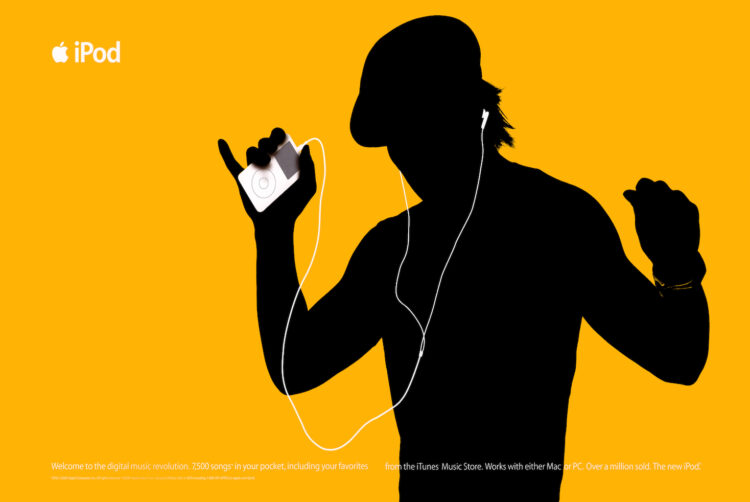
Most brands responded by trying to outsmart the limitation: more copy, more claims, more reasons to care. Apple did the opposite. Think back to Silhouettes, or later Shot on iPhone, or even the stark product-led executions that feel almost unfinished to a traditional marketer. They stripped everything back to a single, undeniable idea.

Not “what do we want to say?” But “what is impossible to ignore?”
Then Apple did something equally important, making that simplicity consistently visible. The same restrained approach appeared in the same high-impact environments year after year, until it stopped feeling like a campaign and became a standard.
The result of this shift was iconic work that quietly reset expectations for public space.
Messaging to meaning
Apple understood early that OOH isn’t a messaging channel; it’s a stage. A place where brands don’t explain themselves, they demonstrate who they are.
The best Apple creativity rarely tells you anything new. It simply shows you something in a way that feels self-evident – a photograph taken on a device, a product floating in negative space, or a copy line so short it does just enough.
In doing so, Apple turned OOH from a place of persuasion into a place of proof. Once one brand proves you can do more with less, everything else starts to feel like noise.
Apple’s influence hasn’t just been aesthetic; it’s systemic. Over time, it has quietly pushed the entire OOH ecosystem forward. Reshaping expectations around simplicity and craft, evolving formats to accommodate more restrained executions, and raising production standards in a world where reduction leaves nowhere to hide.
The discipline behind simplicity
In many ways, Apple has done to OOH what it did to product design. Remove the unnecessary, and in doing so, make everything else look overdesigned.
You can see this ripple effect everywhere: luxury brands embracing restraint, tech brands leaning into product truth, even FMCG starting to understand that clarity outperforms clutter.
Of course, there’s a catch. Simplicity is expensive; it requires confidence in the product, clarity in the idea, and a willingness to say less when every instinct tells you to say more.
It also requires patience. The discipline to show up in the right places, repeatedly, without feeling the need to constantly reinvent.
That’s why Apple’s approach is often imitated… but rarely matched. Because what looks like minimalism on the surface is the result of precision underneath. Every pixel is doing a job, every word has survived ruthless editing, and every execution assumes the audience is intelligent enough to fill in the gaps.
In a world obsessed with optimisation, that’s a difficult discipline to maintain.
Designing for the next era of OOH
As OOH becomes more dynamic, more digital, more data-driven, there’s a risk we forget what made it powerful in the first place. More screens, more triggers and more personalised messages, while all valuable, can lead to a temptation to overcomplicate.
Apple’s legacy offers a useful counterbalance, a reminder that the future of OOH isn’t about doing more, but about doing less, better.
The most effective work will still hinge on a single, clear idea. One that can live in six seconds, that can be understood without explanation and earns attention rather than demanding it. Technology should amplify that idea, not replace it.
Perhaps the most important thing Apple has taught us is: constraints aren’t a limitation; they’re a filter.
OOH doesn’t need to behave like every other channel. Its power lies precisely in what it can’t do. It can’t tell a long story; it can’t explain nuance. It can’t rely on interaction. So, the work must be sharper, cleaner, more confident.
Apple didn’t succeed in OOH despite those constraints. It succeeded because it embraced them.
Fifty years in, Apple’s greatest contribution to OOH isn’t any single campaign. It’s the discipline imposed on the medium. A quiet but persistent reminder that in a world full of noise, clarity is not just powerful, but a competitive advantage most brands continue to undervalue.
 Saj Nazir is SVP media creativity, head of radical + disruptive lab at Mediahub Worldwide (Omnicom)