



ITV deserves praise for spotlighting the injustices of the phone-hacking scandal
Opinion
There may be varying reviews, but ITV’s lawyers would have slept more easily without this challenge and many must have questioned the wisdom of poking a stick into this hornet’s nest.
There is one important thing to say about ITV’s The Hack, a seven-part series on Rupert Murdoch and the phone-hacking scandal that killed off the News of the World.
It is that, despite varying views on the quality and execution of the show, ITV should be congratulated on having made it at all.
As the scandal increasingly recedes into history, except when it is kept alive by the legal actions of Prince Harry and the continuing (but slowing) drips of compensation payments, it would have been easy not to bother.
Certainly, ITV’s lawyers would have slept more easily without this challenge and in-house strategists must have questioned the wisdom of poking a stick into this particular hornet’s nest.
And, as several have pointed out, hacking phones for news about stars and royals seems positively quaint if you think about what has happened since.
It pales into insignificance compared with criminal hackers threatening the very existence of major corporations or Russia’s hybrid information war against Western democracies.
In the end, however, the integrity of news matters, the rule of law matters and the behaviour of journalists matters. And those who seek to hold society to account should themselves be held to account when they transgress.
What we found with the previous ITV hit in the scandals arena, Mr Bates vs The Post Office, is that television drama has a unique power to convey the raw emotions of obvious injustices that could otherwise be ignored.
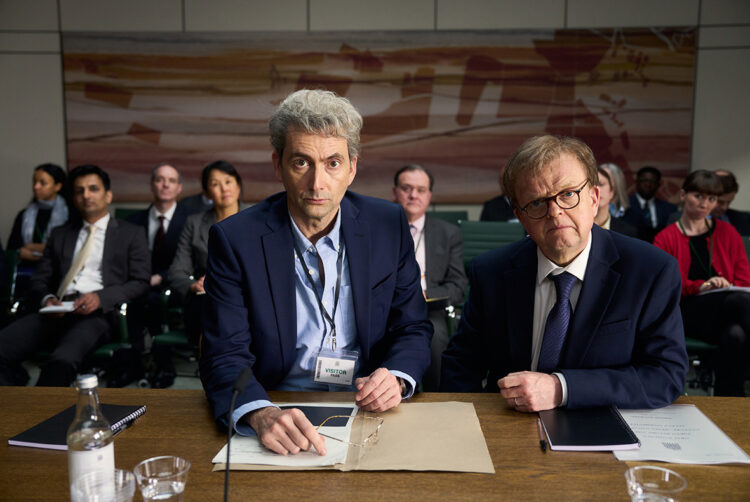
ITV must have thought it was applying an existing template to the phone-hacking scandal. The series is largely made by the same team and the similarity is enhanced by the return of Mr Bates actor Toby Jones as Alan Rusbridger, editor of The Guardian at the time — even though Rusbridger is tall and Jones is not.
Snoddy: Post Office drama shows real scandals must be pursued to the bitter end
Lukewarm reception
If the broadcaster was hoping that one success would almost effortlessly seep into another, there must be an element of disappointment at ITV towers.
First signs are that The Hack in its opening episode may not have got close to the audience achieved by Mr Bates, although no direct comparison is possible because Mr Bates launched on New Year’s Day last year.
There is the other obvious point that those parts of the media that were involved in phone-hacking were not exactly putting out the bunting for the drama.
Most ignored it, nor were there many reviews outside The Independent, The i Paper, in the remnants of the Evening Standard and The Guardian itself.
There were a couple of five stars, but it is unfortunate that a drama celebrating one of The Guardian’s most dramatic achievements should have been largely trashed by its reviewer, Lucy Mangan.
Mangan, who gave the programme two out of five stars, may or may not be right to criticise what she called “cringe-making lines”, strange dream-like sequences and the recurring image of a dung beetle.
But in one respect, she is spot on.
The Hack, she argued, is stymied because, unlike Mr Bates, “it deals mostly in ideals (and journalistic ideals at that) rather than human emotions that make ideals real and valuable to us in life and as viewers. Abstraction is harder to care about”.
For Mangan, having David Tennant, who plays Guardian journalist Nick Davies, speak directly to the camera merely adds to the confusion.
News, analysis, comment and community — Join The Media Leader
Dissipating momentum
Scheduling of The Hack raises further questions.
While the four-part Mr Bates was run on consecutive nights to build momentum, The Hack is being stretched out over seven weeks when there is a danger that any momentum will gradually dissipate.
Clearly with Mr Bates, there was an urgent call to action to right injustices and speed up compensation payments. And, to a certain extent, it succeeded.
The Hack‘s first episode does not suggest there is any such call to action, unless the intention is to try to revive calls for a second Leveson inquiry, which was supposed to examine allegedly corrupt links between the media and the police. That was postponed and then dropped.
Whatever happens now, it is still courageous for ITV to commission such a drama.
Who knows, it might even make more money that Mr Bates, which was very much a UK-centric scandal compared with the international appeal of Murdoch, a world-class bogeyman.
Problems persist
It is unlikely that any government will now embark on a full-scale public inquiry into the press of the sort ruled out by David Cameron years ago.
There is indeed a problem with media — but it has nothing to do with corruption.
It is the fact that, in many places, sensible relations between the media and the police barely exist because the police are too scared to engage.
The result has been dangerous vacuums on major news stories for social media conspiracy theorists to fill.
But the series could yet have an important afterlife. The implications of the phone-hacking scandal did not end in 2012, when the show runs to. More than 1,200 victims have been awarded compensation totalling more than £1bn — though always attached to confidentiality agreements.
Above all, Davies has not gone away. He is still asking important questions. What if the phones were hacked not just for scoops but also for political and commercial advantage?
What did Murdoch know and when? And how did so many documents go missing?
It might even make a second series. If not, perhaps a drama about Russian influence on Brexit, UK politics and Reform? Jones would make a very fine Nigel Farage.
 Raymond Snoddy is a media consultant, national newspaper columnist and former presenter of NewsWatch on BBC News. He writes for The Media Leader on Wednesdays — bookmark his column here.