



ITV promotes challenger brands and record-setting World Cup as Sky deal remains ‘active’
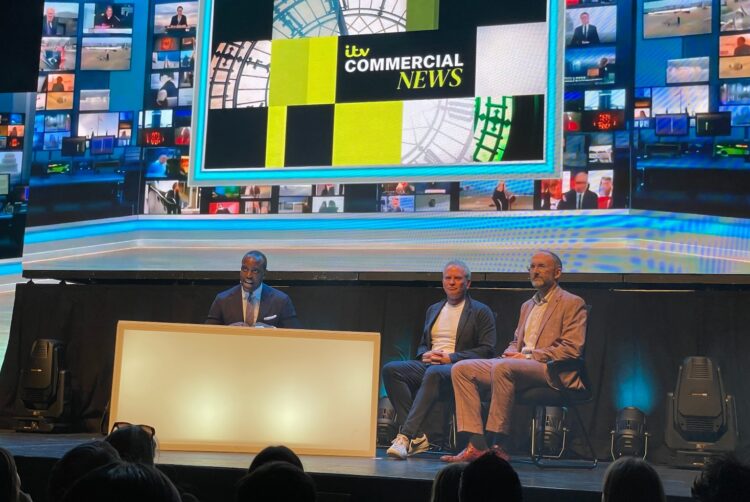
ITV held its 16th annual Showcase in Manchester yesterday, promoting TV as a high-attention medium that is actively working to onboard more new-to-TV advertisers amid a record-setting FIFA World Cup.
But hanging over the presentation, held at Manchester’s HOME theatre, was the ongoing question of whether and when ITV might sell its Media & Entertainment business to Comcast’s Sky. Last month, ITV News itself reported Sky’s acquisition was just “weeks away“, though The Media Leader understands any potential agreement is unlikely to be announced before the conclusion of Cannes Lions next week.
“Sky and ITV continue to have really active discussions” Kelly Williams, ITV’s commercial manager director, said on stage when asked for an update on the potential deal. He added he “just came off a call” on the matter.
Williams situated the potential deal within the wider context of a media industry that has seen power shift away from broadcasters and toward US-based tech platforms. The size of Google, Amazon and Meta within the ad market, he indicated, is placing pressure on regional broadcasters to compete, necessitating consolidation to keep up.
“UK broadcasters need to collaborate,” Williams said, adding that, “If a deal is done, it will be reviewed by the CMA [Competition and Markets Authority] and take months.”
Even without a merger of the UK’s two largest commercial broadcasters, the companies have already been collaborating on a number of initiatives, namely a new outcomes measurement panel, Lantern, and an SME marketplace dubbed Universal Ads.
In cooperation with TV trade body Thinkbox, ITV, Sky, Channel 4, Paramount and Disney are slated to speak about such collaborative efforts next week at the Cannes Lions Festival of Creativity.
Apocalypse soon? Why the ITV/Comcast deal will make new regulation essential
Despite the acquisition hanging over the presentation, ITV projected strength, lauding the commercial opportunity with this year’s World Cup.
Williams described the tournament as ITV’s “six-week summer Super Bowl moment”, as the broadcaster plays host to 51 matches. Group stage matches have averaged peak audiences between 5m and 6m, but England’s opening match on Wednesday peaked at a remarkable 15.4m viewers, the largest TV-set audience of the year and the biggest peak audience for any broadcaster or streamer since the UEFA Euros in 2024.
Around 200 brands have signed on to advertise against the tournament, the largest being Google, which is promoting its Pixel and Gemini products. Of the 200, Williams described that 70 are new to football and seven are new to TV.
‘Start with media that holds attention’
ITV has sought to make strides with new-to-TV advertisers in recent years as part of a wider effort to grow the TV pie by extending into the “fat end of the long tail”.
To that end, new research presented by Amplifed founder Dr Karen Nelson-Field evidenced the importance of advertising in high-attention media channels, such as TV, for challenger brands.
“All brands compete in the media jungle, but not all brands survive equally,” Nelson-Field said, referencing ITV’s I’m A Celeb…
Explaining that brands waste adspend in the “gap between served and seen”, she described that media creates upper and lower bounds for the amount of attention an ad can receive, regardless of creative excellence. There is a “false hope”, she said, that quality creative can “stop the scroll” on short-form video platforms, for example.
Importantly, challenger brands face an uphill battle in the attention economy compared to market leaders. Established brands, which tend to be more immediately recognisable, need less attentive time to register an impact than brands with less awareness.
Describing the “eye watering cost of dull media,” she warned challenger brands (and brands of all sizes) to avoid overweighting spend in media channels with fast decaying attention. Challengers “lose first” in those environments, with a 6x steeper performance drop compared to established brands.
Thanks to its slower attention decay curve, TV, Nelson-Field said, helps build stronger memory associations than other channels, and it is particularly good at providing brand uplift for consumers that otherwise would not have conisdered buying one’s product.
She advised brands to re-weight their media portfolios and invest “appropriately” to get their advertising to stick.
“If you want good creative, you need to start with media that holds attention,” she concluded.
A £100k giveaway and a new ad format
The Showcase, hosted by comedian and presenter Joel Dommett, also featured a £100,000 advertising giveaway to the champion of a The 1% Club game. The winner? Plumbing service Emergency Hero, thanks to the efforts of marketing manager Lucy Mason, who beat out the rest of the crowd by correctly answering a set of increasingly challenging questions.
A new-to-TV advertiser, Emergency Hero founder Aaron McWilliam commented: “Winning this is an absolute game changer for us, especially at the stage we are as a business.”

In addition, Spencer revealed ITV’s latest ad innovation, a new ad format that combines ITV’s Lead Gen Ads and Pause Ads in what he joked was aptly named, Lead Gen Pause Ads.
The format gives viewers the option to opt in to receive follow up communication or special offers from brands using their remote control when served pause ads. It is aimed at “performance brands” that lack video assets but are still seeking to access valuable TV audiences.
Beta testing for the format will begin in autumn, with ITV seeking “a limited number of advertisers” to partake ahead of a wider release.
Spencer described Lead Gen Pause Ads as like “an addressable poster in the living the room.”