



New York Times publisher warns journalism faces its ‘Napster moment’
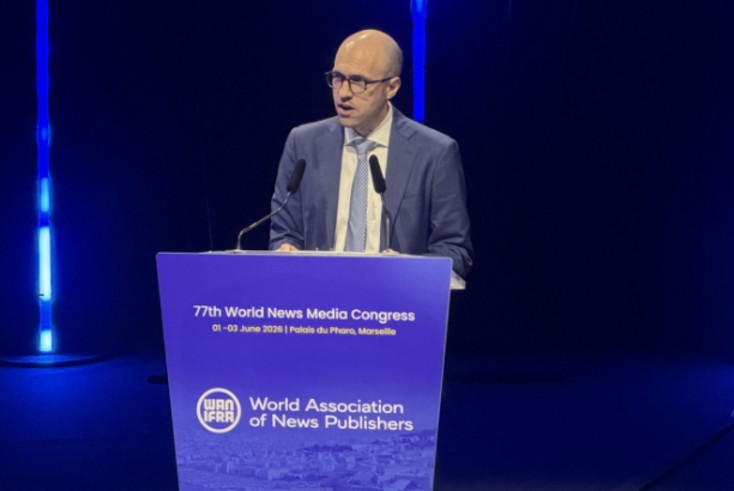
The 77th World News Media Congress opened its doors on Monday at the Palais du Pharo in Marseille to a unanimous verdict: journalism is at an existential turning point, and generative AI is its primary accelerator.
Speaking before more than 1,300 delegates from 60 countries — the largest Congress in WAN-IFRA’s history — AG Sulzberger, publisher of The New York Times, delivered a forceful indictment of the practices of the world’s largest technology companies.
‘You are what you eat’
Sulzberger structured his address around a central argument: AI models are built on four ingredients — talent, computing infrastructure, energy, and data. The first three are paid for. The fourth, which in practice means books, films, music and journalism, is taken without authorisation or compensation.
“AI companies take data without consent or compensation,” he said, noting that “OpenAI has acknowledged that it would be impossible to train the most popular AI models without using copyright-protected material.”
He then quoted one of the company’s engineers: “The success of models is not determined by architecture or parameters. It is determined by your dataset, nothing else” — before drawing his own conclusion: “In other words, you are what you eat.”
Sulzberger laid out the scale of the issue through the lens of The New York Times. In 2025 alone, the paper published nearly 500,000 original works — articles, photographs, videos and podcasts — at a cost of more than $2bn, with journalists deployed across all 50 US states and in 155 countries.
Over its 175-year history, The Times has produced more than 20m original works. He also revealed that The Times was the single most-used proprietary data source in training datasets for numerous AI models, ahead of The Guardian and the Los Angeles Times.
In response, The New York Times has taken legal action against OpenAI, Microsoft and Perplexity for copyright infringement.
“These proceedings have already lasted two and a half years and cost more than $20m,” Sulzberger acknowledged, while noting that the vast majority of news organisations lack the resources to pursue such cases.
The no-click web: an existential threat to publishers
Sulzberger also documented the collapse of the traffic-based economic model, in which search engines once directed readers to publishers’ websites; now, generative AI short-circuits that flow.
“Getting a Google user to click on a link is ten times harder today than it was a decade ago,” he said, adding that competing AI models send referral traffic at a rate 96% lower than Google Search.
Major US news titles tracked by Comscore have seen average traffic declines of more than 45% amid the AI economy’s intensification. He cited Microsoft, which launched Copilot with a telling tagline: “Instead of clicking on links, we can talk about what you’re curious about.”
His conclusion on the economic model was unambiguous: “In the next phase of disruption, technology companies, by using journalism itself, are also taking a larger share of the audience.”
He called on publishers to defend their intellectual property rights, to scrutinise licensing deals carefully to ensure they reflect something close to fair value, to lobby legislators, and to build coalitions with other creative industries.
“Study how our colleagues in music managed their Napster moment,” he said.
An opening ceremony defined by democratic urgency
Sulzberger’s keynote set the tone for an opening ceremony in which every speaker returned to the same theme: independent information is a threatened pillar of democracy, and public authorities must act.
Ladina Heimgartner, WAN-IFRA president and CEO of Ringier Media Switzerland, opened with sobering figures on press freedom. According to Reporters Without Borders’ 2026 index, more than half of the world’s countries — 52.2% — are now rated “difficult” or “very serious” for press freedom.
“Less than 1% of humanity lives in a country where press freedom is considered good. In 2002, that figure was 20%,” she said.
On AI, she was equally direct: “There is no functioning ecosystem if the people who pay to produce the facts are the only ones not paid when machines sell them.”
Véronique Saadé, president of CMA Media, the media arm of Marseille-based global shipping group CMA CGM, and co-organiser of the Congress alongside WAN-IFRA, further stressed Europe’s responsibility.
“Europe has always defined a certain vision of culture, creativity and sovereignty,” she said. “I believe it must continue to champion a strong ambition for information and journalism.”
She also set out a principle that resonated across all the speeches: “Human judgement must remain the final decision-maker, because trust cannot be delegated to an algorithm.”
Publishers advised to be ‘niche at scale’ amid the winding road to Google Zero
Henna Virkkunen, executive vice-president of the European Commission for Technological Sovereignty, announced several ongoing workstreams. She confirmed that the Commission has launched preparatory work on revising the 2019 Copyright Directive, with a public consultation under way, and that it is examining whether additional measures are needed to strengthen rights holders’ ability to license their works to AI users.
Virkkunen also announced that a new European programme, Agora-EU, will for the first time provide structural support to the news media sector, with an initial estimated budget of €3.2bn, targeting a launch date of 1 January 2028. She highlighted a concerning figure: “87% of European citizens access news media every week, but 66% pay nothing for that news.”
Catherine Pégard, a former journalist and France’s Minister of Culture, closed the institutional addresses on behalf of the French state. Quoting President Macron’s words from last November, she said: “For a democracy to function, it needs reliable and clear information, and therefore it needs a free, independent and professional press.”
On AI, she offered a pointed warning: “AI is imposing itself before we know how to master it. Some would like to pit this innovation against creativity — that resolves nothing.” And on neighbouring rights: “Dialogue that respects copyright will always be preferable to litigation.”
BBC journalist and session moderator Ros Atkins opened proceedings with another line that echoed throughout the day: “Everything is changing, but nothing has changed.”
He closed by quoting The Atlantic editor Jeffrey Goldberg: “The media must keep going, keep pressing, keep being aggressive. Try not to be frightened by everything happening in the world.”
This article was translated and adapted from an article originally published on The Media Leader France by editorial director François Quairel.
The Media Leader France is an official media partner of the 77th World News Media Congress.