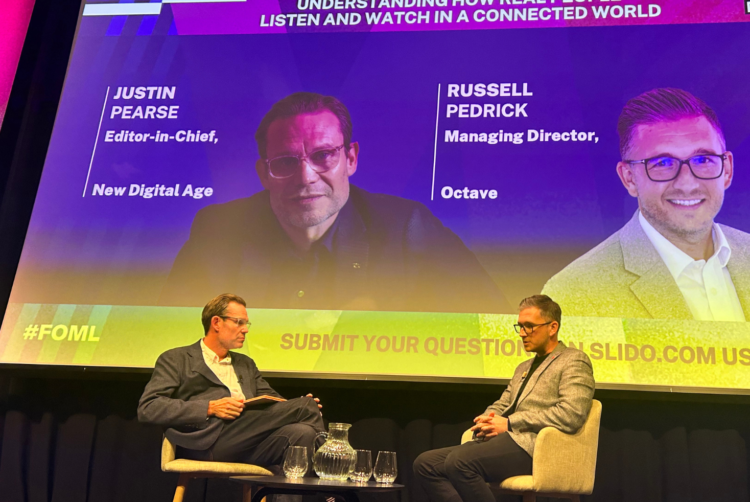
The Future of Media London 2025
Audio is becoming a secondary asset to podcasts, with video taking the primary spot, according to Octave’s MD, Russell Pedrick.
Speaking on-stage earlier today, Pedrick bridged the gap of understanding in how people are watching and listening to podcasts today.
Following the recent announcement of a partnership between Netflix and Spotify, which will see a selection of Spotify’s top video podcasts appearing on Netflix, Pedrick underlined the growth in video and the transition of podcasts to “shows.”
Last month, Global also announced the launch of Global Studios to accelerate a video-first approach to podcasting.
The media and entertainment group further announced it has acquired the creator network The Fellas Studios.
Also last month, Rosie Allimonos, Nishma Patel Robb and Kirsty Hunter launched HERA, the UK’s first video podcast network to focus on stories through a female lens.
But what is the advantage of video with audio? And what are the dangers?
Video’s moment
Pedrick stated how Octave started experimenting with visualising podcasts through its Talksport brand three years ago.
“Over time, we saw it didn’t cannibalise the audio audience,” said Pedrick.
“It was bringing podcasts into a new world and extending the audience through social platforms.”
He further underlined how this transformed the conversation with agencies, especially around branded content, offering advertisers new and extended reach.
Additionally, Pedrick revealed that when selling podcast sponsorship, 70-80% of the actual investment goes towards a visualised element rather than the audio.
He commented on how the roles of audio and video have “kind of reversed.”
However, Pedrick stressed the importance of brands not losing sight of the value of audio and the power it commands, regardless of listening habits.
“Listening to a podcast is a real one-to-one, intimate experience with your host.
“Audiences want to consume podcasts however they want to consume them, some like watching them whereas some people like listening with smart speakers.”
Vodcasts: Is it the future of podcasting?
What video offers advertisers
Throughout the session, one point was clear: video offers deeper engagement.
Pedrick pointed to the success their podcast has had on YouTube and also through cut-downs on other social channels, such as TikTok and Instagram.
Speaking on brand association, the opportunity for more visualised brand association with products was highlighted as a key advantage of video podcasts.
Pedrick underlined the need to communicate this strength with brands.
He said: “It’s for us as a business to communicate the power of both platforms together.”
Education gaps
Despite the praise, Pedrick drew on the example of certain agencies that did not know Talksport was a radio station.
He outlined how they were used to seeing the show on socials and Connected TV (CTV), with the danger being that the audio value is lost.
“There was an education job to be done,” added Pedrick.
“There’s a huge amount of innovation happening in the audio space as well, and we need to shout about that.”
Data elevates
Data was noted as a clear driver of success, especially its targeting capability.
Pedrick echoed this: “Increasing the connectivity of our business has opened up a vast wealth of data and sources.
“The broadcast business gives a lot of insights hour by hour, so when we get a certain guest on a show, we know if that guest has worked or not.
“Our job is to simplify that data and present it in a way the brands understand.”
Pedrick explained how to simplify the data; the focus is on segmenting audiences, which comes from understanding their publishing businesses and logged-in audiences from their connected apps.
He added: “We then enrich that data, which gives us location data, and then you can really tailor the creative.”
An AI age of creativity
AI was highlighted as a massive aid in driving creativity and making audio more accessible to smaller, more localised businesses.
Pedrick also underlined the dynamic advertising opportunity AI brings to audio, which previously has been utilised within TV.
The use of AI in creative was pitched as a market leveller, with the process being more streamlined and therefore more accessible to SMEs.
However, emphasis was placed on maintaining the human element of the creative, as Pedrick warned: “If we allow AI to make the creative it could become a bit direct and unpersonable.”
Female-focused video podcast network is more than a business, it’s a ‘movement’
Adwanted UK are the audio experts at the centre of audio trading, distribution, and analytics. We operate J‑ET - the UK’s trading and accountability system for both linear and digital radio. We also created Audiotrack, the country’s premier commercial audio distribution platform, and AudioLab, the single-point, multi‑platform digital audio reporting solution delivering real‑time insight.
To scale up your audio strategy,
contact us today.