



Ukraine talks: Let’s play Guess the Newspaper
Opinion
A journalist trainee could probably pick out the identities of the newspapers simply from their headlines. But have they all painted too rosy a picture of the prospects of a deal?
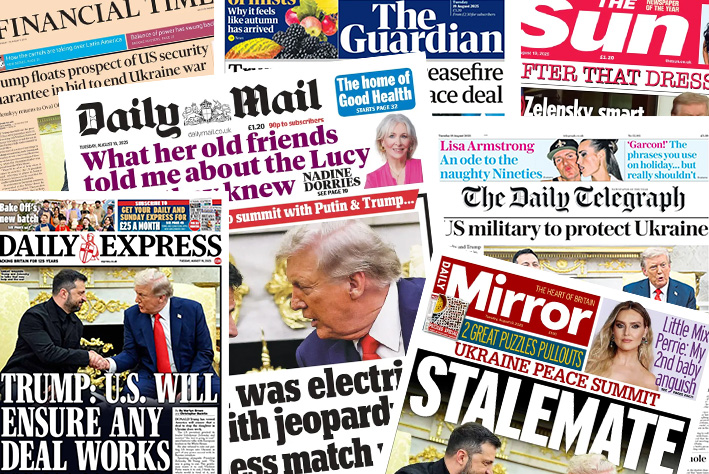
There was absolutely no question what the big story was this week or, indeed, for many weeks or even months: the return of Ukraine president Volodymyr Zelenskyy to the White House, flanked by a European coalition of “the willing”.
The second coming of Zelenskyy was so remarkable that it was the obvious splash for all the national newspapers. Well, almost.
While the peace of Europe and the fate of millions in Ukraine were at stake, the Daily Star preferred to concentrate on the story that “King Chas” was allegedly being stalked by a big cat near his Highgrove home.
Much less predictably, Metro chose to hone in on the UK’s 5,000 “fake online pharmacies”.
News, analysis, comment and community — Join The Media Leader
Chess metaphors galore
Apart from these two outliers, the remarkable thing is a journalist trainee could pick out the identities of many of the other newspapers simply from their choice of headlines.
A newspaper’s DNA feeds inevitably into its editorial approach. Or, less scientifically, the letters run the whole way through the sticks of rock.
No prizes for guessing which paper chose to concentrate on the fact that the Ukrainian president did not turn up this time in his war fatigues and wore something resembling a suit.
There was a suitably inspired matching headline: “Suited… not booted.” Even if The Sun did seem to imply that Zelenskyy might have won major concessions from US president Donald Trump because he decided to wear a suit.
Another title displayed its typical watermark by letting its political sketch writer loose on the front page.
“It was electric with jeopardy, a chess match with live grenades,” the splash read. The sketch writer went on to note that the trapdoor under Zelenskyy’s seat had not been activated, nor had he been served poisoned tea.
Yes, maybe, but surely the poisoned tea is a Vladimir Putin speciality.
Of course it’s the Daily Mail‘s Quentin Letts, who described the meeting in meticulous detail, down to the fact that “a male flunky accompanying the EU’s Ursula von der Leyen was wearing blue trainers”.
It read almost as if Letts was there. But was he covering the momentous matters from his TV set in the Herefordshire village of How Caple?
Beyond the gestures, Ukraine marks an extraordinary moment for our media
Another tabloid deployed some of its famous optimism — the kind of optimism it has stuck to year after year as it has lauded the benefits of Brexit.
“Trump: US will ensure that any deal works” was the chosen headline of the Daily Express, despite an obvious lack of any guarantee that the US would make a deal work. No commitment that there would be US boots on the ground to back any deal and nothing more than the fact that the US might help co-ordinate and support a European effort.
Another tabloid also reached for a chess metaphor — without the grenades — with the accurate, factual and punchy headline: “Stalemate.”
Almost by process of elimination, that would have to be the Daily Mirror, which also carried the intriguing subhead: “Trump’s security offer to Zelenskyy is rejected by Russia.”
More nuance elsewhere
On to the broadsheets and a headline that carries a very clear mark of its origin because of the nuances and qualifications involved.
“Trump floats prospect of US security guarantee in bid to end Ukraine war” carries the clear whiff of Financial Times exceptionalism.
Another broadsheet simply blurts out the main line without any reservations or even the usual fig leaf of quotation marks.
“US military to protect Ukraine” is the rather naïve pro-US line in the sure and certain knowledge that it is far from clear how the US will indeed protect Ukraine or what concessions will be involved in getting any “protection” at all.
It sounds a bit like The Daily Telegraph.
In truth, the final headline is a bit on the vanilla side, but with an aftertaste of contentiousness: “Trump: No need for ceasefire to secure Ukraine peace deal.”
This is clearly attributed to Trump, but there is a long history in the view of senior diplomats and former spies that, without a ceasefire first, peace deals rarely take root.
But that’s not the fault of the paper, which has to be The Guardian.
Rose-tinted newspapers
Apart from the headlines and their variety in pointing out what is essentially the same set of facts, there is one uniting theme.
Zelenskyy and his posse of Western leaders have taken a leaf from the Putin playbook and gone in to flatter the US president — essentially sucking up to his unrealistic peace efforts to achieve permanent peace.
Sir Keir Starmer, the UK prime minister, was one of those limiting their gaze to a single day and therefore able to claim that considerable progress had been made.
It was the mood music and it was legitimate for the media to report what Western leaders said, even though they may have been crossing their fingers behind their backs.
That is before taking into account the fact that the US president may change his mind suddenly in the way he dropped a ceasefire as a pre-condition to further talks or took a stance against postal votes after talking to Putin.
The death of Anas al-Sharif is a grim reminder of the need for evidence
Every angle in a complex situation may be found somewhere in the media, but there is a considerable danger that the overall coverage gives far too rosy a picture of the prospects of a deal.
There is the not-so-small matter of 20,000 Ukrainian children kidnapped by Russia with barely a word being said. And that is before you get to Putin’s territorial demands.
Is Zelenskyy really going to give up the rest of the Donbas region that Russia does not already control, when he is banned from doing so under Ukraine’s constitution?
There is also the issue that Nato believes that, at the present run rate, taking the rest of Donbas would take Russia more than four years and lead to 2m Russian casualties.
Perhaps, in the circumstances, a more honest headline would read: “Huge obstacles make permanent peace deal with Putin impossible.” Or maybe: “Peace with Putin in peril.”
 Raymond Snoddy is a media consultant, national newspaper columnist and former presenter of NewsWatch on BBC News. He writes for The Media Leader on Wednesdays — bookmark his column here.