



What is to be done about Reform TV?
Opinion
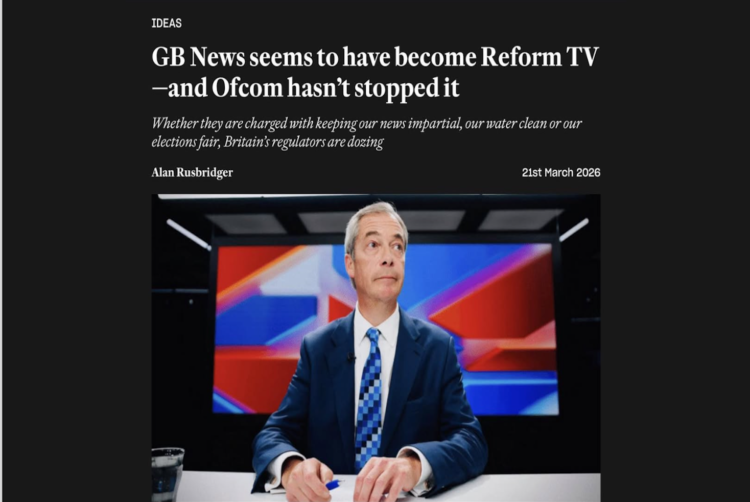
Alan Rusbridger has proof that GB News is in continuous breach of the Ofcom code on impartiality. So what will the Government or the regulator do about it?
The former Financial Times editor, Lionel Barber, paid an appropriate tribute this week to the former Guardian editor and his podcast co-host, Alan Rusbridger.
“His (Rusbridger) 12-page expose in The New World is a tour de force, showing how a single political party, Nigel Farage’s Reform UK, effectively ended up with its own TV channel, GB News,” said Barber.
Rusbridger’s research is devastating for both GB News and the communications regulator Ofcom, which has allowed the right-wing television channel to get away with blatant breaches of any normal concept of impartiality for years.
The study involved asking 20 experienced journalists from newspapers, magazines, and broadcasters, working in pairs and from a wide political spectrum, to watch 15 GB News programmes. Each was scored from zero to five on the extent to which they were deemed to have complied with the Ofcom code on impartiality.
Inevitably, there is an element of subjectivity in such a process, but it involved the views of 20 journalists, not a handful, and assessors from The Sunday Telegraph and the Daily Mail, as well as The Guardian.
Their average score was 1.4 across the range of GB News programmes viewed, and Rusbridger concluded that “one political party in Britain has effectively ended up with its own television station. GB News has essentially become Reform TV”.
One of the programmes cited was broadcast on 23 January and was presented by Matt Goodwin. It discussed the forthcoming by-election in Gorton and Denton. Four days later, it was announced that Goodwin would be the Reform UK candidate in the election.
Apart from the by-election, which Goodwin went on to lose, nearly all the subjects discussed related to illegal immigration in some form.
Including Goodwin, the voices were five-to-one in favour of the right-wing/Reform point of view, and the only contrasting voice came from a public relations consultant called Cai Wilshaw, who often appears on GB News as the “left voice.”
The assessors noted that he was interrupted and shut down by Goodwin, something that didn’t happen to the pro-Goodwin panellists.
One reviewer said of the Goodwin programme: “Absolutely did not comply (with the code). It was one man’s rant against immigration, supported by compliant and affirmative opinions and a pretence of an opposing view that was shut down rapidly. It was a disgrace.”
Over the past eight months, GB News has had higher average audiences than either BBC or Sky News over seven of those months, and Reform UK has been leading in the polls, although the lead has eased somewhat in recent weeks.
Even though GB News has already lost more than £130m, it has managed to pay one of its star presenters, Nigel Farage, a sitting MP, more than £580,000 since July 2024.
Lord Grade and Ofcom’s abject failure to tackle GB News
The Government has done absolutely nothing to tackle the GB News problem, but the lack of balance exposed by The New World research is, above all, an indictment of Ofcom, which has been chaired for the past four years by Lord Grade, a Tory peer and Brexiteer.
Ofcom’s remit is wide, and there might be an excuse for Lord Grade if he wasn’t up to speed with the intricacies of telecom legislation. However, he has held high positions in broadcasting all his working life and should know what impartiality, due impartiality and due accuracy mean.
Grade may not be a details man and was never agile with strategy, but as the head of the regulatory organisation, he must accept responsibility for Ofcom’s abject failure to tackle GB News.
Critics note that as recently as eight years ago, the BBC was found guilty of a breach of its duty of due accuracy when it failed to challenge remarks by Nigel Lawson on the science of climate change on the Today programme.
Ofcom has had nothing to say when GB News presenter Bev Turned failed to challenge Donald Trump when he said climate change was a hoax and made the totally false claim that China does not use wind power, and many other such comments across its programme schedules.
Two former Ofcom experts, Stewart Purvis and Chris Banatvala, argue that Ofcom has increasingly spent its energy identifying narrow “technical breaches” rather than concentrating on the core issue of whether GB News complies overall with the law on impartiality.
There was a telling comment by the GB News chief revenue officer, Ross Sergeant, to Jack Benjamin in The Media Leader podcast this week.
Benjamin asked, “Shouldn’t there be a greater plurality of views on the channel?”
Sergeant, choosing his words carefully, claimed that the channel was “fully interested” in such a thing and gave the opportunity to do that. Up to a point.
Can GB News scale its advertising business? With chief revenue officer Ross Sergeant
What is to be done about Reform’s TV station and day-by-day coverage that could have serious political and social consequences for the UK?
First, the Government should do something, and urgently, about the scandal of sitting MPs such as Farage presenting television programmes on news channels.
Farage does not read the news but is able to present his views in a news and current affairs environment.
Lisa Nandy’s promise to take action
At last week’s Society of Editors conference, Lisa Nandy promised to take action on sitting MPs being able to present news programmes.
She should be more precise and go further, and simply ban all sitting MPs from presenting any programme on a news channel, cutting short arguments about the difference between news, current affairs and entertainment.
The Government has been asleep at the wheel on an issue that could greatly affect its future electoral chances.
Luckily, Lord Grade’s term as Ofcom chair ends on 30 April. He could be replaced by Dame Margaret Hodge, the former Labour MP and culture minister who was also the formidable chair of the Commons Public Accounts Committee.
She would be a great appointment, but even if someone else gets the job, it is time for action on GB News.
Whoever takes over has to launch a thorough inquiry – internal or external -into GB News and all its works to investigate whether its overall output is in breach of impartiality law.
One great weakness of Ofcom has been its tendency to respond only to complaints, and it needs to be more proactive going forward.
Rusbridger and 20 public-spirited journalists have shown the way forward and exposed Ofcom’s obvious failings.
GB News gains kudos and respectability from being an Ofcom-licensed and regulated channel.
The question in the future could easily be whether it is a channel that deserves to keep such a licence.
 Raymond Snoddy is a media consultant, national newspaper columnist and former presenter of NewsWatch on BBC News. He writes for The Media Leader on Wednesdays — bookmark his column here.