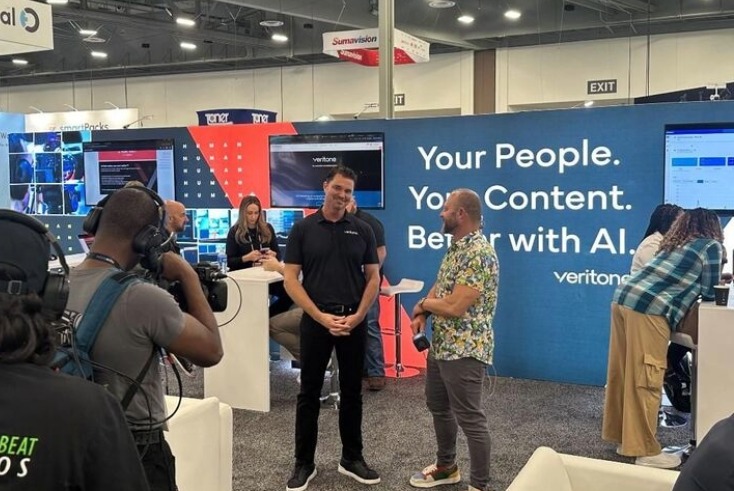
The rapid AI infrastructure build-out has triggered a surge in demand for high-quality AI training data, presenting a new revenue opportunity for TV content rights holders, according to Ryan Steelberg, president & CEO at Veritone.
His company operates a ‘data refinery’ that converts massive volumes of video, audio, and text datasets, which can be licensed to anyone training large language models (LLMs) or developing proprietary AI applications.
According to Steelberg (pictured above at NAB Show), Veritone can charge $1-1,000 per hour of video, depending on the application and the available tagging and metadata.
Veritone negotiates the value of the video (or audio) and provides a revenue share to the content rights holders, such as sports federations and broadcasters.
Real-world video capture
Video captured in the real world is the most valuable, favouring sports, nature, and some reality TV programming, Steelberg reveals.
Video data can be used to create virtual and augmented reality products, with two popular applications today being physics reasoning and motion dynamics.
Veritone says sports video (and also security surveillance, tapping a separate market) depicts real movement and cause-and-effect sequences that make them uniquely suited to ground AI models across complex areas.
One example is golf simulation, which will be improved by incorporating the real movements of a top professional (via sports coverage).
Veritone says dormant rights archives can be monetised for AI training and claims that “owning vast, rights-cleared, high-quality video archives is like owning oil fields at the dawn of the automotive industry.”
The company is bullish because, it says, AI hyperscalers and model labs will pay a premium for unstructured video and audio datasets.
That’s because, according to Steelberg, “Humans learn on unstructured data, primarily with video and audio sensory inputs – our eyes and ears.”
Fuelling next-gen AI
He believes that greater use of unstructured data will fuel the development of next-generation cognitive and generative AI. His company’s role is to turn the unstructured data into actionable, license-ready intelligence.
That process includes acquiring IP-cleared video and audio and, where necessary, confirming rights (which may include individual rights, for example, in the case of sports stars). The video is ingested and analysed, then provided as a package to the licensee.
In one instance, Veritone processed 500,000 hours of video to provide 26,000 hours of content for use with an LLM.
“It is more efficient if we prepare the data, rather than asking internal data science and data engineering teams to do that,” he argues.
The Veritone Data Refinery solution is being deployed across a rapidly expanding group of hyperscalers and venture-backed AI model developers, the company says, citing qualified bookings and a near-term pipeline valued at $40M as of the end of Q3/25 (the latest figures). That is up 400% over Q1/25.
Steelberg asserts that the next generation of video AI will not be built on freely available Internet data but on legally safe, premium video data, which can help offset data scarcity in the AI economy.