



Outcomes measurement vital to averting an Australian TV disaster, says Foxtel Media CEO
The last four years have been a calamity for the Australian TV industry, according to Mark Frain, CEO of Foxtel Media, who observes that marketing budgets have migrated to digital tech platforms.
However, the next two years can be different, he argues, if the television industry focuses on measuring business outcomes and making TV easier to buy, with both priorities backed by industry-wide collaboration.
Foxtel Media is the sales house for DAZN-owned Foxtel Group, one of Australia’s leading TV providers, which boasts Fox Sports and the streaming services Kayo Sports and Binge among its brands.
Speaking at The Future of TV Advertising Sydney in March, Frain said: “The TV industry in Australia, even if you include YouTube in the category, is not growing.
“That is despite the incredible advertising results it delivers for brands and agency partners.
“The Australian TV advertising market has lost over $1bn in the last four years.
“If we do nothing and stay focused on our old [measurement] metrics and work on our individual [tech stack, measurement, trading] systems, we can expect the same direction of travel as the last four years.
Potential $200m disaster
“That would mean over the next two years, we watch another $200m leave the industry.
“That would be a disaster.
“There will be more mergers and acquisitions, more transformation, meaning taking costs out. It will not be fun.”
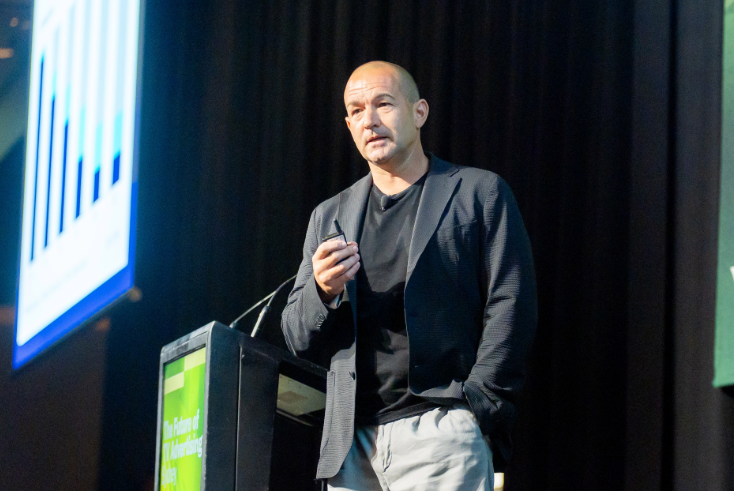
Frain (pictured) outlined two alternative scenarios, the first of which harnesses increased collaboration to evolve TV measurement to focus more on frequency, attention, and especially outcomes.
This would reverse the flow of budget out of TV and bring $100m back, he claimed.
If the TV industry combined this with a collaborative push to simplify TV buying and create the now legendary ‘easy button’ – mirroring the ease with which Google and Meta can be bought – another $100m could be won back.
Focusing on the second option, Frain said: “We need to deal with the transactional woes we hear about from agencies and clients.
“We are talking about a $400m positive change from a scenario where we do nothing,” Frain said of the second option.
He declared that the next two years will define the future of the TV market in Australia.
Frain highlighted a global trend towards greater media investment in media not measured in a joint industry currency.
Instead, the media or tech platforms that gain the budget use metrics and measurement systems they have architected themselves. Buyers have accepted that because of the direct attribution of media spend to outcomes.
“The global platforms have been doing outcomes better and faster than us for the last 10 years,” he noted.
“We are heading towards outcomes-based measurement, and the local [TV] industry [in Australia] is not there with outcomes yet.
“We will continue to compete based on content and use measurement to show how great that content is, but unless we track to outcomes, that will not matter.
“We must prove the relationship between our content and platforms – and we must do that as fast as possible.
“We have enough data to prove the impact of TV. We have the foundations to do this.”
Frain said a shift towards tangible business outcomes measurement should be the No.1 priority for the TV industry in Australia over the next two years.
Foxtel Media and the free-to-air broadcasters Seven West Media and Nine Entertainment are already working together, alongside adtech vendor Adgile, to provide a practical solution.
These companies are running a proof-of-concept for a TV analytics platform that links TV exposure to business outcomes, with always-on, real-time data.
Shared outcomes measurement
The hope is that this can become a shared industry resource.
Returning to the ‘easy button’, Frain noted how easy it is to buy YouTube. “Every agency has a red button that they press to send money to YouTube. Outstanding,” he commented.
“TV is hard to trade. It is too difficult. Where is our simple button? As an industry, we need to create one.”
His vision is for a single place where clients and agencies can buy TV audiences, through a tech collaboration that leaves TV companies competing on content, customer experience, ad experience, and client satisfaction.
“We keep competing fiercely in those areas,” he told the Sydney thought-leadership conference.
“If we fix that, and get closer to outcomes, I genuinely think we can grow the overall industry moving forward.”