



SXSW 2026: Rediscovering conviction and creativity in the age of AI
Opinion
The IPA’s Simon Frazier reflects on his visit to SXSW and how AI is challenging what it means to be human.
Shortly after publishing my first article, Why insight matters more than ever in the age of AI, I was fortunate to attend the annual South by Southwest (SXSW) festival in Austin, Texas. Historically, SXSW has held great allure as the place where culture and innovation come together to offer a genuine glimpse of future tech innovations and how they will change our lives. But 2026 felt different
If you’ve attended a media-related conference in the last two years, or any conference for that matter, you’ll likely have noticed that discussing AI has become, as Rory Sutherland would say, an ‘obligation rather than an option.’
Looking at the SXSW schedule, almost everything in the innovation or education space contained those two letters: AI. Although sessions were peppered with mentions of ‘humans’, ‘people’ and ‘The future of AI is human centric’ – the more I read, the more I worried that this narrative is not a genuine reflection of confidence, but an attempt at reassurance.
This emphasised a problem: in getting caught up in the AI arms race, we’ve become uncertain of what we’re all about.
One quote that perfectly sums up the state of the AI world in 2026 comes from Matthew McConaughey in his cameo role as stockbroker Mark Hanna in The Wolf of Wall Street:
Nobody – and I don’t care if you’re Warren Buffett or Jimmy Buffett – nobody knows if it’s going to go up, down, sideways or in circles. It’s a whazy. It’s a woozie. It’s fairy dust. It doesn’t exist. It’s never landed. It doesn’t matter. It’s not on the elemental chart. It’s not real.”
He wasn’t talking about AI, of course, but this phrase rings truer with every AI discussion where I’m told what the future will be.
Despite narratives which often allude to answers, we don’t know what the industry will look like in ten months, let alone ten years. But do you know what? I don’t think we really knew what the world today would look like 10 years ago either, and I’d argue that’s a good thing as unpredictability invariably drives agility.
After witnessing many amazing talks at SXSW, I firmly believe the industry of the future will be the industry we design for today – whether good or bad.
Almost every innovation creates new, potentially landscape-shifting possibilities, but in reality, how much do they really drive change? We’re all architects of our own destiny, and AI won’t ever change that.
Refocusing on the real: It’s a lack of conviction, not understanding
As is often stated, “The more you know, the more you know you don’t know”, and that’s the challenge with the explosion of AI.
It’s made us more uncertain about our capabilities, reinforced self-doubt about our courage in our convictions, and fundamentally questioned what it is to be human.
Luckily, on the first day of SXSW, I managed to make it through my existential crisis and jet lag to attend the premiere of a film that shifted the lens drastically on what the festival had to offer.
The AI Doc: or how I became an apocaloptimist dissected the crisis of confidence we are all facing with AI and examined it from two distinct angles: those who felt AI would destroy all we knew and loved, and those who took the opposite approach, prioritising human agency.
The documentary interviewed some heavy hitters in the world of AI, but what really hit home was that even they haven’t got a clue, making me think we shouldn’t look to them for answers but should view their offerings with the scrutiny we would afford any product we may consider buying.
The reality is we should approach AI brands like any other, and question what engaging with them really says about us.
Comfort as the enemy of creativity
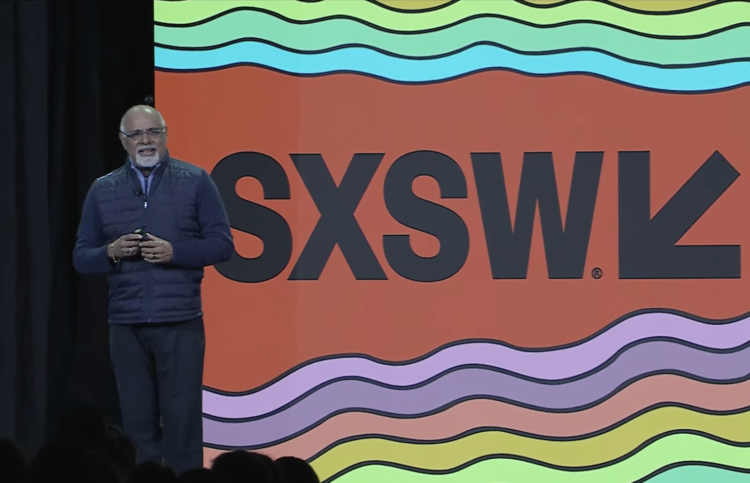
One of the absolute standout sessions of SXSW was the keynote speech ‘Why saying yes to the unthinkable works’ by the amazing Raja Rajamannar, CMO of Mastercard (pictured). “If something feels comfortable – that’s actually the zone you shouldn’t be in,” he said.
This ‘do what you’ve always done, in the hope of getting what you’ve always got’ approach is a non-starter. It drives cultures of provable efficiency rather than effectiveness, where empirically backed up failures are defended over intuitive successes.
This rationale was exemplified in another standout quote:
We are living in a sea of sameness, where every brand follows the same patterns and nothing is memorable anymore.”
As data-driven digital marketing and the associated metrics of predictability and provability dominate marketing decisions, it’s no wonder the fear of AI-driven replacement is so prevalent.
AI is driven by predictability, and predictability and logic ultimately expose weaknesses to competitors.
This isn’t a new rule; it’s how the natural world has operated since time began. Take one look at the species, ideas and brands that thrive rather than just survive, and you’ll see the one thing they all have in common is creativity, uniqueness and unpredictability baked in from the start.
The work of art in the age of mechanical reproduction
Back in 1935, German philosopher Walter Benjamin published his thesis ‘The work of art in the age of mechanical reproduction’ which questioned what value should be attributed to works of art in an age where they could be preproduced at scale by machines. But actually, did the fact that we could buy a scale replica of the Mona Lisa for a fiver make the appeal of the original any less alluring? No. If anything, it made it more desirable.
While strategy decks, research summaries and brand assets can all be generated faster than ever using AI, the outputs are just derivative imitations of great work, not great work in themselves. What SXSW made clear is that speed alone doesn’t equal progress.
Several speakers at SXSW, from academics to brand leaders, returned to the same provocation: insight doesn’t come from knowing more things; it comes from knowing which things matter.
AI is exceptional at surfacing possibilities, but it is far less capable of telling us which ones are worth acting on, in what context, and with what consequences.
At SXSW, the most compelling work wasn’t the most technologically impressive, but the most situationally intelligent – the stuff that made your brain come alive.
There’s a persistent myth that AI threatens creativity, but SXSW also suggested something far more uncomfortable and equally interesting: AI doesn’t replace creativity; it exposes the absence of it. Taste, judgment and creative courage suddenly matter more than ever.
Why SXSW still matters
In my first article, I argued that we risk mistaking efficiency for effectiveness, and, in many ways, SXSW reinforced that concern.
Many organisations are racing to deploy AI to cut costs, remove friction and accelerate output. But what was refreshingly candid at SXSW was an emerging recognition that optimisation without direction is a dead end.
The companies thinking long-term weren’t asking, “How can AI replace this role?” They were asking, “What new value could exist if our people were freed to think differently?” That shift from substitution to augmentation is where the true value of AI lies.
In an age where AI can summarise the world at the click of a button, events like SXSW can feel indulgent, but that’s exactly why being there is so necessary.
From the film portion of the festival in particular, attendees were able to glean insights from sources that often had nothing remotely to do with advertising on the surface, but spoke to the fundamental core of what it means to be human and have agency in 2026.
From a purely efficiency-driven perspective, a person might consider the cost of attending and question the investment. But from an effectiveness perspective, the question is, can you afford not to be there?
Who knows, one off-the-cuff conversation while queuing for an event may just spark the seed of a thought that could turn into the next billion-dollar idea.
SXSW reminded me that whilst AI may reshape how we work, it won’t define what matters. That responsibility remains firmly human.
That is why we at the IPA have recently launched the IPAi forum – to help the industry navigate this fast-moving world.
SXSW will take place in London from 1-6 June 2026.
 Simon Frazier is the associate director and head of marketing, data innovation and The Making Sense unit at The IPA.