



Creative leaders accuse UK government of failing to enforce copyright protection
UK creative leaders are using US president Donald Trump’s state visit to the UK to reignite the debate around AI copyright infringement.
More than 70 leading creative voices and organisations have penned an open letter demanding the government to explain its failure to protect the rights of UK copyright holders, countless of whom have alleged copyright infringement by major AI companies.
The letter was signed by organisations including the News Media Association, Getty Images, Telegraph Media Group, the Association of Online Publishers, the National Union of Journalists, Pan Macmillan and UK Music, as well as artists including Sir Paul McCartney, Sir Elton John, Robbie Williams, Kate Bush, Annie Lennox and Sir Mick Jagger.
It also demanded the government set out its justification for why it blocked an amendment during the passage of the Data (Use and Access) Act that would have required AI companies to declare their use of copyrighted material.
The letter follows similar action in May, ahead of the passage of that data act.
That earlier letter was part of a wider effort by the creative industries to seek clarity and accountability over alleged copyright infringement by AI companies’ use of work by artists and publishers. In February, news brands united to call on the government to “Make It Fair” in the AI era.
Failure to stand up to Big Tech
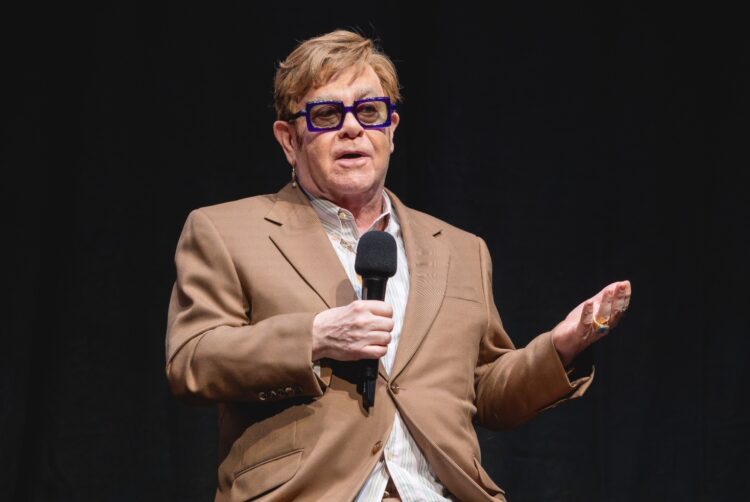
John commented that the government must remember its obligations to the UK’s 2.4m creative workers.
“Administration of copyright must be transparent. And it must have an artist’s full permission. These two principles are the bedrock of our industry and crucial for the survival of future generations of world-beating UK creatives,” the musician said.
“What is being waved through leaves the door wide open for an artist’s life work to be stolen, skimmed and scraped by Big Tech AI companies. We will not accept this and we will not let the government forget their election promises to support our creative industries.”
Robert Smith, frontman of The Cure, added that the government should be “standing up to the Big Tech AI companies that continue to ignore the many long-established laws of copyright”.
The letter argued that the government’s current position of not take steps to make existing copyright law enforceable risks ceding control over the UK’s creative economy and the rights of its citizens to overseas interests.
‘Our work is not yours to give away’: Creative leaders urge Starmer to enforce copyright law
The signatories also pointed out that, while former science secretary Peter Kyle and former creative industries minister Chris Bryant had committed to creating a parliamentary working group so that the Commons and Lords could have greater input into policy development around AI and copyright, such a group has yet to be formed. Both Kyle and Bryant have left their roles amid this month’s cabinet reshuffle.
In the meantime, there have been initial meetings between industry working groups that aim to bring together creative and tech industry stakeholders. However, a lack of UK AI companies involved in such meetings has raised alarm that UK tech is being ignored in favour of larger US competitors.
As Baroness Beeban Kidron, who led the data act amendment effort, explained: “The government have asked the creative sector to trust in their process, then they packed their industry working groups with US interests, made multiple deals with AI companies who have stolen copyright material and then ministers left the building. Following the reshuffle, it is for the prime minister himself to reset the relationship between government and industry.
“If the government cannot grasp the economic or cultural importance of this issue, perhaps this action — setting out the clear contravention of international and UK human rights law — will help clarify the seriousness of their position.
“It’s deeply regrettable that it has come to this, but by prioritising the short-term optics of data centre announcements and trade deals, they are knowingly undermining the foundations of the UK’s creative industries.”
Read the full open letter
Dear Prime Minister,
One of the defining characteristics of your Government, which is more important now than ever, is its unqualified commitment to the rule of law, human rights principles, and international law.
Given this, we, the undersigned, are concerned that the law is being flouted en masse by predominantly overseas tech companies to the fundamental detriment of the UK’s £127bn creative industries and in violation of creators’ human rights.
Artificial Intelligence companies have ingested millions of copyright works without permission or payment, in total disregard for the UK’s legal protections. Even Ministers have recognised that “much content has already been used and subsumed by AI models, usually from other territories and under the current law”. This means UK citizens are experiencing consistent and deliberate breaches of their rights under human rights law.
Looking forward, it may well be that the Government seeks to weaken copyright law, and we are closely watching the consultation process; you will know that many have suggested the consultation itself may be subject to legal challenge. However, your Government must answer the need to uphold the human rights of creators, not only in its future plans but right now.
To be clear, the consultation process does not, in itself, constitute a response to the widespread human rights violations happening now, and Ministers have offered no timeline and no planned action with regard to those violations. Indeed, the Government has repeatedly acted to remove amendments which would have empowered copyright holders to exercise their rights during the passage of the Data (Use and Access) Bill. In doing so, they have actively stood in the way of creators’ rights being exercised.
What are those rights?
Article 15, paragraph 1 (c) of the International Covenant on Economic, Social and Cultural Rights (ICESCR) of 1966 states: “[e]veryone has the right to the protection of the moral and material interests resulting from any scientific, literary or artistic production of which he is author”.
This is a basic, universal entitlement; it does not need to be asserted or claimed.
Article 15 echoes the Berne Convention for the Protection of Literary and Artistic Works, which dates back to 1886, has been updated periodically and is one of the most widely adopted international conventions. The Berne Convention proclaims its signatories’: “desire to protect, in as effective and uniform a manner as possible, the rights of authors in their literary and artistic works”.
It lays down minimal, internationally-agreed standards for copyright protection. The protection of copyright material is automatic and applies from the moment a work is: “fixed in some material form”: see Article 2(2). By Article 5(2) “[t]he enjoyment and the exercise of these rights shall not be subject to any formality…”
Furthermore, the European Convention on Human Rights and Fundamental Freedoms of 1950 (ECHR), made enforceable here in the UK through the Human Rights Act 1998. Article 1 of Protocol 1 assures everyone’s: “peaceful enjoyment of… possessions. No one shall be deprived of his possessions except in the public interest and subject to the conditions provided for by law and by the general principles of international law.”
Where such rights are interfered with by the state, either directly or because of the way it frames, enforces or fails to enforce the law, there must be a meaningful compensation system.
Ministers’ deliberate choice to remove the amendments to the Data (Use and Access) Bill mark a clear breach of UK citizens’ human rights “to the protection of the moral and material interests resulting from any scientific, literary or artistic production of which he is author”. The Government’s formal position has exhibited a shocking indifference to mass theft, and a complete unwillingness to enforce the existing law or uphold the human rights stipulated by the ICESCR, the Berne Convention and the ECHR.
The first duty of any government is to protect its citizens — not to promote corporate interests, particularly where they are primarily based abroad. The failure to do so — apparently driven largely by conflicted advisors, and inadequate understanding of the matter by Ministers — risks yet more breaches of international conventions and of the human rights ‘brought home’ by the Human Rights Act 1998 on a greater scale than is already occurring.
Therefore, we ask you to set out the Government’s justification for actively ignoring the rights of UK copyright holders set out above since the general election. We also ask you to explain the reasoning behind Ministers’ statements that appear to undermine those rights, and the rationale for standing in the way of the transparency demanded by rights holders that would allow their rights to be asserted, given the clear and consistent breaches of their rights that continues to take place. For clarity, we are not asking for an explanation of the decision to consult on AI and copyright, or the “prefered option”, but rather ask for an explanation of the Government’s stated position that no steps will be taken to make the existing law enforceable.
We, the undersigned, believe that the UK Government has so far failed to account for international and UK human rights law regarding the enforcement of UK copyright law, and we ask for a timely response from the Government whilst we consider our further options.
Who will win the AI/publisher copyright fight? With PPA’s Sajeeda Merali