



‘Just talk about it’: Initiative’s new global CEO on leading an agency amid industry consolidation
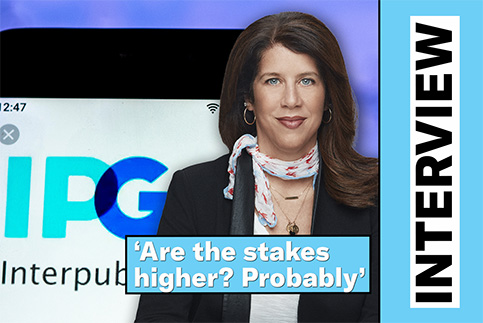
The Media Leader Interview
Stacy DeRiso discusses what sets Initiative apart from its agency competitors and how she’s leading her staff amid a transitory period as Omnicom awaits approval on its plan to buy Interpublic.
Taking on a new role as global CEO of a media agency is a career-defining challenge at any time, let alone when the agency is in the process of being acquired.
But for Stacy DeRiso, the new global CEO of Interpublic’s Initiative, the looming $13.5bn acquisition of its parent by Omnicom is an exciting opportunity, not something to be overly anxious over.
“I’m a very transparent person,” she tells The Media Leader over call from Brooklyn. “I actually am very excited by it. That’s a genuine, authentic Stacy statement. When I heard the news, when I thought about it — I’ve been in the agency business my entire career — this is the biggest thing that’s happened in the agency world in my career and will happen in our lifetimes, even.
“I’d way rather be on the inside of that than on the outside of that. And I try to bring that excitement and perspective to our people and our teams from the onset.”
For DeRiso, Omnicom’s acquisition will bring her home — in a way. Before joining Initiative as US CEO in March 2021, DeRiso spent more than six years at Omnicom agency PHD, including as its chief client and chief operating officer.
Calling the decision to leave what was a comfortable job at PHD “one of the best risks and decisions I’ve ever made”, DeRiso was subsequently promoted to global CEO this summer when her predecessor, Dimitri Maex, left the agency to join Accenture Song.
While she gets her arms around the new remit, her initial priorities are in grasping the needs of markets outside the US and gaining a strong understanding of Initiative’s global client relationships. While the US is Initiative’s largest market, DeRiso points to Latin America, EMEA and Canada as opportunities.
In search of differentiation
Of course, among her list of priorities is also presenting the agency in top shape for its new owners. Since the announcement of the acquisition in December 2024, Initiative has been focused on “surrounding and securing our current clients” by meeting their business objectives and ensuring strong interpersonal relationships.
According to DeRiso, the effort has been rewarded with Initiative’s highest-ever The Referral Rating scores.
“[I’m] thinking about how we’re going to show up to Omnicom as Initiative, what that story is that we’re going to tell them and bring with swagger,” she adds.
DeRiso views the agency as having two core differentiating factors: its Fame and Flow strategic model and a unique approach to client relations.
The latter has two components, including an “empathy charter” — a sort of interpersonal contract with clients on how they would like to interact with the agency. This could include agreeing to guidelines on standard work hours, available hours for meetings or even granular decisions like what restaurants to dine at together.
“It’s both functional and practical things, as well as some fun and relationship-building things,” DeRiso explains. “Like any relationship, let’s set expectations and manage toward them.”
In addition, Initiative has a “walk-a-mile” programme, based on the idea of walking a mile in someone else’s shoes. The scheme began internally, later expanding to client interactions. It involves agency staff switching jobs for a short period to gain a greater understanding of the challenges and pain points of clients’ marketing teams.
Interpublic shows continued decline in Q2 ahead of Omnicom merger
Fame and Flow, meanwhile, is built on the classic dichotomy of brand and performance. Launched as a media planning proposition in 2023, DeRiso refers to it variously as a “more modern interpretation of the funnel”, “a new mental model for marketing” and a “diagnostic tool” that seeks to understand the most potent levers media can pull for a client to hit their KPIs.
“The word we say is the most important in Fame and Flow is ‘and’,” she says. “Because what our model allows us to do is identify the relationship between fame and flow, quantify the impact that fame will have on flow, and vice versa.”
According to DeRiso, the general trend in favour of larger performance marketing (or “flow”) budgets is “recalibrating itself” as more clients shift to focusing on longer-term impacts. But as more media owners expand their inventory up and down the funnel, there are no longer specific media channels that just provide “fame” or “flow”.
For example, declining to use the term “TV” over the much broader “video”, DeRiso notes that the medium can now be used in a variety of ways to drive performance and brand marketing. Social media, similarly, can be a “big fame driver”, even if bought in the highly targeted way it often is.
“It’s not a channel-based conversation. It’s a how-we-use-these-channels conversation,” she clarifies.
‘An eye on tomorrow’
DeRiso stresses that Initiative has had “an amazing few years” with “significant” growth “despite some setbacks”, thanks in part to Fame and Flow and the agency’s general client-centred ethos.
She agrees Initiative’s work — like the work of any agency — is ultimately consultative. But while many industry leaders have suggested agencies must become more consultative to succeed in an era of AI efficiency and heightened client expectations, DeRiso argues that the agency’s responsibility has always been to focus on clients’ business results, not just executing a campaign.
“We’ve got to be as good at understanding our clients’ business, and partnering with them on that path to growth, as we are at planning and buying media,” she says. “Is it shifting to consultative? I’d argue that responsibility has always been consultative. Are the stakes higher? Are the pressures and KPIs changing? Probably.”
When asked whether Interpublic’s embrace of AI has spooked some staff, particularly amid anticipated consolidation following the acquisition, DeRiso says: “It’s not just about efficiency; it’s about enablement.”
She continues: “People are creating tons, thousands of custom agents on behalf of their teams and their clients. That’s doing some amazing and magical things.”
DeRiso has asked each of Initiative’s client teams to conduct audits of how they are using AI today, with an eye towards not only promoting how the agency is developing its tools but also “merchandising […] that we’ve got an eye on tomorrow”.
Is what “tomorrow” looks like ever certain? Over the weekend, the US Federal Trade Commission gave its final stamp of approval to Omnicom’s acquisition of Interpublic.
But there are potentially dangerous strings attached: the new company will not be allowed to divert advertising spend away from publishers whose “political or ideological views” it does not share. This means it will be harder to choose not to advertise on Donald Trump-allied platforms such as X or the soon-to-be-Ellison-controlled TikTok, even if there are legitimate brand-safety concerns in doing so.
The acquisition still faces regulatory scrutiny from the EU, which has yet to grant the green light.
Understandably, staff have felt the impact of uncertainty. Mergers often lead to redundancies; in the past year, rival WPP cut 7,000 jobs amid its own agency consolidation effort.
For her part, DeRiso takes the stance that it’s best to “just talk about it” as openly as she is able to with her staff.
“I’m not hiding from talking about the fact that this is happening, sharing what information we have as it unfolds and comes to us, and taking questions around it,” she says. “There’s just uncertainty in it. People worry about what this means for them. I think the reality is, client teams and client businesses, that’s what people pay for. That isn’t going to change, right?”
Regardless of the acquisition effort, DeRiso adds, every agency has to operate as an independent entity to reach its unique goals on behalf of clients.
“I don’t think that will change. I guess, how Omnicom determines which agencies play for what will be what changes. We’ll see — I can’t speak to how that will go.
“But what I can speak to is: Initiative has a differentiated product.”