



Pareto principle appears to apply to YouTube viewing, says Thinkbox
The heaviest 25% of YouTube viewers account for around 90% of viewing hours on YouTube while the other three-quarters of users account for just 10% of YouTube consumption by time viewed.
That is according to data from TV audience measurement company Barb, presented this week by Anthony Jones, head of research at commercial TV marketing body Thinkbox.
“The Pareto analysis seems to operate here,” Jones told a packed audience of media agency buyers and TV industry professionals at London’s Ham Yard Hotel on Tuesday. The Pareto principle, also known as the “law of the vital few”, states that for many outcomes, around 80% of effects are driven by 20% of causes.
Accordingly, the heaviest 25% of YouTube viewers watch, on average, just over two hours of YouTube each day. The remaining 75% are, on average, only watching six minutes of YouTube content — and, by definition, a smaller proportion of advertising — daily.
In January, YouTube made headlines when TV audience measurement company Barb reported that it had surpassed the BBC in monthly audience viewership in each of the final three months of 2025, a first for the video sharing platform.
But Jones noted that measuring by time spent viewing content on the platform, as opposed to reach, appears to undermine YouTube’s apparent momentum in the UK market.
Who are the YouTube “superfans”?
Barb data shows the top 25% of YouTube users skew slightly male, slightly downmarket, and toward students, with heavy users “predominantly” overindexing with under-15s and slightly overindexing with 25-44-year-olds. The platform was surprisingly found to underindex with the valuable 16-24 demographic.
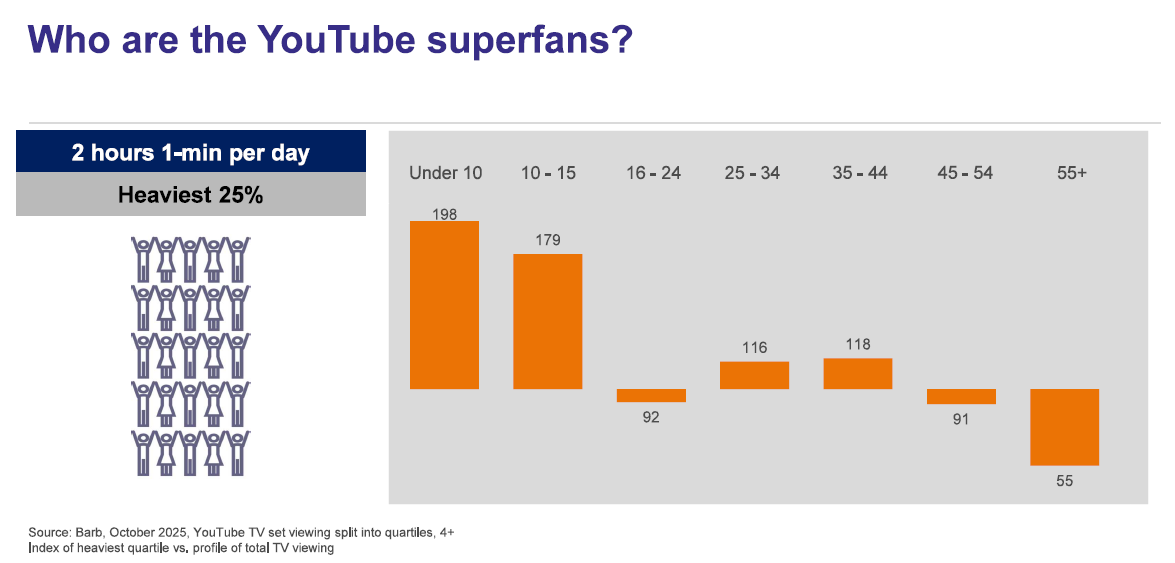
“Our hypothesis here is that this is children and parents consuming YouTube together within the home,” Jones said.
Nailah Uddin, Thinkbox’s research manager, further noted that heavy YouTube viewers are, more generally, heavy video and TV viewers. “We know that they consume about two hours and one minute of YouTube per day. But when we looked at how much TV content they were consuming, it was actually around 2 hours and 23 minutes,” she explained.
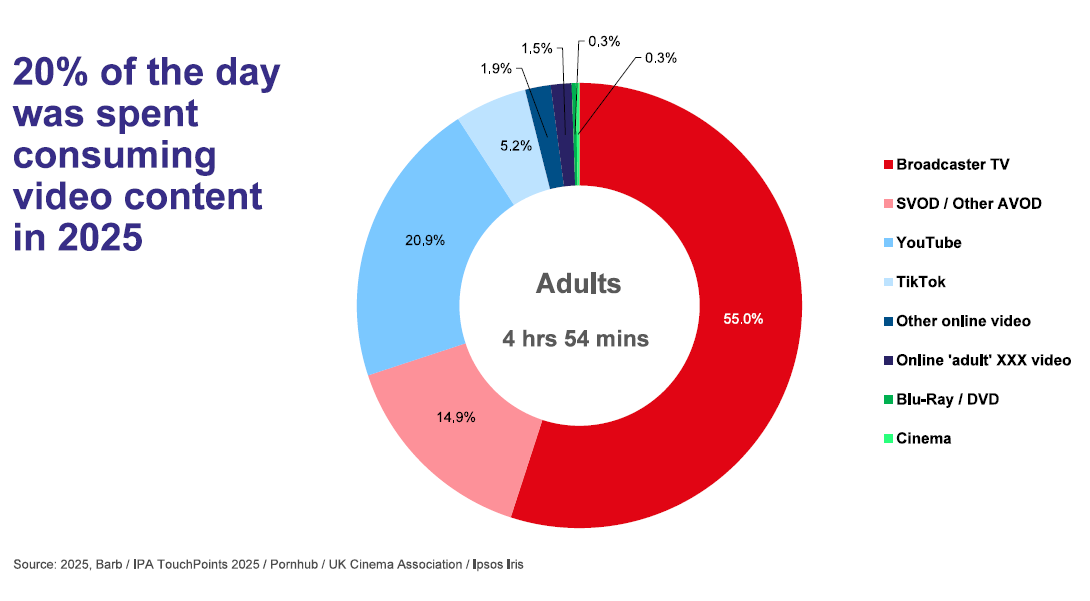
Last year, UK adults spent an average of four hours and 54 minutes each day consuming video content, equivalent to 20% of the day. Of that viewing time, roughly 70% was spent watching either broadcaster TV or streaming video-on-demand (SVOD) services, which Thinkbox chief strategy officer Elliott Millard refers to as “total TV“.
YouTube, by comparison, accounted for 20.9% of viewing time, though, as Jones reiterated, this is heavily skewed toward YouTube’s top quartile of users.
Breaking down viewing trends by category, time spent watching commercial TV fell 10% year on year in 2025, while commercial broadcaster video-on-demand grew by a comparable 11%. Streaming video-on-demand (SVOD) viewing time likewise grew 8%.
In comparison, according to Barb data, time spent viewing YouTube grew 4% year-on-year in 2025, while time spent viewing TikTok fell 3%.
What about how much time is spent not just viewing content across different media channels, but also ads?
As Uddin noted, YouTube’s skip feature means the longer the ad spot, the more it is likely to be skipped, with viewers on average watching less than half (48%) of a given ad on the platform.
Among the 16-34 demographic, which watches on average eight minutes and 58 seconds of video ads per day, the amount of time they spent watching ads on TV (48%) is marginally greater than the amount of time they spend watching ads on YouTube (33%) and TikTok (14%) combined.
Uddin added: “This is important because not all advertising environments are created equal.”
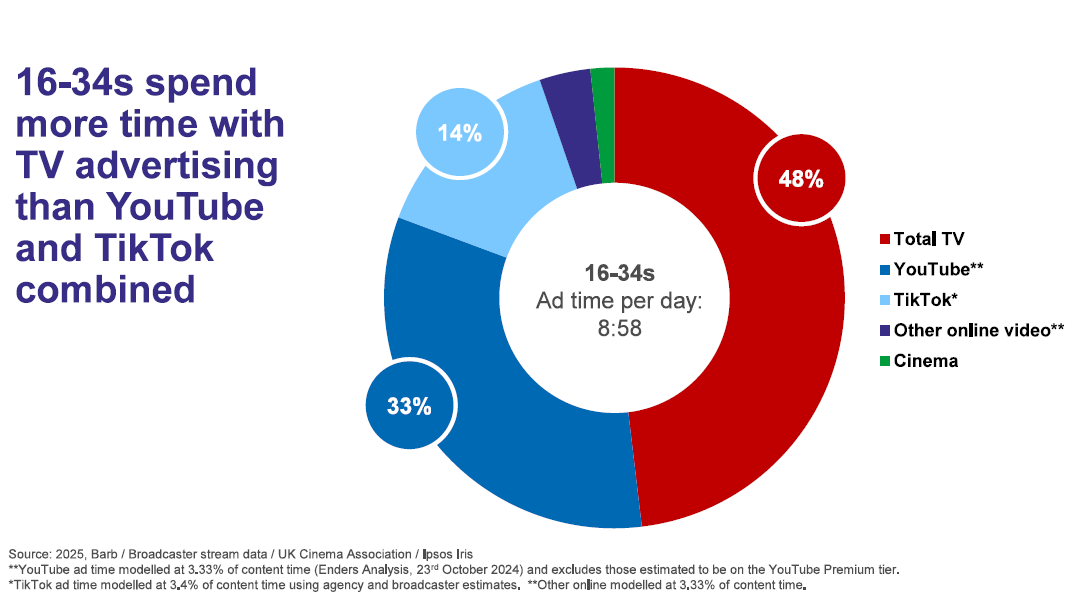
To Jones, this is evidence that despite the past 10 years amounting to “a decade of disruption” between the rising popularity of short-form video, the introduction of streaming TV ad tiers, and Covid-19 shifting media consumption habits, video viewership has remained remarkably consistent.
“What has happened to video consumption? The answer is: not very much,” Jones declared. There has been a “slight” increase in Brits’ total amount of video consumption, but “television still remains the dominant video channel people are using on a day-to-day basis.”
Most of YouTube’s content is not ‘TV-like’
During his presentation, Jones shared one chart that he warned “gets me thrown out of the research community” for attempting to estimate YouTube viewership across both TV sets (via Barb data) and other devices, including smartphones, tablets, and desktops (via Ipsos Iris data).
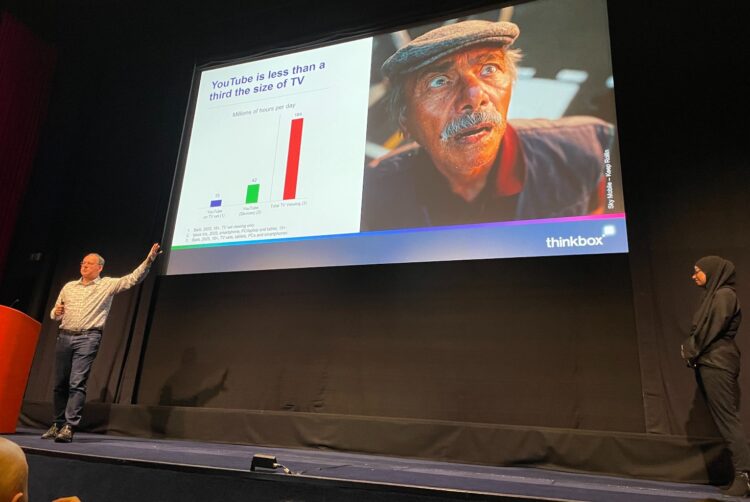
Offering the caveat that “technically you can’t” add those figures together due to differences in measurement methodology, Jones nevertheless offered that doing so showed, likewise, that YouTube viewing is less than one-third the size of total TV viewing by daily time spent.
As The Media Leader reported, Barb itself has been restricted from its effort to measure viewing of specific YouTube channels on TV sets after Google handed the joint-industry currency a cease-and-desist letter in January.
Jones acknowledged the back-and-forth in his presentation: “We wanted to dig deeper into what content people are consuming on YouTube. Some of you are probably aware that Barb, for a while, was publishing information on YouTube channel consumption. Unfortunately, that data has been removed from our laptops, briefly.”
In light of Barb’s efforts, Thinkbox turned to TRP Research, a firm that specialises in Barb analysis and runs its own consumer audience panel.
TRP groups YouTube viewing into two buckets: “TV-like content”, a narrower definition of professionally-produced videos, and “Unlike-TV content”, consisting of the long tail of user-generated videos.
According to TRP, “TV-like content” accounts for around 41% of YouTube viewing. Of that fraction, Uddin noted, more than half (51%) is derived from music-related consumption.