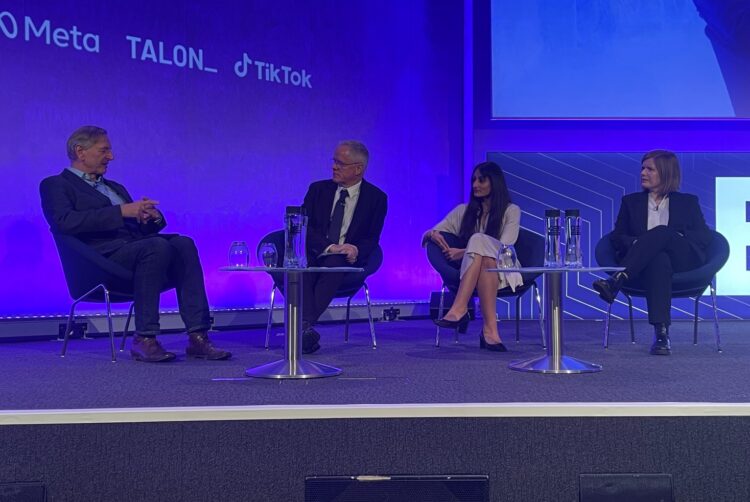
At the Advertising Association’s annual LEAD conference in London on Thursday, Rima Amin, security policy manager for community defense at Meta, was asked to respond to a November report from Reuters that revealed the tech giant internally projected that it would earn about 10% of its overall annual revenue in 2024 (equivalent to $16bn) from running ads for scams and banned goods.
Disputing the reporting in front of an audience of hundreds of UK advertising industry leaders, Amin said of the 10% figure: “That is not true, that is not accurate, it is a misinterpretation of the [leaked] document.”
She explained that Meta intentionally “cast a wide net”, overestimating the scale of the problem of scam and fraud ads on its platform. “If you’re looking at a problem like scams, that is very complex, you need to be able to study them,” she reasoned.
The 10% figure in the internal report, Amin insisted, was inclusive of real scam ads, ads that were “suspicious” but not conclusively fraudulent, and ads from some legitimate businesses that weren’t violating Meta’s policies but that scammers appeared to have been copying.
In reality, she claimed, “real scams” on Meta “might” have accounted for 3-4% of Meta’s total annual revenue in 2024.
Even if that explanation is taken at face value, it would still mean that Meta knowingly earned between $5bn and $7bn off of scam or fradulent ads in 2024.
“It’s higher than we would like it to be,” Amin admitted, adding the tech giant “expect[s] that number to drop” in 2025.
According to Amin, 55% of Meta’s 2024 ad revenue derived from verified advertisers. Amin claimed Meta increased that figure to 70% in 2025, and hopes to further increase that to 90% in 2026 by expanding verification requirements for advertisers on the platform.
Amin also indicated Meta has grown efforts to increase its collaboration with global law enforcement to help assist authorities in cracking down on ad fraud.
LEAD 2026 – The Media Leader Live Blog
Open questions
Despite Meta knowingly earning billions of dollars in revenue from scam ads, the company was awarded the IAB’s Gold Standard certification last year. Critics, including Lindsay Clay, CEO of TV industry marketing body Thinkbox, accussed the IAB’s certificate of becoming “tarnished gold; a fig leaf on a bin fire” and amounting to “scam-washing”.
During the panel, IAB UK’s head of policy and public affairs, Sinead Coogan Jobes, responded to the criticism by downplaying the purpose of the Gold Standard certificate, stating that it is meant to help advertisers have confidence that buyers and sellers in the digital media market are “playing their role in doing the right thing”.
She continued: “But what it isn’t, and what we’ve never claimed to be, is a single solution to this problem. We think it plays a very important role in raising the bar across the industry […] but it has to be part of a mix of the way that we solve these issues.”
During the panel, the LEAD audience was encouraged to submit questions to the moderator, Mark Lund OBE, co-chair of the Government Online Advertising Task Force.
Attendees submitted questions including:
- “It must be frustrating to hear people argue that Meta’s actions don’t match their words on fraud. How can you convince people?
- “If Meta are doing enough to address scam ads and fraud, then why are the majority of scams targeting the banking sector still coming from Meta?”
- “A share of scam ads of 3%-4% is around $5bn per year globally. Should Meta return that money to global law enforcement for better policing?”
- “Critics argue that scam ads would disappear if all Meta advertising was properly pre-vetted in advance (like TV). Why don’t you do that?
Citing the large volume of questions submitted and limited time available, Lund instead loosely summarised the questions: “We’re starting to get questions in and they’re mostly about how the standards can improve, in terms of pre-vetting or moving to 100% verified advertisers. What’s the most likely possibility there?”
Amin responded that “no single tool on its own is going to fix this”, and pointed to iteration efforts Meta is making to its ad review system and to its verification efforts with advertisers.
“Fundamentally, we’re gonna take any piece of technology that is available and try to use it to drive this stuff down.”