



Barb x YouTube: Yay or nay?

Opinion
Any improvements in measurement should be welcomed. But what if Barb’s development does more harm than good? Does reporting on just 200 channels actually say anything?
Given the flurry of recent news directly or indirectly related to YouTube and Barb, did anyone stop to wonder what the industry that is built around the YouTube platform thinks about Barb’s announcement that it will start including YouTube in its reporting?
The Media Leader did.
At Little Dot Studios, YouTube is our bread and butter — we manage over 1,000 of the world’s biggest entertainment, sport and consumer brand channels.
We’ve got a deep understanding of how YouTube works, not just the flashy bits that everyone sees but the gritty, behind-the-scenes data that fuels it all. We’ve worked with hundreds of content owners, brands and agencies, building strategies that get results across the full spectrum of YouTube content.
And, as much as we welcome efforts to improve measurement, we also know that just slapping YouTube data into the same system as TV might miss the mark.
Without doubt, we welcome any improvements in measurement throughout the media and advertising ecosystem, as it can help to reduce perceived risk and increase confidence that advertisers’ money is being well-spent.
The gradual consolidation of media buying into global holding companies means that people’s media consumption changes faster than media buying and, perhaps more importantly, long-held beliefs about “what works”.
Small sample
So, having the respected Barb start to measure YouTube must be a positive, right?
But what if it does more harm than good? Does Barb reporting on 200 of the 4.6m-plus monetising channels actually say anything?
There are some 14bn videos on YouTube; Barb will tell you which videos on 200 channels uploaded since April have been watched — this may be around 13,000 videos. That’s a sample of around 0.000001% of the total video inventory and still only around 0.5% of videos that are being monetised (ie. which are showing ads).
In the aftermath of Barb releasing the early data, observers have been comparing one YouTube channel or video to TV viewing data: “So-called massive YouTube channel actually only reached 0.5% of the UK adult population and would have been 97th in the rankings for TV viewing this week.”
Naysayers pointed out that even “so-called YouTube behemoth” MrBeast only reached 4% of the UK audience in a given period.
Let’s take the example of Peppa Pig: “YouTube is ‘a mile wide and an inch deep’ — even Peppa Pig makes it to only 1.2% of individuals aged four-plus… [with a] reach of 768,000.”
Well, let’s look at this number. First of all, let’s remember that Barb is only including views on videos posted since April. For most established channels, according to our data, at least 50% of viewing comes from videos at least one year old.
Agencies welcome Barb’s YouTube measurement but emphasise need for development
So, in nearly all cases, the Barb methodology will severely underestimate viewing on the channels it does include. It’s a mystery to me why its measurement partner didn’t audio-fingerprint the most-viewed videos (this information is public so it wouldn’t be difficult).
On Peppa Pig’s official channel, views from videos published since April represent about half the total viewing on the channel (635m of 1.3bn views in the period). So the Peppa Pig figure (assuming that global viewing is the same for the UK) means that the channel actually had a reach of 2 x 768,000 = 1.5m approximately.
This would put it just outside the top 50 “TV” shows reported by Barb in the most recent week and would, I imagine, be the most-viewed kids’ show in the country.
Lack of agility
These costly mistakes or decisions in the methodology are failing the planners who need it most and who maybe don’t have an in-depth understanding of YouTube viewing behaviour — and how this might be skewing the Barb data.
Anyone buying advertising on YouTube already knows that they are not buying individual channels or videos (unless you’re buying directly from a publisher or a specific sponsorship-style campaign).
You build your reach across a huge swathe of video content on hundreds or even thousands of channels. You can see that data in your campaign report — it’s no secret.
It’s also worth noting how real-time data and agile campaign management are crucial in the YouTube space. Advertisers are used to adapting and optimising campaigns almost instantly — something that is difficult with slower, aggregated data sources like Barb. With YouTube, speed is key and relying on traditional reporting methods slows down the ability to take action on insights.
Whereas the power of statistics and sample sizes is used to great effect in making sure the Barb panel is representative of TV broadcast viewing, when you then apply a sample to the content, the whole house of cards collapses.
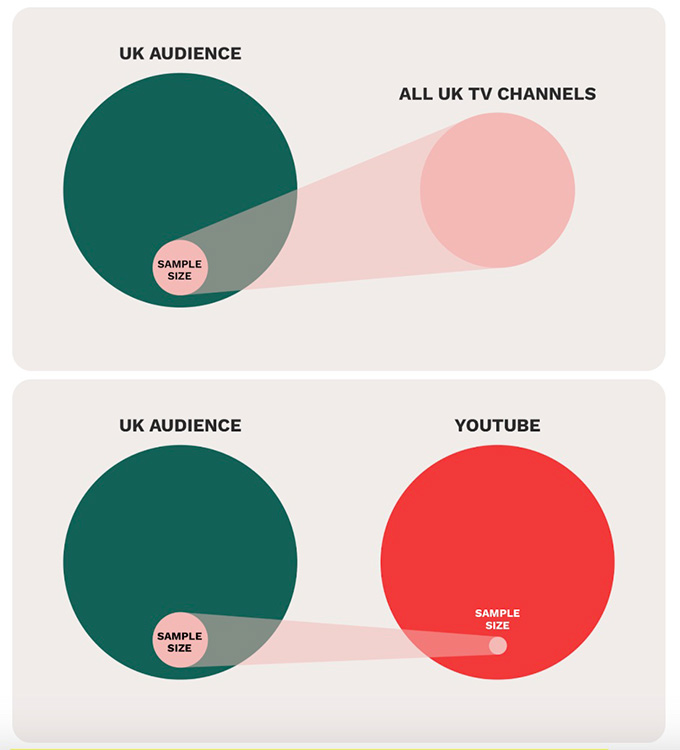
It is missing 99.5% of the YouTube views, yet reporting it as comprehensive.
Unlike TV, YouTube is a global platform with fragmented audiences and content consumption is influenced by a wide array of factors that are not considered in this simplistic overview.
It’s not only the fault of Barb; YouTube also has to shoulder some blame. Without releasing the data, it’s impossible for Barb, its suppliers or the broader industry to ever know this informoation.
And then, finally, we have the “industry” now arguing over whether YouTube is “TV” or not. Honestly, do you think anyone cares or that this even matters? Surely the question is: how can I get my 60-second video ad on a big screen in front of the audience I’m targeting?
If your audience is on YouTube (it is) and they are watching on a TV (they are — and you can ensure your ad appears there), then it’s TV. It’s on a TV. How is this a debate?
So is this a good first step, another sidestep or, worse, a backwards step? It doesn’t seem like this will move the needle in any direction. Those who know know and those who don’t won’t be any wiser.
 Graham Swallow is director of data, tech and product at Little Dot Studios