



The death of Anas al-Sharif is a grim reminder of the need for evidence
Opinion
Israel must be made to provide proof for its claims. A journalist’s job is to speak for the silent and not accept anything at face value.
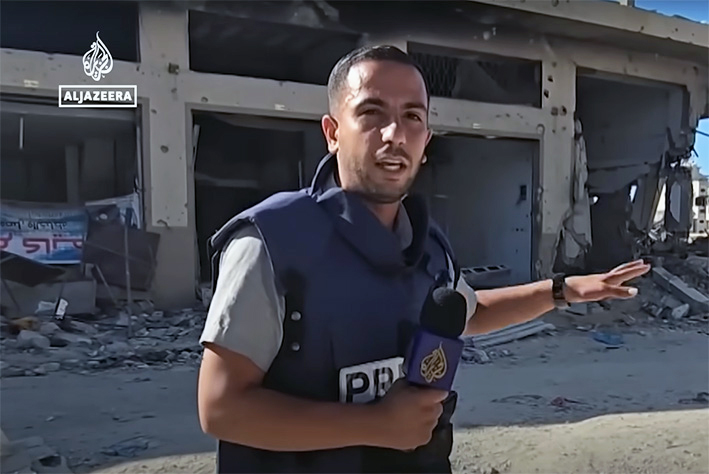
The shocking killing of a prominent Al Jazeera TV correspondent and four of his colleagues in Gaza, an attack that the Israel Defense Forces (IDF) admitted had been deliberately targeted, have generated headlines around the world.
And some of them raise issues about how the media reports such tragedies.
Perhaps the most unsettling came from popular German tabloid Bild, which seems to have swallowed the IDF line whole. “Terrorist disguised as journalist killed in Gaza. Israeli army claims: he was a Hamas mastermind and worked for Al Jazeera,” said the paper.
While it is impossible to contest claims based on alleged Israeli intelligence, it is strange that Anas al-Sharif had time to be a front-line war correspondent while being a Hamas “mastermind”. No allegations were made against al-Sharif’s four colleagues, who were presumably mere collateral damage.
The approach taken by Reuters was mercifully much more sceptical. The news agency reported Israeli statements that it had targeted and killed al-Sharif, alleging that he headed a Hamas militant cell. It also noted that the IDF refused to provide any evidence.
Reuters added that press freedom groups and a United Nations rapporteur found “no evidence of Hamas ties” in al-Sharif’s case, highlighting the fact that Israel’s accusations lacked publicly verifiable proof.
Deliberate targets
Even if al-Sharif had previously been a member of Hamas, unless he was actively demonstrating violent acts at the time of his death — and clearly he was not — he should be seen as a civilian.
So then his death and those of his colleagues would amount to a war crime.
If this had been one isolated incident, that would have been bad enough. But nearly 200 Palestinian journalists have been killed in Gaza since the current crisis began when Hamas terrorists murdered 1,200 Israelis on 7 October 2023.
Those deaths were all Palestinians because the Israeli government does not allow independent journalists into the area. Human rights organisations believe that as many as 60 of them may have been deliberately targeted.
Indeed, The Guardian reported in June that some within the IDF view journalists affiliated with Hamas-run news titles as legitimate targets. A senior IDF spokesman was quoted as saying he saw “no difference” between working for a Hamas media outlet and belonging to Hamas’ armed wing.
As The Guardian’s legal experts noted, such an approach represents a complete misunderstanding of international law. Even biased reporting does not represent direct participation in hostilities.
There is a clear pattern of IDF responses to the death of Palestinian journalists.
After they have been killed, statements are issued claiming they were active Hamas fighters based on no independent evidence other than Israeli intelligence.
Curiously, many Palestinian doctors and their families have met a similar fate.
Implausible claims
Both Al Jazeera and press freedom groups such as Reporters Without Borders have denounced the apparent Israeli policy of “discrediting journalists post-killing” with baseless claims of Hamas involvement.
The al-Sharif attack is just the latest incident.
In January, Hamza al-Dahdouh, an Al Jazeera journalist and camera operator, and Mustafa Thuraya, a freelance video journalist, were killed in an Israeli airstrike.
Both were accused of being members of terrorist organisations, while Thuraya was alleged to have been operating a drone for surveillance.
Media organisations from the BBC to NBC to Le Monde appeared to carry the IDF statements uncritically. Both Al Jazeera and the families of the victims denied the Israeli claims.
It is possible that some Palestinian journalists have been accidentally killed amid military chaos. It is also possible that some are using the cloak of journalism to disguise their real motives. Such things have always happened in war.
Yet nearly 200 being killed by error or posing as journalists? Implausible by any standards and it is more than likely that most were doing something the Israelis did not like: showing the reality on the ground in Gaza.
Giving a voice
What is to be done? We live in an unprecedented world where the likes of US president Donald Trump or Reform UK leader Nigel Farage apparently believe if they repeat a falsehood often enough they will get away with it.
It is the job of journalists to ensure this does not happen.
Both this Israeli government and the IDF have demonstrated many times that a lot of their statements simply cannot be trusted.
They should be made to provide evidence for what they say rather than have their assertions accepted at face value.
It’s much harder work for journalists to challenge false statements than merely repeating them — particularly in the age of 24-hour news. But the effort has to be made, otherwise terrible injustices will prevail.
There is a final troubling aspect to the reporting of the death of journalists in Gaza. It is that there has been not nearly enough outrage.
Imagine if nearly 200 journalists from Western countries had been killed by the IDF. There would be a furore in parliaments and ambassadors would be recalled, and perhaps real pressure applied to stop the killings.
Alas, not only do Palestinians lack a state, they have not much of a voice either.
The media must provide that voice while reminding Israel that the deliberate targeting of journalists is a war crime and one that the country may one day be held accountable for.
 Raymond Snoddy is a media consultant, national newspaper columnist and former presenter of NewsWatch on BBC News. He writes for The Media Leader on Wednesdays — bookmark his column here.