



Acast CEO bets on independence and scale during podcasting’s prime
Podcasting, once an unfamiliar term, is now coming into its own as a medium.
With Rajar’s latest Midas survey finding a quarter of the UK population are tuning into podcast episodes weekly, advertisers are following the audience.
For Greg Glenday, Acast’s new CEO, this is the industry’s moment and his company’s position as an independent, globally scaled, podcast-only platform makes it perfectly poised to succeed.
He says: “People say podcasting is 20 years old, but nothing really happened for 10 years.
“But in the last two years, podcasting has started to really mature, big brands are asking questions, agencies are becoming more sophisticated.
“Let’s capture the tailwinds, because people want to put money in the industry. So let’s make it easy for them to do it.”
Telling the story
Having taken over the top job after two and a half years as Acast’s global chief business officer, Glenday spent his first three months as CEO on what he describes as a “listening tour” across Stockholm, London and New York.
For him, while the business told a great narrative to investors, creators and blue-chip brands, this story needs aligning: “Nobody really was telling the whole Acast story.
“And I think that’s true for podcasting. There’s a little bit of: who’s supposed to buy it? What is it? Is it an influencer platform? Is it audio only? Is it both? Is it vlogging?
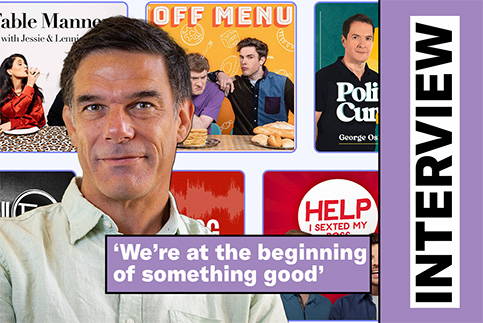
“So I think that’s a fun place to be — it feels like we’re at the beginning of something good.”
Glenday, a founder and former president of iHeartMedia’s Connections division, believes telling the story of Acast in its entirety, along with its global scale and strategy, is what will put the business ahead of rivals.
Global scale with local focus
If there’s one asset Glenday thinks Acast has undersold, it’s the company’s global reach.
It is dominant in the UK and Nordics, strong across Europe and has now made the US its single largest market.
“A big one that we probably don’t talk about enough is the fact that we are global,” Glenday admits.
“You and I could launch a podcast tomorrow and we could have 1,000 listeners, but they could be in 25 different countries. There’s no rights fees on our platform; you put it out there and, if it’s good, it’s a meritocracy and people can consume it.
“We want to take advantage of the fact that Acast really has spent 10 years building infrastructure to monetise that and to dominate.”
However, he acknowledges that this global approach has to be balanced with local nuance.
“We don’t want to be McDonald’s, where it’s all the same, no matter where you go,” Glenday stresses.
At the heart of this approach is what he refers to as Acast’s “three constituents”: creators, audiences and brands.
He explains: “We deeply care bout our creators, so we have a team focused on the creators and content.
“Then we have a team focused on the audience, because when advertisers come and say they want to buy a podcast, what they really mean is they want to buy the audience.
“And then the third constituent is brands. Our job is to make it easier for all three to talk to each other.”
Acast’s engineering and product teams sit “in the middle”, removing obstacles between these groups and ensuring the platform can adapt to individual markets.
Pod-racing: Listening numbers and ad revenue grow for podcasts
Power of independence
In an industry with big players such as Amazon and Spotify, as well as increasing consolidation, Acast positions its independence as a defining advantage.
As Glenday reflects: “Everybody we compete with has another business that’s more important to them than podcasting.
“We don’t. This is all we do. We don’t have ulterior motives. What you see is what you get. That focus makes us unique.”
He points to Australian hit podcast Toni and Ryan as a case study in how independence and global infrastructure go hand in hand.
“By joining Acast in Sydney, they instantly had a team selling their show in New York, London, LA — everywhere their audience listens,” Glenday points out.
“Twenty-five percent of their audience is outside Australia. We can monetise that globally. That’s not something most competitors can offer.”
Tech focus
Acast has been big on dynamic ad insertion, changing the game in terms of monetising podcasts, according to Glenday.
Automation, programmatic trading and AI are seen as central to scaling podcast revenue streams.
“I think we are well ahead of the industry in programmatic and I’m a believer that’s really good for our future,” he says.
“Programmatic used to be a dirty word. Now there are big brands that we may have a direct relationship with, and we have really good creative dialogue with, but they still want to book programmatically. It’s just another way to transact.”
Another shift is redesigning its marketplace with AI to lower barriers to entry for smaller advertisers.
“The biggest obstacles for self-serve advertisers were around not knowing what to buy and not having an ad that makes sense,” Glenday observes.
“So we’ve solved those two obstacles. Literally, we took their biggest complaints and we made them features. AI helps them choose shows and make ads.”
The “three constituents” framework comes through again here, with AI and programmatic technology sitting in the middle.
Glenday makes clear that while Acast’s creators are “AI-proof”, AI should be utilised as a tool that connects creators, brands and audiences more efficiently. “Our job is to remove friction,” he adds.
Community and ‘long-form influence’
Video podcasts may be a growing trend, but Glenday is cautious about the hype.
“I think it’s a little bit of hysteria. If your show only works when people watch, that may not be a podcast,” he suggests.
It is up to the creator how they reach their audience and this is where the value lies, Glenday explains, as opposed to forcing video.
For him, the bigger story is that podcasting has become the most effective form of “long-form influence”.
As Glenday puts it, while social media offers users quick hits, if you want to unpack a story — or a brand narrative — properly, podcasting offers a much more effective platform to do so.
Essentially, this means podcast creators have much deeper relationships and greater storytelling potential — an appealing message to brands looking to access trust and attention.
Moreover, as communities around podcasts to grow and develop — one recent example being Bundesliga’s expansion of rights distribution to podcast creators on YouTube — Glenday thinks podcasting’s community focus is what will continue to set it apart.
“With TikTok, you think you’re in control, but the algorithm decides. Podcasting is different — users seek it out,” Glenday notes.
What’s next?
For Glenday, the next chapter involves further establishing Acast globally, but also being at the forefront of responsible and sustainable podcasting.
He hints that this is an area where Acast is preparing to lean in to more heavily in the near future.
“We know we use a lot of computer power, so we’re working on making our processes and ads as carbon-neutral as possible,” Glenday says.
“It’s an important part of the future.”
News, analysis, comment and community — Join The Media Leader