



Would the real Nigel Farage stand-up to media scrutiny?
Opinion
Is the media finally beginning to scrutinise Reform UK and Nigel Farage properly? Not before time says Ray Snoddy.
The LibDem leader, Sir Ed Davey, summed up this week the curious situation of the media’s relationship with Nigel Farage and Reform UK.
There was even an element of politeness and understatement involved.
“It’s clear to anyone that Farage gets an easy ride from the media. They give him as much airtime as he wants but never hold him to account for the damage he has done. So much of what is broken in Britain is thanks to Nigel Farage,” Sir Ed said.
Not only very clear, but also very true, many would say.
Through his 38 appearances on Question Time over the years, the BBC has virtually created the public political persona of Farage. The coverage disparity still continues.
In the 25 editions of the programme so far this year, there have been 11 appearances by Reform figures with their five MPs, but only 9 for the LibDems with 72 seats, and a mere three slots for the Greens with four MPs.
Then there are the live news channel feeds of Farage’s speeches and unrealistic policy announcements, which usually go unchallenged.
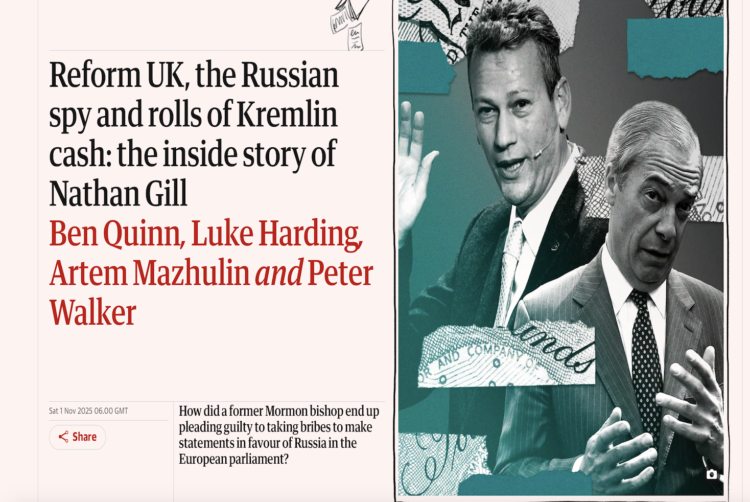
There has been little national attention given to the fact that the former leader of Reform in Wales, Nathan Gill, will almost certainly face a jail sentence later this month after pleading guilty to taking bribes to make a statement favourable to Russia.
In fact, the Question Time presenter, Fiona Bruce, actively blocked Greens leader Zack Polanski from raising the issue on the programme recently, insisting that no one was interested in such a thing.
Likewise, there has been little national coverage of the chaos in Reform-controlled local councils, which promised savings and cuts in council tax and are now putting council tax up.
An unprecedented number of Reform councillors have already resigned or been pushed out since the May elections – close to 40- and the number is rising almost by the day.
There was some criticism in June of Farage’s economic pledges that included massive tax cuts and £140bn in spending commitments.
No one earning £20,000 a year should be paying income tax, the Reform leader argued, before adding they would scrap the two-child rule on child benefits.
Sir Ed described the package as Trussonomics on Steroids in honour of the 49-day Prime Minister Liz Truss, and economists said the numbers did not add up.
There was only modest coverage when former Conservative Cabinet Minister Lord Heseltine described Reform as a fascist party and that Farage reminded him of Oswald Mosley and Enoch Powell before adding: “We must stop Nigel Farage.”
The 92-year-old Heseltine said it would be one of the remaining tasks of his life to see off Reform.
Waking up to the reality of Reform
But now, not before time, the media seems to be waking up to the reality of Reform, which is still attracting a leading 31% of the vote in opinion polls.
On Saturday, The Guardian devoted its Saturday Read to the Gill affair with four reporters, including Luke Harding, on the task.
They argued that Gill’s fall from grace, a former Mormon bishop, was almost unique in British politics. The only possible parallel was the story of John Stonehouse, the Labour MP recruited as a spy for Czech intelligence in the early 1960s.
The pro-Kremlin Ukrainian politician Oleg Voloshyn denied to the paper that he had paid Gill bribes and that a series of payments of around £5,000 each were merely media appearance fees.
The Guardian quoted multiple sources in Brussels saying that Gill and Farage had been close and had offices right next to each other, although Farage has expressed “shock” about what Gill had done.
There are no direct parallels between the two. Still, Farage indeed received fees for appearing on the Kremlin-funded television channel Russia Today and has in the past held views supportive of Vladimir Putin.
Perhaps Gill’s sentencing at the Old Bailey on 21 November may inspire further media research into the extent to which Nathan Gill was a one-off, a lone wolf.
Further signs of reality’s encroachment spread across the pages of The Times yesterday.
On the front page, there was the news that more than two million households under Reform-run councils faced tax increases of £127m next year, despite promises to cut council bills.
The paper also noted that Reform, for the first time, conceded that if it were to take power in Westminster, it would not be able to cut taxes until spending was under control.
The fact that Reform is considering cutting the minimum wage for younger people is unlikely to cause much political damage because young people don’t vote for Reform.
But it was courageous politically for Farage to hint that the triple lock for pensions – that pensions rise by average earnings growth, inflation or 2.5% whichever is higher – might be unsustainable. The core Reform vote is over 65.
Which Nigel Farage do the voters want?
Never mind the factual reporting, it was The Times’ sketch writer Tom Peck who got to the heart of the matter.
The Farage speech, Peck wrote, was a strong candidate for the most boring political speech of the past 15 years.
All the old policies, like raising the personal tax allowance to £20,000 and scrapping the two-child cap, were gone. What would replace them? Sadly, Peck noted, it was too early to say.
The sketch writer asked tellingly whether voters would actually want the new prudent Farage.
“It’s time for Sensible Nigel, Sane Nigel, Yes My Sums Add Up Nigel (but I still can’t tell you what they are).”
What if he has got it wrong and people really want “Crazy Nigel, “Breaking Point” Nigel, Bring Back Uniforms For Bus Conductors Nigel, £140bn of Unfunded Tax Cuts Nigel, and when do they want it? Yesterday.”
Never mind such subtlety, The Sun’s political editor, Jack Elsom, believes that Farage is “the odds-on next Prime Minister” who could convince people he could pick up the pieces from Labour’s economic collision course.
Ah, but which Farage will turn up – Crazy Nigel or Sensible Nigel and would either of them be capable of standing up to sustained media scrutiny, which might now intensify?
 Raymond Snoddy is a media consultant, national newspaper columnist and former presenter of NewsWatch on BBC News. He writes for The Media Leader on Wednesdays — bookmark his column here.